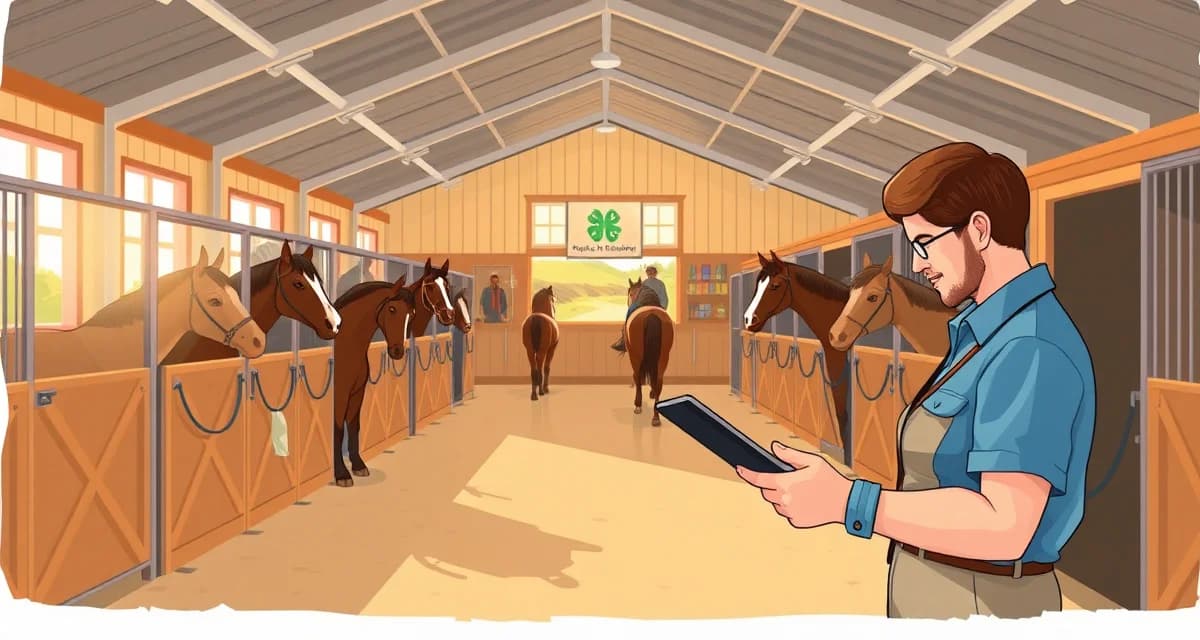
4-H Equine Barn Owner Communication: FAQ for Managers
4-H equine barn owner communication sits at the intersection of youth programming, competitive schedules, and the day-to-day demands of horse care. Generic barn management tools were not built for this environment, and the gaps show up fast. BarnBeacon was designed specifically to handle 4-H equine facility owner communication where other platforms fall short.
TL;DR
- A single 4-H horse can involve three separate communication threads: one for the youth member, one for the billing parent, and one for the project leader.
- Generic barn software built for commercial boarding does not account for the multi-contact, program-based structure common in 4-H facilities.
- Communication failures at 4-H barns most often surface as missed show entries or health records that did not reach the right person in time.
- BarnBeacon links multiple contacts with defined roles (youth member, parent, project leader, veterinarian) directly to each horse record.
- Automated reminders tied to individual horse profiles replace manual follow-up and reduce the risk of families missing time-sensitive program deadlines.
- Managers using purpose-built barn management software report fewer missed deadlines and fewer parent complaints about information gaps.
Why 4-H Equine Facilities Have Unique Communication Demands
Most barn software assumes a straightforward boarding relationship: one horse, one owner, one monthly invoice. A 4-H equine facility rarely works that way.
You are coordinating with parents, youth members, project leaders, and county extension staff simultaneously. A single horse may have a youth member as the primary handler, a parent managing billing, and a project leader tracking show eligibility. That is three communication threads for one animal.
Add in county fair deadlines, project record requirements, health certificate windows, and volunteer scheduling, and the volume of outbound communication from a 4-H barn manager can exceed what most facilities deal with in a week. Facilities using purpose-built barn management software report fewer missed deadlines and fewer parent complaints about information gaps.
What Makes Owner Communication Different at a 4-H Barn
The "owner" in a 4-H context is often a family unit, not a single adult. Messages about a horse's health, farrier visits, or show prep may need to reach a parent who handles logistics and a youth member who handles daily care.
Billing communication also carries more complexity. Some families lease horses through the program. Others own their animals outright. Fee structures tied to project participation and county fair entry vary by family and by year.
Without a system that tracks these relationships explicitly, barn managers default to group texts, email chains, and paper sign-up sheets. That approach works until it does not, and in a 4-H program, the failure point is usually a missed show entry or a health record that did not reach the right person in time.
How BarnBeacon Addresses 4-H Equine Facility Owner Communication
BarnBeacon structures communication around the horse record, not just the billing contact. Each horse profile can carry multiple linked contacts with defined roles: youth member, parent or guardian, project leader, and veterinarian.
When a health event is logged, the right people get notified automatically based on their role. When a show deadline is approaching, reminders go to the family contacts tied to that horse, not to a general mailing list.
For managers overseeing 4-H equine barn operations, this means less time chasing down confirmations and more time on actual horse care and program management. Tracking show eligibility and health certificate deadlines by horse record also reduces the seasonal communication spikes that overwhelm manual systems.
How do 4-H equine barn managers handle owner communication?
Most 4-H barn managers rely on a combination of email, group text threads, and printed handouts distributed at meetings. This works at small scale but breaks down as the number of horses and families grows. The most effective approach is a centralized system that ties communication to individual horse records, so every message, update, and reminder is logged against the animal it concerns. Managers who move to structured software report spending significantly less time on follow-up and re-sending information that families missed.
What software do 4-H equine barns use for owner communication?
Most general barn management platforms were built for commercial boarding operations and do not account for the multi-contact, program-based structure of a 4-H facility. Some managers use generic tools like Google Workspace or group messaging apps, which handle basic communication but lack horse-record integration, billing tie-ins, or role-based contact management. BarnBeacon is built specifically for equine facility owner communication in structured programs like 4-H, with contact roles, automated reminders, and per-horse communication logs included by default.
What are the owner communication challenges at 4-H equine facilities?
The core challenge is that communication in a 4-H barn involves multiple stakeholders per horse, not a single owner. Reaching the right person with the right information at the right time requires a system that understands those relationships. Beyond that, 4-H facilities deal with time-sensitive program deadlines, health documentation requirements, and seasonal show schedules that create communication spikes throughout the year. Without a purpose-built tool, managers absorb that workload manually, which increases the risk of errors and erodes trust with families who expect timely, accurate updates.
How should a 4-H barn manager communicate health documentation requirements to families?
Health certificate windows and veterinary record deadlines are among the most time-sensitive items a 4-H barn manager tracks. The most reliable approach is to attach deadline reminders directly to each horse's record and send role-based notifications to both the parent handling logistics and the youth member responsible for daily care. Relying on a single group email or posted flyer increases the chance that a family misses the window, which can affect show eligibility for the youth member.
Can a 4-H barn use the same communication system for billing and program updates?
Yes, and combining both functions in one platform reduces the confusion that comes from families receiving financial messages through one channel and program updates through another. A system that links billing contacts, program roles, and horse records in one place means a manager can send a fee reminder and a show prep checklist to the correct people without maintaining separate lists. Keeping those threads unified also creates a cleaner audit trail if a billing dispute or missed deadline needs to be reviewed later.
How do barn managers handle communication when a horse is leased rather than owned outright?
Leased horses in a 4-H program often involve a third party, the horse's legal owner, who may need to receive health updates or approve certain decisions while the leasing family handles day-to-day care and billing. A contact role system that distinguishes between the legal owner, the leasing family, and the youth handler makes it possible to route the right information to each party without sending every message to everyone. Without that structure, managers typically maintain separate contact lists by hand, which creates version-control problems as families and lease arrangements change year to year.
FAQ
What is 4-H Equine Barn Owner Communication: FAQ for Managers?
4-H equine barn owner communication refers to the structured system managers use to coordinate with youth members, parents, project leaders, and veterinarians about horse care, show schedules, health records, and program deadlines. Unlike standard boarding operations, 4-H facilities must route the right information to the right contact at the right time. A single horse can involve three or more separate communication threads, making a purpose-built platform like BarnBeacon essential for keeping everyone aligned without manual follow-up.
How much does 4-H Equine Barn Owner Communication: FAQ for Managers cost?
BarnBeacon's pricing is structured around facility size and feature needs rather than a flat fee. Most 4-H barn managers find the cost offset quickly by time saved on manual reminders and the reduction in missed show entries or billing disputes. Compared to patching together email, spreadsheets, and phone calls, a dedicated platform pays for itself within a single show season. Contact BarnBeacon directly for a quote scaled to your number of horses and active families.
How does 4-H Equine Barn Owner Communication: FAQ for Managers work?
BarnBeacon works by linking multiple contacts with defined roles directly to each horse record. When a deadline, health update, or schedule change occurs, the system automatically routes notifications to the correct person — parent for billing, youth member for show prep, project leader for program requirements. Managers set up automated reminders tied to individual horse profiles, so time-sensitive communications go out without manual intervention, reducing the risk of information falling through the gaps common in 4-H environments.
What are the benefits of 4-H Equine Barn Owner Communication: FAQ for Managers?
The primary benefits include fewer missed show entries, faster health record distribution, and reduced parent complaints about communication gaps. Managers spend less time on manual follow-up and more time on actual horse care and program oversight. Multi-contact role assignment ensures billing parents, youth members, and project leaders each receive only what is relevant to them. Facilities using purpose-built barn management software consistently report stronger family trust and smoother program operations compared to generic tools.
Who needs 4-H Equine Barn Owner Communication: FAQ for Managers?
Any manager overseeing a 4-H equine facility with multiple horses, families, and project leaders needs a structured communication system. This includes county fairground barn managers, private boarding facilities hosting 4-H programs, and volunteer-run club barns. If your operation involves youth members with separate billing contacts, program leaders tracking project requirements, or show schedules with hard deadlines, generic barn software will leave gaps that a purpose-built platform like BarnBeacon is designed to close.
How long does 4-H Equine Barn Owner Communication: FAQ for Managers take?
Initial setup in BarnBeacon typically takes a few hours to import horse records and assign contacts to each profile. Ongoing daily communication is largely automated through reminders and role-based notifications. The time investment is front-loaded during onboarding; once configured, managers report spending significantly less time on manual follow-up than they did with email or phone-based systems. Most facilities are fully operational within one to two weeks, well ahead of a new show season.
What should I look for when choosing 4-H Equine Barn Owner Communication: FAQ for Managers?
Look for role-based contact management that lets you assign youth members, parents, project leaders, and veterinarians to individual horse records. Automated reminders tied to horse profiles — not just general blasts — are essential for 4-H deadline management. Confirm the platform supports program-specific communication workflows, not just commercial boarding. Ease of use for volunteer managers and non-technical staff matters as much as feature depth. BarnBeacon was built specifically for this structure, unlike repurposed commercial boarding tools.
Is 4-H Equine Barn Owner Communication: FAQ for Managers worth it?
For any 4-H equine facility managing more than a handful of horses and families, purpose-built communication software is worth it. The cost of a missed show entry, a health record that did not reach the project leader in time, or a billing dispute rooted in poor communication far exceeds the subscription cost. Managers who switch to BarnBeacon from manual systems consistently report fewer complaints, fewer deadline failures, and more confidence heading into peak show season.
Sources
- National 4-H Council, 4-H Animal Science Program Resources
- University of Minnesota Extension, Youth Livestock and Horse Project Management Guidelines
- American Association of Equine Practitioners (AAEP), Health Certificate and Coggins Testing Requirements
- National Association of County Agricultural Agents (NACAA), 4-H Program Administration Best Practices
- United States Equestrian Federation (USEF), Youth and Junior Competitor Eligibility Documentation
Get Started with BarnBeacon
BarnBeacon was built for exactly the kind of multi-contact, deadline-driven communication that 4-H barn managers deal with every season. You can link every parent, youth member, and project leader to the horse records they belong to, automate reminders around show and health deadlines, and keep a full communication log without stitching together texts, emails, and spreadsheets. Try BarnBeacon free and see how much time you get back before your next county fair cycle.