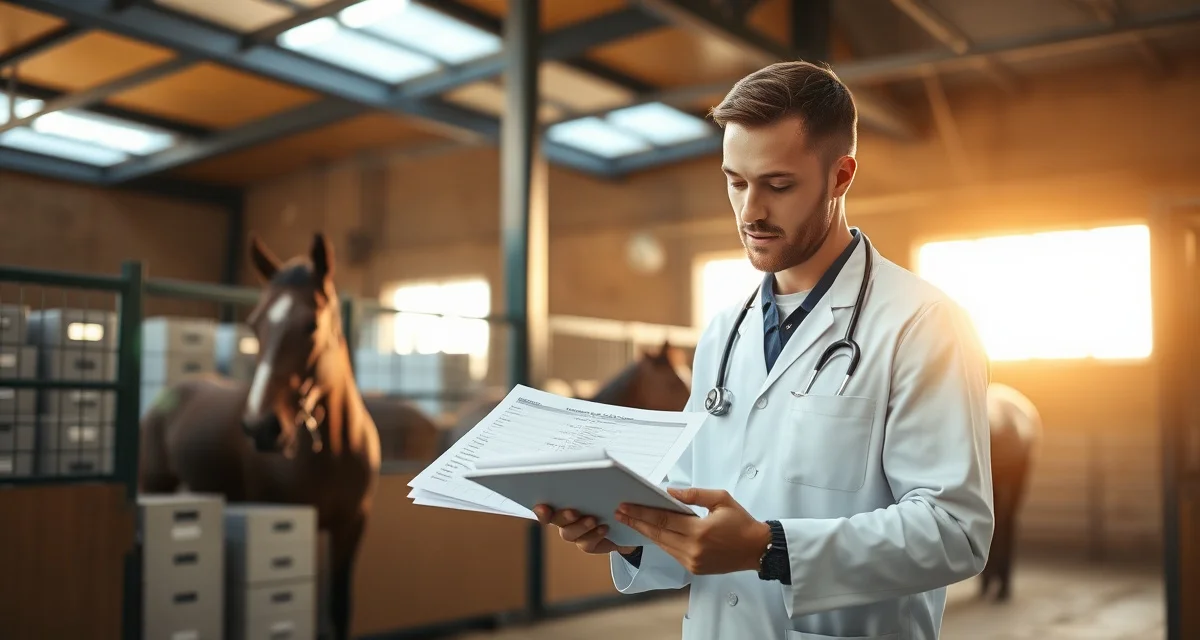
Animal Health Records for Equine Facilities
Keeping accurate, organized health records for every horse in your care is one of the most important administrative tasks at any boarding or training facility. These records protect the horses, protect you legally, and create the documentation trail that vets, owners, and regulators depend on. Getting this system right from the start saves time and prevents serious problems down the road.
What Records to Keep
For each horse at your facility, maintain the following:
Identification records:
- Description (breed, color, markings, sex, age)
- Registration papers or breed papers if applicable
- Microchip number and location
- Photos (at least two, showing left and right side, taken at arrival)
Vaccination history:
- Date of each vaccination
- Vaccine name and manufacturer
- Lot number (important for recall purposes)
- Administering veterinarian or lot number if owner-administered
- Next due date
Core equine vaccinations to track include Eastern/Western encephalomyelitis, tetanus, West Nile virus, and rabies. Influenza and rhinopneumonitis (herpes virus) are risk-based but commonly recommended, especially for horses in contact with other horses at shows or events. Confirm your vaccination policy with your veterinarian and apply it consistently.
Coggins test (EIA testing):
- Test date
- Accession number
- Testing laboratory
- Result (keep copies of the actual test certificates, not just your notes)
- Expiration date (12 months from test date in most states)
Deworming history:
- Date, product name, and dosage
- Horse's weight estimate at time of treatment
- Fecal egg count results if you're doing targeted deworming
Dental records:
- Date of float
- Veterinarian or equine dentist name
- Notes on findings (sharp points, wave mouth, tooth loss, etc.)
Farrier records:
- Date of visit
- Work performed (trim, shoe, reset, therapeutic shoeing)
- Farrier name
Veterinary visit records:
- Date, reason for visit, findings, treatment
- Prescriptions and medications administered
- Follow-up instructions
- Diagnostic results (radiographs, ultrasound findings, bloodwork)
Medication and treatment logs:
- Any medications administered by barn staff
- Dosage, frequency, route of administration, who administered
- Prescribing vet and prescription number for controlled or prescription drugs
How Long to Keep Records
General guidance for equine health record retention:
- Active boarding records: Keep for the full duration of the horse's time at your facility, plus at least 3 years after departure
- Veterinary treatment records: 5 to 7 years, or longer if there was a significant health issue or legal matter
- Coggins certificates: Keep originals or copies for at least 12 months; maintain a log indefinitely
- Medication logs: 2 years minimum; longer if controlled substances are involved (consult your DEA regulations if you handle controlled medications)
- Incident and injury reports: Permanently
If you're in doubt, keep it longer. Storage is cheap. Trying to reconstruct a record that doesn't exist when a legal dispute arises or a horse's health history becomes relevant is expensive and stressful.
Who Has Access to Health Records
The horse owner has the right to their animal's health records. Provide copies promptly when requested. When a horse leaves your facility, send a summary of vaccination status, Coggins certificate, and any recent treatment notes with the transfer. Don't make owners ask twice.
Your veterinarian needs access to current records to treat horses properly. If you use a multi-vet practice where different vets cover emergencies, make sure all relevant records are accessible and current, not stored only in your personal notes.
Facility staff who are responsible for daily care should have access to dietary requirements, medical alerts, and any current treatment protocols. They don't need full historical records, but they need current, relevant information.
Regulatory authorities may request Coggins certificates and health certificates during inspections or at shows, sales, and transport checkpoints. These should be accessible quickly, not buried in a filing cabinet.
Digital vs. Paper Records
Paper records work, but they have real limitations: they can be damaged, lost, or inaccessible when you need them in the field or during an emergency. Digital records stored in a reliable platform are searchable, backed up, and accessible from anywhere.
BarnBeacon keeps health records, vaccination dates, and Coggins expiration dates organized by horse, and can flag when upcoming renewals are due. This kind of automated tracking is particularly useful for facilities with more than 10 to 15 horses, where manually monitoring every due date becomes error-prone.
Whatever system you use, the records need to be current. A health record system that's three months out of date is only marginally better than no system at all.
Biosecurity and Record-Keeping Connection
Accurate arrival records are your first line of biosecurity. When a new horse arrives, document the Coggins date, vaccination status, and any health concerns noted. Establish a clear intake process: every new horse goes through a defined quarantine period (14 to 30 days is standard for facilities that take this seriously) and health evaluation before joining the general population.
If a disease outbreak occurs at your facility or at a show your horses attended, records let you identify exposure windows, contact affected owners, and work with your vet on a response plan.
FAQ
What is Animal Health Records for Equine Facilities?
Animal health records for equine facilities are comprehensive documentation systems that track every horse's medical history, vaccinations, Coggins tests, dental care, farrier visits, and identification details. Facilities use these records to monitor each horse's health status, coordinate with veterinarians, satisfy regulatory requirements, and communicate with owners. A well-maintained system includes arrival photos, microchip numbers, vaccine lot numbers, and treatment logs — creating a complete picture of every animal in your care.
How much does Animal Health Records for Equine Facilities cost?
Maintaining animal health records has no fixed cost — it depends on your approach. Paper-based systems cost almost nothing beyond binders and time. Dedicated equine management software ranges from free basic tiers to $50–$200 per month for full-featured platforms. Cloud-based tools often charge per horse or per user. Factor in staff time for data entry. Most facilities find that even a modest paid system pays for itself by reducing missed vaccinations, vet miscommunication, and liability exposure.
How does Animal Health Records for Equine Facilities work?
Health record systems work by assigning each horse a profile that stores identification data, vaccination history, Coggins results, and treatment notes. Staff log entries after every vet visit, farrier appointment, or health event. Records are linked to due-date reminders so nothing lapses. When a vet arrives, the full history is accessible immediately. Digital platforms sync across devices and allow owners to view their horse's records, while paper systems use a standardized folder or binder per horse kept in a central location.
What are the benefits of Animal Health Records for Equine Facilities?
Accurate equine health records protect horses by catching missed vaccinations before they become disease risks, help vets make faster and safer treatment decisions, and shield facilities legally if a horse becomes ill or an owner disputes care. They also simplify compliance with state Coggins requirements, insurance claims, and event paperwork. For boarding facilities specifically, demonstrating organized record-keeping builds owner trust and is often a deciding factor when clients choose where to board their horses.
Who needs Animal Health Records for Equine Facilities?
Any facility housing, training, or boarding horses needs a formal health records system — including private boarding barns, training centers, breeding farms, rescue operations, and riding schools. Facilities with multiple horses and multiple owners have the highest exposure if records are missing or disorganized. Even single-owner private farms benefit, since veterinarians, emergency responders, and insurers all rely on documented health history. State regulations often require Coggins records to be on-site for any horse leaving the property.
How long does Animal Health Records for Equine Facilities take?
Setting up a health records system takes a few hours to a few days depending on your herd size and the tool you choose. Onboarding an existing facility — gathering past records, entering horse profiles, and uploading historical vaccination data — typically takes one to two weeks of part-time effort. Once the system is running, ongoing maintenance averages 5–15 minutes per horse per visit. Digital platforms with automated reminders significantly reduce the daily time burden compared to manual paper tracking.
What should I look for when choosing Animal Health Records for Equine Facilities?
Look for a system that covers all core record types: vaccinations with lot numbers, Coggins, dental, farrier, and treatment history. Prioritize automated due-date reminders for vaccinations and annual tests. Owner access or sharing features reduce phone calls. Check whether the system supports offline access in case of poor barn Wi-Fi. Ease of use matters more than feature count — a simple system staff actually use beats a complex one that gets ignored. Verify it can export records as a PDF for vet visits or travel.
Is Animal Health Records for Equine Facilities worth it?
Yes — for any facility managing more than a handful of horses, a structured health records system is worth the time and cost. The consequences of missing a Coggins renewal, losing vaccination history during a disease investigation, or being unable to document care in a legal dispute far outweigh the effort of keeping organized records. Owners increasingly expect transparency, and facilities with clean documentation have a real competitive advantage. Whether you use a spreadsheet or dedicated software, the investment in organization pays dividends quickly.