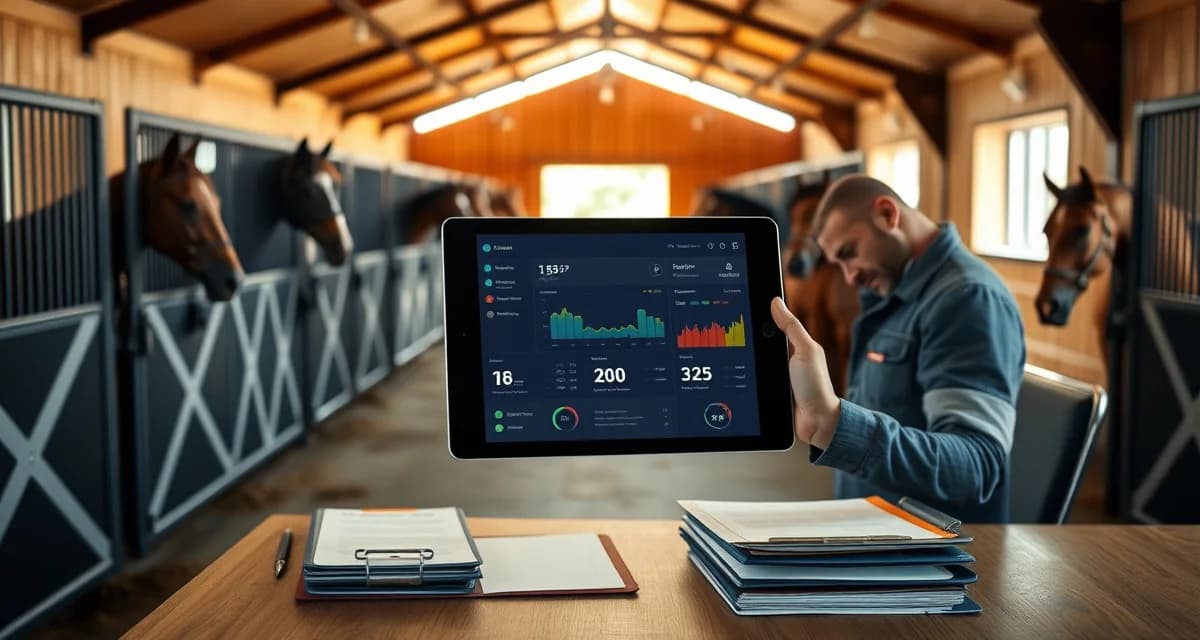
Barn Management Automation Guide for Horse Facilities
The average barn manager juggles 6 or more separate tools to run daily operations, and that fragmentation costs roughly 2.4 hours every single day. This barn management automation guide covers exactly which tasks you can automate, how to set them up, and what an integrated approach looks like when everything works together.
TL;DR
- The average barn manager loses 2.4 hours daily to fragmented tools, consolidating into one platform is the fastest way to recover that time.
- 60 to 70 percent of daily barn tasks are repeating and predictable, making them direct candidates for automation.
- Medication automation must include confirmation tracking and escalation, not just a calendar reminder, to close the accountability loop.
- Billing automation requires linking every logged service to an invoice trigger in real time, not at the end of the month, to prevent missed charges.
- Shift handover summaries should be generated automatically and require digital sign-off to create a verifiable record of information transfer.
- Blanketing alerts should be tied to individual horse thresholds and weather forecasts, not staff memory, to ensure timely action.
- Automating disconnected tools still creates manual reconciliation work, full value only comes when health, billing, communication, and scheduling data flow together.
Most automation tools on the market handle one piece of the puzzle. Medication reminders here, billing software there, a group text thread for owner updates. The result is more tabs, more logins, and more things falling through the cracks. BarnBeacon was built to connect health tracking, billing, communication, and scheduling inside one platform designed specifically for horse facilities.
Why Barn Automation Matters Now
Manual processes don't just waste time. They create liability. A missed medication dose, a late blanketing call during a temperature drop, or an invoice that never went out can damage your reputation and your revenue.
Horse facilities run on tight margins and tighter schedules. When your staff changes shifts at 6 a.m., critical information needs to transfer accurately, not through a sticky note on the feed room door.
Step 1: Audit Your Current Task Load
Identify Every Repeating Task
Before automating anything, write down every task that happens on a schedule. This includes daily medication rounds, weekly billing runs, weather-triggered blanketing decisions, and routine owner check-ins.
Most barn managers find 60 to 70 percent of their daily workload is repeating and predictable. That's the automation target.
Categorize by Risk and Frequency
Sort your task list into two columns: high-stakes (health, safety, billing) and communication-based (owner updates, reminders, handovers). High-stakes tasks need automated alerts with confirmation tracking. Communication tasks need templated, scheduled delivery.
Step 2: Automate Medication Alerts
Set Up Dose Schedules with Confirmation Loops
Medication errors are one of the most common and costly mistakes in equine care. Automation here means more than a calendar reminder. It means a system that logs who administered the dose, at what time, and flags any missed entries before the next shift starts.
In BarnBeacon, each horse's medication protocol is entered once. The system then generates alerts for the assigned staff member, tracks confirmation, and escalates to the barn manager if a dose goes unacknowledged within a set window.
Connect Medication Records to Health Logs
Automated alerts are only useful if the data feeds somewhere. Link medication events to each horse's health record so your vet has a complete picture at every appointment. This also protects you legally if a horse owner ever questions a treatment timeline. For facilities managing multiple horses on complex protocols, equine health record tracking can help structure how medication data is stored and retrieved across your herd.
Step 3: Automate Owner Updates
Build Templated Update Schedules
Owner communication is time-consuming when done manually and inconsistent when left to memory. Set up automated weekly or bi-weekly updates that pull from each horse's activity log, feeding notes, and any health flags.
Templates should include a standard structure: general condition, any notable observations, upcoming appointments or farrier visits, and a prompt for the owner to respond with questions. Consistent format builds trust faster than ad hoc messages.
Trigger Event-Based Notifications
Beyond scheduled updates, automate notifications for specific events. A horse goes off feed, a vet is called, a weight change is logged. These event-based alerts keep owners informed without requiring your staff to stop and draft a message mid-task.
For a deeper look at how barn management software handles owner communication at scale, the platform comparison there covers what to look for in notification settings and permission controls.
Step 4: Automate Billing Generation
Link Services to Automatic Invoice Triggers
Manual billing is where most facilities lose money. Services get rendered and never invoiced, or invoices go out weeks late and owners dispute the charges. Automating billing means every service logged in the system generates a line item in real time.
Board, farrier visits, vet calls, supplements, blanketing fees, and training sessions should all trigger invoice entries automatically when they're recorded. At the end of the billing cycle, the invoice is already built.
Schedule Invoice Delivery and Payment Reminders
Set invoices to send on a fixed date each month. Follow that with automated payment reminders at 7 days, 14 days, and 30 days past due. This removes the awkward manual follow-up and keeps your accounts receivable current without extra staff time.
The billing and invoicing tools inside BarnBeacon handle this entire cycle, including partial payments, credits, and multi-horse household accounts.
Step 5: Automate Blanketing Alerts
Connect Weather Triggers to Staff Notifications
Blanketing decisions are judgment calls that depend on temperature, wind, precipitation, and each horse's individual needs. Automation doesn't replace that judgment. It makes sure the right person gets the right information at the right time.
Set temperature thresholds for each horse based on their blanketing protocol. When the forecast drops below that threshold, the system sends an alert to the staff member responsible for that barn section. No one has to remember to check the weather at 10 p.m.
Log Blanketing Events for Accountability
Every blanketing action should be logged with a timestamp and the staff member's name. This creates accountability, helps identify patterns (a horse that consistently needs an extra layer), and gives you data to reference if an owner questions a decision.
Step 6: Automate Shift Handover Summaries
Generate End-of-Shift Reports Automatically
Shift handovers are where information gets lost. The outgoing staff member is tired, the incoming person is rushing, and verbal communication is unreliable. An automated handover summary pulls the day's key events into a structured report delivered to the incoming shift before they arrive.
The summary should include any horses flagged for monitoring, medications due in the next four hours, any owner communications that need follow-up, and maintenance issues logged during the shift.
Require Digital Sign-Off
When the incoming staff member acknowledges the handover summary digitally, you have a record that the information was received. This closes the accountability loop and protects you if something goes wrong during a transition period. Facilities that want to build stronger staff accountability practices overall may also benefit from reviewing barn staff scheduling and task assignment tools that integrate with handover workflows.
Common Mistakes to Avoid
Automating before standardizing. If your processes are inconsistent, automation will just make the inconsistency faster. Document your protocols first, then build automation around them.
Ignoring staff training. A system no one uses is worthless. Budget time to train every staff member on the tools before going live. Adoption is the real implementation challenge.
Over-notifying. Too many alerts creates alert fatigue and staff start ignoring them. Be selective. Automate the high-stakes and high-frequency tasks first, then expand.
Using disconnected tools. Equine facility task automation only delivers its full value when the data flows between functions. A medication alert that doesn't connect to the health record, or a billing trigger that doesn't pull from the service log, still creates manual reconciliation work.
FAQ
What is the most important thing a barn manager can do to improve operations?
Standardize your processes before adding any technology. Automation amplifies whatever system you already have, good or bad. Document your daily protocols, assign clear ownership for each task, and then build automation around those documented workflows.
How do I reduce time spent on barn administration?
Consolidate your tools. Most of the time lost in barn administration comes from switching between systems, re-entering data, and manually connecting information that should flow automatically. Moving to a single platform that handles health tracking, billing, owner communication, and scheduling together eliminates most of that overhead.
What tools do professional barn managers use?
Professional barn managers increasingly use integrated barn management platforms rather than a collection of separate apps. The most effective setups include digital health and medication logs, automated billing with payment tracking, scheduled owner communication, weather-triggered blanketing alerts, and digital shift handover tools. BarnBeacon combines all of these in one platform built specifically for equine facilities.
How long does it typically take to set up barn management automation?
The setup timeline depends on how well your current processes are documented. Facilities with clear written protocols can typically configure medication schedules, billing triggers, and owner update templates within one to two weeks. The larger time investment is staff training and the initial data entry for each horse's individual protocols.
Can automation help with compliance and liability protection at a boarding barn?
Yes, and this is one of the most underappreciated benefits. Digital logs with timestamps and staff sign-offs create a verifiable record of medication administration, blanketing decisions, and shift handovers. If a horse owner disputes a treatment timeline or a staff decision, that documentation is immediately accessible rather than reconstructed from memory or paper records.
Is barn management automation practical for smaller facilities with only a few staff members?
Smaller facilities often see the highest per-person benefit because each staff member carries more responsibility across more tasks. A two or three person operation has less margin for a missed medication alert or a late invoice than a large facility with dedicated administrative staff. Starting with the highest-risk automations, medication tracking and billing, delivers immediate value regardless of facility size.
What is Barn Management Automation Guide for Horse Facilities?
The Barn Management Automation Guide for Horse Facilities is a comprehensive resource covering how barn managers can automate repetitive daily operations—such as medication tracking, billing, blanketing alerts, and shift handovers—using integrated software. It explains which tasks are automation-ready, how to set them up, and why consolidating tools into a single platform can recover the 2.4 hours per day the average barn manager loses to fragmented workflows.
How much does Barn Management Automation Guide for Horse Facilities cost?
The Barn Management Automation Guide for Horse Facilities is free to read on BarnBeacon. It provides practical, actionable guidance at no cost. If you're evaluating barn management software solutions mentioned in the guide, pricing will vary by platform and feature set—most providers offer tiered plans based on facility size and the number of horses or users managed.
Sources
- American Association of Equine Practitioners (AAEP), guidelines on equine medical record keeping and medication administration standards
- United States Equestrian Federation (USEF), facility management and horse care standards for boarding operations
- University of Minnesota Extension, Horse Program, equine facility management and operational best practices
- Equine Business Association, industry research on barn management practices and technology adoption among equine facilities
- Colorado State University Equine Sciences Program, research on equine health monitoring and record-keeping protocols
Get Started with BarnBeacon
BarnBeacon brings medication tracking, automated billing, owner updates, blanketing alerts, and shift handover summaries into one platform built for the specific demands of horse facilities, so the 2.4 hours you're currently losing to fragmented tools goes back into your barn. If you're ready to see how the full automation workflow fits your operation, start a free trial and have your first automated processes running within the week.