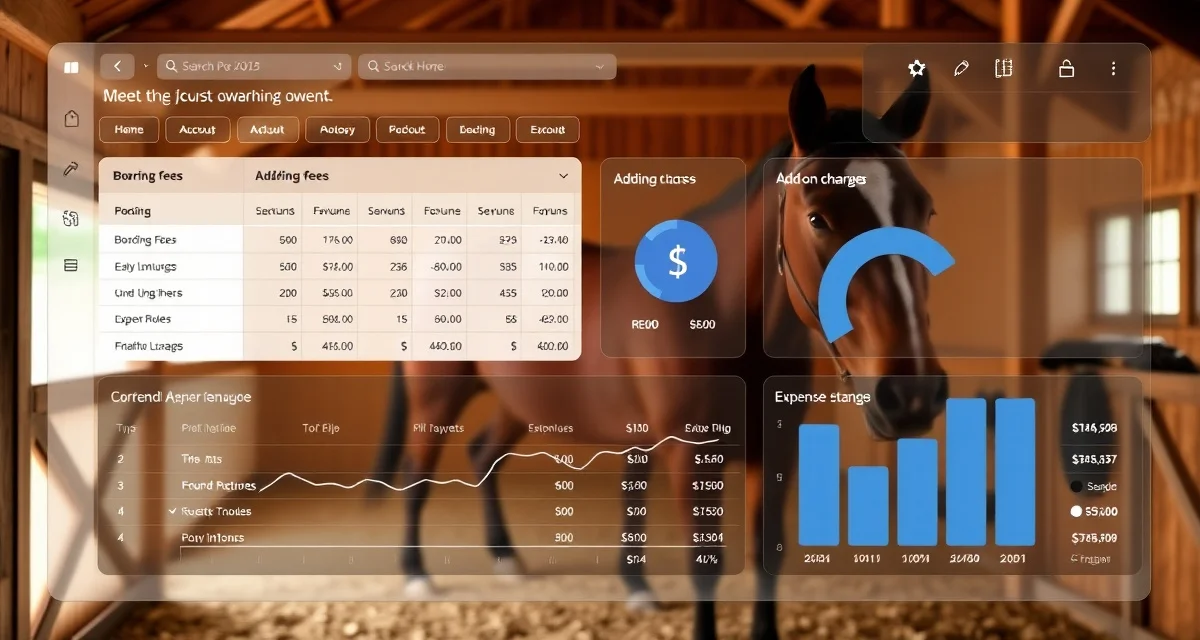
Boarding Barn Financial Reporting: Revenue and Expense Tracking
Most boarding barn owners are excellent horsepersons. Fewer are excellent accountants. That gap costs real money: the average boarding barn loses $2,800 per year to billing errors on multi-horse accounts alone, through missed charges, duplicate invoices, and unbilled add-ons that slip through the cracks.
TL;DR
- Discipline-specific facilities have billing and scheduling demands that differ meaningfully from general boarding operations.
- Performance horse health monitoring needs to track training load and recovery, not just routine care events.
- Show and competition billing requires real-time charge capture at events to avoid reconstruction errors after returning home.
- Owner communication expectations at training facilities are higher than at basic boarding operations.
- Trainer-client trust depends on documented progress records, not just verbal updates after each ride.
- BarnBeacon supports performance-focused facilities with training logs, competition billing, and owner update automation.
Boarding barn financial reporting is not just a bookkeeping exercise. It is the difference between knowing your barn is profitable and assuming it is.
Why Boarding Barn Finances Are Harder Than They Look
A 20-stall barn sounds simple. Twenty horses, twenty monthly board fees, done. In practice, it rarely works that way.
One owner has three horses. Another boards two horses but splits costs with a co-owner. A third client gets a discount for helping with barn chores. Add in farrier charges, vet call fees, extra hay, blanketing services, and arena rental, and you have dozens of line items across a handful of accounts every single month.
Without a structured system for equine facility revenue tracking, those line items get missed. Or they get billed twice. Either way, your revenue report does not reflect reality.
Setting Up Your Revenue Categories
Before you can report on revenue, you need to define it. Most boarding barns have at least four distinct revenue streams that should be tracked separately.
Board fees are the foundation. Track these per stall, per horse, and per board type (full board, pasture board, partial board). Blending them into a single "board income" line makes it impossible to analyze which board type is most profitable.
Service fees cover everything beyond basic board: blanketing, fly spray, holding for the vet or farrier, grain supplements, and extra feedings. These are often the most under-billed category because they happen informally and get forgotten before invoicing.
Facility rental includes arena time, wash rack fees, trailer parking, and lesson space rental if you lease to an independent trainer. This revenue stream is frequently tracked separately from board but should still appear in your consolidated monthly report.
Ancillary charges catch the rest: shavings overages, late payment fees, and one-time charges like stall deep-cleaning after a horse departs.
Expense Categories That Actually Matter
On the expense side, vague categories create vague decisions. "Barn supplies" tells you nothing useful. Breaking expenses into specific categories lets you spot where costs are creeping up before they become a problem.
Feed and Bedding
This is typically the largest variable expense for a boarding barn, often running 35 to 45 percent of total operating costs. Track hay, grain, and shavings separately. If hay prices spike mid-year, you need to see that in your reports immediately, not when you reconcile at year-end.
Labor
Whether you employ staff or pay independent contractors, labor should be broken down by function: daily care, turnout, stall cleaning, and administrative time. Many barn owners underestimate how much time goes into billing, scheduling, and client communication. That time has a cost.
Facility Maintenance
Fencing, footing, equipment repair, and building upkeep. These expenses are irregular, which makes them easy to overlook in monthly reporting. A rolling 12-month view helps you see the true annual cost rather than treating a $3,000 fence repair as an anomaly.
Veterinary and Farrier Coordination
If your barn coordinates vet or farrier visits and passes costs through to owners, you need a clean system for tracking what was spent and what was billed. Discrepancies here are a common source of both billing errors and client disputes.
The Multi-Horse Account Problem
Here is where most barn management systems fall short. When one owner has multiple horses, billing becomes significantly more complex.
Each horse may have a different board type, different service add-ons, and different billing arrangements. Some co-ownership situations require splitting a single horse's expenses between two clients. Some owners want one consolidated invoice; others want itemized breakdowns per horse.
Tools that handle simple one-horse-one-owner billing often break down here. Stable Secretary, for example, can become unwieldy when managing complex multi-horse invoices across a single account. BarnManager's billing module lacks the automation needed to handle recurring split charges without manual intervention each month.
BarnBeacon was built specifically to handle these scenarios. Multi-horse per owner billing, split expense allocation, and automated monthly invoicing are core features, not workarounds. You can configure each horse's charges independently, assign co-owner billing splits, and generate a single consolidated invoice or separate invoices per horse, depending on client preference.
For barn owners managing more than 10 horses across a mix of ownership structures, that kind of flexibility is not optional. It is essential. You can see how this works in detail on the billing and invoicing features page.
Occupancy Rate: The Metric Most Barns Ignore
Revenue per horse is important. Occupancy rate is what tells you whether your revenue potential is being realized.
Occupancy rate is simple: divide your occupied stalls by your total available stalls, then multiply by 100. A 20-stall barn with 17 horses boarded is running at 85 percent occupancy.
What most barn owners do not track is occupancy rate over time. A barn that averages 90 percent occupancy in summer and drops to 70 percent in winter has a seasonal revenue problem that needs a strategic response, whether that is winter boarding incentives, a waiting list strategy, or a pricing adjustment.
Monthly occupancy tracking also helps you evaluate the impact of adding stalls, converting pasture board to full board, or taking on a training program. Without the baseline data, those decisions are guesswork.
Building a Monthly Financial Report
A useful monthly financial report for a boarding barn does not need to be complicated. It needs to be consistent and complete.
At minimum, your monthly report should include:
- Total revenue by category (board fees, services, facility rental, ancillary)
- Total expenses by category (feed, labor, maintenance, utilities, insurance)
- Net operating income
- Occupancy rate for the month
- Revenue per occupied stall
- Outstanding receivables (unpaid invoices)
- Month-over-month comparison for both revenue and key expense categories
That last item matters more than most barn owners realize. A single month's numbers tell you very little. Twelve months of consistent data tells you whether your barn is trending in the right direction.
Accounts Receivable: The Silent Cash Flow Killer
Unpaid invoices are a chronic problem in the boarding industry. Clients who are otherwise responsible horse owners sometimes let board bills slide, especially when they feel the invoice is unclear or incorrect.
The fastest way to reduce late payments is to make invoices easy to understand and impossible to dispute. Every charge should be itemized with a date, a description, and a per-horse breakdown. Vague line items like "extra services - $85" generate questions and delays.
Automated invoicing, sent on the same date every month, also reduces late payments by removing the informal nature of billing that many small barns rely on. When clients receive a professional, consistent invoice, they treat it like a professional, consistent obligation.
Tracking accounts receivable as a separate line in your monthly report also forces you to confront the problem rather than absorb it. If your outstanding receivables are growing month over month, that is a cash flow issue that needs attention now.
Using Financial Data to Make Better Decisions
Boarding barn financial reporting is not just about knowing what happened. It is about making better decisions going forward.
A few examples of decisions that require solid financial data:
Pricing adjustments. If your revenue per occupied stall has not increased in three years but your feed and labor costs have risen 18 percent, you have a margin problem. Your financial reports should make that visible before it becomes a crisis.
Service profitability. Blanketing services are popular at many barns, but they are also labor-intensive. If you are charging $5 per blanketing and it takes 15 minutes of labor per horse, you may be losing money on the service. Tracking service revenue against service-related labor costs tells you whether to adjust pricing or drop the offering.
Expansion decisions. Adding four stalls sounds like a revenue opportunity. Your occupancy data will tell you whether demand supports it. Your expense data will tell you what the build-out will cost to operate. Together, they give you a real return-on-investment picture.
For barn owners who want a complete view of how financial reporting connects to day-to-day operations, the barn management software overview covers how these tools work together in practice.
Common Financial Reporting Mistakes Boarding Barns Make
Even barn owners who track their finances carefully tend to make a few recurring mistakes.
Mixing personal and business expenses. If your personal vehicle is used for barn errands, that is a legitimate business expense, but only the business portion. Mixing these creates inaccurate reports and tax complications.
Ignoring depreciation. Equipment, vehicles, and facility improvements depreciate over time. Ignoring depreciation overstates your profitability and understates your true operating costs.
Reporting cash instead of accrual. Cash-basis reporting shows you when money arrived, not when it was earned. A client who pays three months of board in advance looks like a revenue spike in cash reporting. Accrual reporting spreads that revenue across the months it covers, giving you a more accurate picture of monthly performance.
Not reconciling invoices to payments. If you are not regularly matching what was invoiced to what was paid, billing errors accumulate silently. A monthly reconciliation process catches discrepancies before they compound.
Related Articles
- Horse Compatibility Tracking for Boarding Barn Turnout
- Tracking Payments Received at a Boarding Barn
FAQ
How do I bill for multiple horses owned by one person?
Each horse should have its own charge record, with board type, service add-ons, and any special arrangements tracked individually. At invoicing time, you can either consolidate all charges into a single invoice for the owner or generate separate invoices per horse, depending on their preference. If there is a co-ownership arrangement, the billing system should allow you to split specific charges between two client accounts automatically rather than requiring manual calculation each month.
What billing features should barn management software include?
At minimum, look for per-horse charge tracking, recurring invoice automation, itemized invoice generation, and accounts receivable reporting. More advanced needs include split billing for co-owned horses, multi-horse consolidated invoicing, and service charge templates that can be applied in bulk. Many tools handle basic one-horse billing adequately but struggle with the complexity of multi-horse accounts or co-ownership structures, so test those scenarios specifically before committing to a platform.
How do I reduce billing errors at my boarding barn?
The most effective step is moving from manual or spreadsheet-based billing to a system that logs charges at the time the service is performed, not at the end of the month when memory is unreliable. Require staff to record add-on services immediately using a mobile-accessible system. Run a pre-invoice audit each month that compares logged services against what is about to be billed. And reconcile payments against invoices within a week of the billing date so discrepancies surface quickly rather than carrying forward.
What is the most common mistake barn managers make with record-keeping?
The most common record-keeping mistake is logging health events, billing items, and care tasks after the fact from memory rather than at the time they occur. Delayed logging introduces errors, omissions, and disputes that are difficult to resolve because the original record does not exist. Moving to real-time digital logging, from any device, is the single most impactful record-keeping improvement available to most facilities.
How does barn management software save time at a multi-horse facility?
The largest time savings come from eliminating manual tasks that recur at high frequency: sending owner updates, generating monthly invoices, tracking care task completion across shifts, and scheduling recurring appointments. At a facility with 25 or more horses, these tasks can consume several hours per day when done manually. Automating the routine layer returns that time without reducing quality of communication or care.
What is Boarding Barn Financial Reporting: Revenue and Expense Tracking?
Boarding barn financial reporting is the systematic tracking of all revenue streams and operating expenses at a horse boarding facility. It goes beyond basic bookkeeping to capture monthly board fees, add-on services, farrier charges, veterinary billing, and feed costs at the individual horse level. Accurate financial reporting helps barn owners identify profitability gaps, reduce billing errors, and make informed decisions about pricing, staffing, and facility investments rather than relying on rough estimates.
How much does Boarding Barn Financial Reporting: Revenue and Expense Tracking cost?
Implementing structured financial reporting for a boarding barn does not have a fixed cost — it depends on the tools you choose. Basic spreadsheet tracking is free but labor-intensive. Dedicated barn management software like BarnBeacon typically runs a monthly subscription fee scaled to barn size. The more relevant cost consideration is the expense of not reporting accurately: boarding operations commonly lose thousands of dollars annually through missed charges, unbilled add-ons, and duplicate invoices that go undetected without systematic tracking.
How does Boarding Barn Financial Reporting: Revenue and Expense Tracking work?
Boarding barn financial reporting works by capturing every billable event and expense as it occurs, then reconciling those entries against boarder accounts at billing intervals. Revenue tracking covers monthly board, training fees, lessons, and incidental charges. Expense tracking covers feed, bedding, labor, farrier, veterinary, and facility costs. When organized by horse, boarder, and cost category, the data surfaces which services are profitable, which accounts carry balances, and where revenue consistently leaks — giving owners an accurate picture of barn financial health.
Sources
- American Horse Council, equine industry economic impact and facility operations research
- American Association of Equine Practitioners (AAEP), equine health care and management guidelines
- University of Kentucky Equine Initiative, equine business management and industry resources
- Rutgers Equine Science Center, equine management research and extension publications
- The Horse magazine, published by Equine Network, equine facility management reporting
Get Started with BarnBeacon
BarnBeacon brings billing, health records, owner communication, and daily operations into one platform built for equine facilities, so the time you spend on administration goes back to the horses. Start a free 30-day trial with full access to every feature, or schedule a demo to see how it handles your specific facility type.