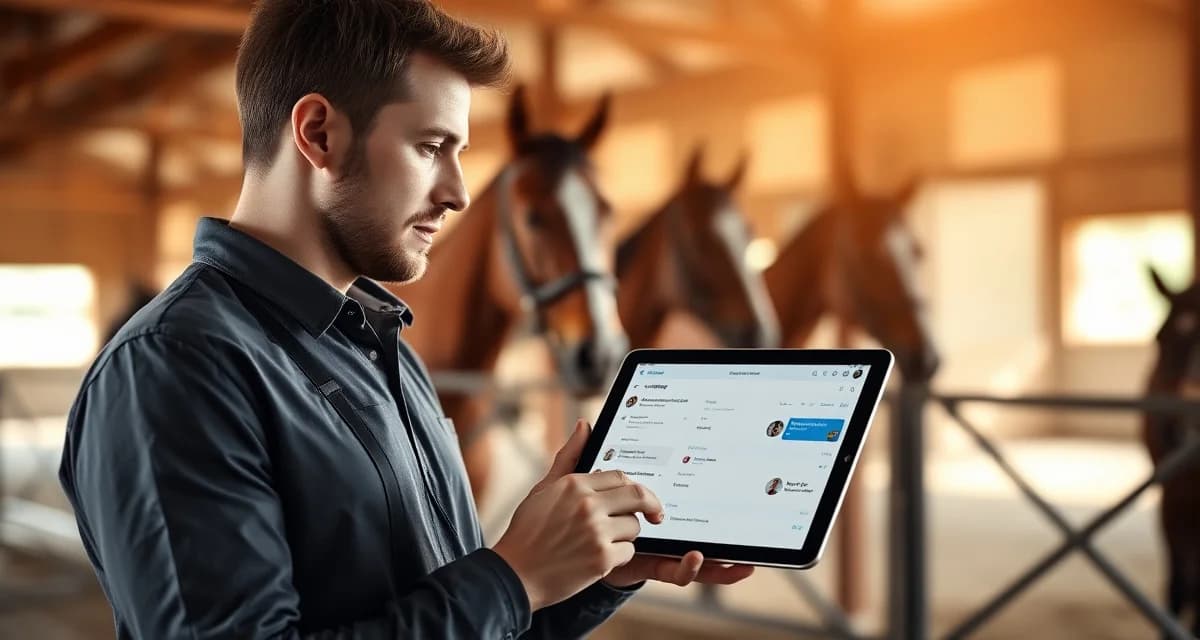
Owner Communication Complete Guide
Owner communication is the client service layer of equine facility operations, and it is, for many facilities, the most inconsistent and most time-consuming function in the entire operation. Studies of equine facility client satisfaction consistently show that communication quality is the top driver of both satisfaction and departure decisions. Clients who feel informed about their horses stay; clients who feel uninformed leave, often for facilities with worse care but better communication. This guide covers the full scope of owner communication at equine facilities: what to communicate, when, how, and what systems make it sustainable at scale.
TL;DR
- Owner communication is the top factor in boarding client retention, ranked above facility quality and pricing in surveys
- Structured daily updates take under 30 seconds to log when built into care workflows and deliver outsized retention value
- Health alerts sent within 30 minutes of an event, with a documented response timeline, build owner confidence
- Billing transparency, specifically itemized invoices and pre-approval for large expenses, prevents most financial disputes
- An owner communication portal gives clients a single place to check updates and reduces inbound call volume significantly
- Written onboarding communication expectations reset habits from a boarder's previous barn and prevent early misunderstandings
BarnBeacon's barn management software provides the owner portal, training log, and communication tools that support systematic, scalable owner communication. The complete barn management guide covers the broader operational context.
Why Owner Communication Matters More Than Facilities Think
The instinct at many equine facilities is to prioritize horse care and treat communication as a secondary concern. This instinct is understandable, the horses are the operational priority, but it produces a predictable pattern: excellent care that clients don't perceive as excellent because they don't know what's happening with their horses.
The perception gap between actual care quality and client perception of care quality is primarily a communication gap. A facility that provides exceptional care but communicates poorly will be perceived as less caring than a facility that provides adequate care but communicates proactively. Clients who can see their horse's daily training observations, who receive timely health updates, and who get invoices they can understand believe they are getting better care, because they have evidence of what's happening.
The reactive communication trap is the most common failure mode. A trainer with 15 horses in active training, handling all communication reactively by text and phone, will spend two to three hours per day on messaging, and clients will still feel undertended. Reactive communication scales poorly. Each additional horse in training adds more potential incoming messages. Each additional client adds more demand for trainer availability.
Proactive communication systems, specifically, training logs accessible through an owner portal, break the reactive pattern. When clients can check their horse's records directly, they don't need to ask for information. The volume of routine status inquiries drops dramatically. The communication that does happen is higher-quality, substantive discussions about training direction, show planning, and health management rather than "how did he go today?"
Training Logs as the Foundation of Owner Communication
Training logs are the single most high-value communication tool available to training facility operators. A well-maintained training log gives clients daily access to information about their horse's work without requiring any additional effort from the trainer beyond writing notes.
What makes a training log valuable:
A training note that says "worked today" provides no value. A training note that says "flatwork focused on the right lead, picking it up cleanly now, worked on keeping the bend in the corners, added a short canter set at the end and she was relaxed and rhythmic" gives the client something worth reading. The difference is specificity.
Good training log entries are:
- Specific about what was worked and how the horse responded
- Brief, three to five sentences is ideal, not a paragraph essay
- Observational, what actually happened, not filtered through what you want the client to hear
- Honest, if a horse had a difficult session or showed concerning behavior, that belongs in the log with context
The training log habit is what separates facilities that use owner portals effectively from those that set them up and abandon them. The habit is: within 30 minutes of finishing a ride, write the log note in BarnBeacon. That timing, while the session is fresh, produces better notes and ensures the log is current when a client checks later that day.
Trainer discipline and training log quality go together. Trainers who write specific, observational notes develop sharper attention to what's actually happening in their rides, the skill of accurate observation and reporting is the same skill as effective training. Training logs are not a communication add-on; they are a training tool that also serves communication purposes.
Owner Portal Implementation
Owner portals give clients direct access to their horse's records without requiring a call, text, or visit to the barn. BarnBeacon's owner portal provides access to training logs, health observations, billing records, and any other information logged per horse.
Setup and invitation: Each client receives an invitation to access the portal for their horse or horses. The onboarding conversation should include a demonstration of what's available and how to access it. Clients who are shown how to use the portal actually use it; clients who receive a link without explanation mostly don't.
What to share through the portal:
- Training and exercise logs: every session, logged the same day
- Health observations: daily check notes, any health concerns, medication tracking
- Billing records: charges accumulated through the month, invoice history
- Documents: boarding contract, vaccination records, any relevant facility documents
Managing client expectations about portal vs. direct communication: The owner portal does not replace all direct communication, it reduces the routine informational messages while preserving the capacity for substantive conversations. Make clear to clients that significant health concerns, training decisions, and show planning discussions still happen in direct conversations; the portal handles the daily information flow.
Portal communication between clients and facility: Some portal implementations include messaging features that centralize all owner communication in one place rather than distributing it across text, email, and phone. Centralizing communication in BarnBeacon means that messages are attached to the horse record, are visible to any relevant staff member, and don't get lost in a personal text thread.
Health Communication Protocols
Health communication is the highest-stakes communication at any equine facility. Done well, it gives owners the information they need to make good decisions about their horses. Done poorly, it creates anxiety, erodes trust, and can result in delayed care.
Routine health observations, daily checks noting appetite, attitude, water consumption, and any minor observations, should flow through the owner portal via BarnBeacon's health log. Clients who can see three weeks of normal, consistent daily observations have a different level of confidence in their horse's wellbeing than those who only hear from the facility when something is wrong.
When to call directly:
- New significant lameness (not a minor transient stiffness, but a clear change in soundness)
- Colic episode, regardless of severity
- Significant injury
- Illness with fever or clinical signs requiring veterinary attention
- Any health situation that will require veterinary assessment or treatment
A direct call, not a text, not a portal message, an actual phone call, is appropriate for any of the above situations. Call promptly, state clearly what you've observed and what you're doing about it (have you already called the vet, or are you calling the vet after this call), and give the owner the opportunity to be involved in decisions about their horse's care.
Communication when a horse is doing well is as important as health emergency communication. Clients who only hear from the barn when something is wrong develop a Pavlovian response of anxiety to any contact. Periodic positive communications, a training milestone, a particularly good work session, a wellness check note, build the trust that makes difficult health conversations less fraught.
Billing Communication
Billing communication is not just about invoices, it's about the ongoing transparency that prevents disputes and builds trust.
Proactive charge notification for unusual or unexpected charges prevents the surprise that drives billing disputes. If a horse had an unplanned veterinary visit that will appear on the next invoice, a brief note to the owner when the vet visit happens, "just wanted to let you know, we had the vet out for [horse] today for [reason], the visit and any medications will appear on your next invoice", transforms what might be a disputed charge into expected billing.
Itemized invoices sent on a consistent schedule are the most direct communication tool for billing. A client who receives a clear, itemized invoice every month on the same date, with dates and descriptions for every line item, rarely needs to call about billing. The invoice communicates everything they need to know.
Billing transparency through the portal: BarnBeacon's owner portal gives clients access to their running charge log as charges accumulate throughout the month, not just when the invoice is generated. A client who can see that a training session was logged on Tuesday before they check on Thursday doesn't need to ask whether their horse was ridden.
Responding to billing questions: When a client asks about a charge, pull the BarnBeacon record and answer with specifics, the date, the service, the logged description. Clients who ask billing questions are most often looking for confirmation that the charge is legitimate and accurately described. A specific, documented answer resolves the question. A vague or defensive answer escalates it.
Communicating During Difficult Situations
Not all owner communication is routine. Difficult situations, health emergencies, horse deaths, training disagreements, client departures, require communication that is honest, timely, and professionally handled.
Health emergency communication should be immediate, clear, and ongoing. When a horse has a colic episode, the call goes out when the signs are noticed, not after the vet has been out and the horse has recovered. The owner should have the opportunity to be present or to be updated throughout the emergency as the situation develops.
When a horse dies in your care, the call goes to the owner immediately. No staging of information, no waiting for a better time, no communication through text or portal. This is the hardest phone call in equine facility management, and the only appropriate delivery is a direct call with clear, honest communication about what happened.
Training disagreements are inevitable at facilities where trainers have strong opinions about the right approach and clients have strong opinions about their horses. The communication approach that preserves relationships while maintaining professional integrity is: listen to the client's perspective completely before responding, acknowledge what is valid in their concern, explain your reasoning with specific training observations as the foundation, and make clear what you can and cannot do within your professional judgment.
Client departure communication should be handled professionally regardless of the circumstances. When a client gives notice, a direct conversation about why they are leaving, not to argue or persuade, but to understand, provides useful information. Clients who leave because of genuine operational or communication failures are telling you something important.
Communication at Scale
Owner communication that works for three horses becomes unmanageable at 20 horses without systems. The challenge is scaling the quality of communication, not reducing it.
Training log as the primary communication vehicle at training facilities serves any number of horses because the incremental work per horse is a few sentences per day, something that fits into the natural training routine. The client portal amplifies the impact of those notes without adding to the trainer's communication workload.
Templated communication for recurring situations reduces the time spent on routine messages. A weekly summary email template, a standard show-week update format, and a health check note template all reduce the effort of routine communication without sacrificing quality or personalization.
Clear response time expectations for direct messages reduce the anxiety that drives clients to follow up repeatedly. If clients know that texts receive a response within 4 hours during barn hours and non-urgent messages are answered within 24 hours, they don't send the same message three times. Setting and consistently meeting response time expectations is a communication system, not just a courtesy.
Designating communication responsibilities at facilities with multiple trainers and staff ensures that every client's questions receive a response. If a client's assigned trainer is at a show, who responds to that client's messages? The answer should be documented and communicated to clients.
How does BarnBeacon compare to spreadsheets for barn management?
Spreadsheets require manual updates, lack real-time notifications, and create version control problems when multiple staff members are working from different files. BarnBeacon centralizes records, pushes alerts automatically based on logged events, and connects care records to billing and owner communication in one system. Most facilities report saving several hours per week after switching from spreadsheets.
What is the setup process like for BarnBeacon?
Most facilities complete the initial setup in under a week. Horse profiles, service templates, and billing configurations can be imported from existing records or entered directly. BarnBeacon's US-based support team is available to assist with setup, and most managers are running their first billing cycle through the platform within days of starting.
Can BarnBeacon support a barn with multiple staff members?
Yes. BarnBeacon supports multiple user accounts with role-based access, so barn managers, barn staff, and owners each see the information relevant to their role. Task assignments, completion logs, and communication history are all attached to the barn's account rather than to individual staff phones or email addresses.
FAQ
What is Owner Communication Complete Guide?
The Owner Communication Complete Guide is a comprehensive resource for equine facility managers covering every aspect of client communication—what to share, when to share it, and how to build sustainable systems at scale. It addresses daily horse updates, health alerts, billing transparency, and onboarding expectations. The guide is designed to help barn operators reduce client turnover, cut inbound call volume, and deliver consistent communication that builds long-term owner trust and satisfaction.
How much does Owner Communication Complete Guide cost?
The Owner Communication Complete Guide is free educational content published by BarnBeacon. There is no purchase required to access the article. BarnBeacon offers barn management software separately, with pricing based on facility size and feature needs. The communication strategies outlined in the guide can be implemented manually at no cost, or with greater efficiency using a dedicated owner communication portal integrated into your facility management workflow.
How does Owner Communication Complete Guide work?
The guide walks facility managers through a structured communication framework covering four core areas: routine daily updates logged during normal care workflows, time-sensitive health alerts sent within 30 minutes of an incident, transparent billing with itemized invoices and pre-approval thresholds, and a centralized owner portal. Each section provides practical protocols that reduce the time spent on ad hoc calls and messages while increasing the consistency and quality of information owners receive.
What are the benefits of Owner Communication Complete Guide?
Implementing the communication systems in this guide delivers measurable retention improvements, fewer billing disputes, reduced inbound call volume, and stronger owner trust. Facilities that send structured daily updates and rapid health alerts report higher client satisfaction scores. Billing transparency eliminates most financial friction before it starts. An owner portal gives clients self-service access to updates, reducing the interruptions that fragment staff time throughout the day.
Who needs Owner Communication Complete Guide?
Any equine facility managing boarding clients benefits from this guide—from small private barns with a handful of owners to large commercial operations with dozens of horses in training or full care. It is especially valuable for facilities experiencing high client turnover, frequent billing disputes, or staff overwhelmed by owner phone calls. New barn managers establishing communication norms and experienced operators looking to systematize inconsistent processes will both find actionable frameworks here.
How long does Owner Communication Complete Guide take?
Reading and understanding the guide takes roughly 15 to 20 minutes. Implementing the full communication framework—including onboarding documentation, alert protocols, billing processes, and a client portal—typically takes one to two weeks depending on your current systems. Daily communication tasks, once integrated into care routines, take under 30 seconds per horse per update. The upfront setup investment pays back quickly through reduced time spent on reactive owner inquiries.
What should I look for when choosing Owner Communication Complete Guide?
When evaluating owner communication systems for your barn, prioritize ease of logging updates during active care workflows, fast alert delivery for health events, itemized billing with customizable pre-approval thresholds, and a clean mobile experience for owners. Look for platforms that reduce staff effort rather than adding steps. A centralized portal that gives owners a single place to check updates, documents, and invoices significantly cuts inbound message volume and improves the overall client experience.
Is Owner Communication Complete Guide worth it?
Yes. Communication quality is consistently ranked as the top driver of boarding client retention—above facility quality and pricing. Clients who feel informed stay; those who feel uninformed leave, often to facilities with objectively worse care. The systems in this guide are not complicated, but most facilities have never formalized them. Structured updates, rapid health alerts, and billing transparency prevent the silent dissatisfaction that leads to departures, making this one of the highest-return investments a barn operator can make.
Sources
- American Association of Equine Practitioners (AAEP)
- United States Equestrian Federation (USEF)
- American Horse Council
- UC Davis Center for Equine Health
- American Horse Council Economic Impact Study
Get Started with BarnBeacon
Owner communication that runs on group texts and personal phones is a system waiting to break. BarnBeacon gives equine facilities the structure to deliver consistent, horse-specific updates automatically, keep health alerts separate from routine notices, and give owners portal access to their horse's complete history. Start a free trial and see what your communication looks like when it runs through a system built for it.