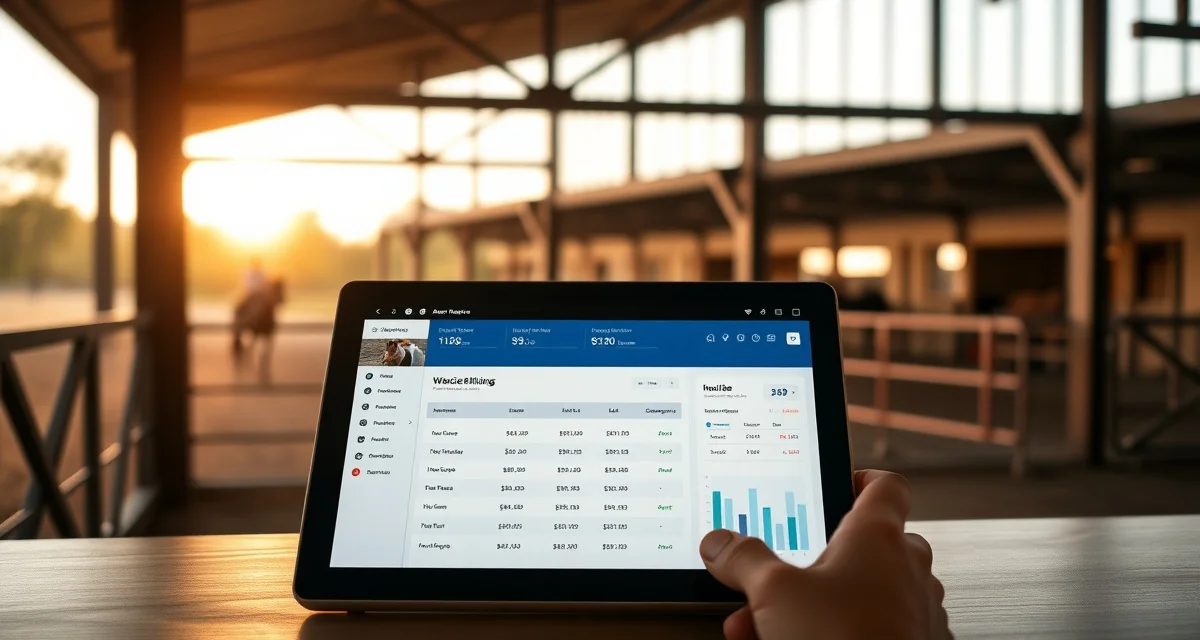
Barrel Racing Barn Billing: Complete Guide for Facility Managers
Barrel racing is the fastest-growing western discipline with 200,000+ participants, and the billing demands at a barrel racing facility reflect the sport's travel-intensive nature. When clients are hauling to multiple events per month, each with its own entry fees, venue stall charges, and potential hauling costs, the end-of-month billing reconstruction that many facilities rely on produces errors, disputes, and frustrated clients.
TL;DR
- Billing errors most often result from delayed charge logging rather than intentional mistakes.
- Same-day charge entry, logged at time of service, is the single most effective billing improvement any facility can make.
- Itemized invoices listing each charge with a date and description are paid faster and disputed less frequently.
- Online payment options reduce late payments by lowering friction for clients.
- Late fee policies only work as deterrents when applied consistently across all accounts.
- Purpose-built barn billing software reduces errors significantly at facilities with 20 or more horses and varied service charges.
This guide covers how to structure barrel racing facility billing, capture event charges accurately, and invoice clients in a way that's transparent and defensible.
Why Barrel Racing Billing Is Different
Event frequency creates billing volume. A barrel racing client in heavy competition season may attend five to eight events per month. Each event generates multiple line items: entry fee, venue stall, bedding, fuel allocation, and potentially a touch-up farrier visit before a major event. Multiplied across multiple clients and multiple horses, that's a significant number of individual charges per billing cycle.
Charge reconstruction doesn't work at this volume. When you try to reconstruct five events' worth of charges at the end of the month from memory and a paper log, you will miss charges. The more events, the more missing charges. The more missing charges, the more you're either losing revenue or scrambling to add charges after invoices have gone out.
Per-horse attribution is critical. When three horses go to the same event on the same trailer, the fuel cost needs to be divided correctly and attributed to each horse's owner. The venue stall fee needs to be attributed to the correct horse. Entry fees go to the correct horse. All of this requires per-horse charge capture, not a lump-sum event expense that gets sorted out later.
Client billing variability. A client whose horse attended five events has a very different invoice than one whose horse attended one. The variability is legitimate, but it creates client confusion when invoices are much higher than expected. Detailed itemization that shows each event's charges reduces surprise and builds trust.
Setting Up Barrel Racing Billing Structure
Map every revenue category at your barrel racing facility:
- Board (stall, partial care, or pasture)
- Training fees (per ride, per week, or monthly)
- Competition entry fees (pass-through at cost)
- Venue stall fees (pass-through at cost)
- Haul fees (your facility's rate for hauling, or fuel cost allocation)
- Farrier coordination billing
- Veterinary pass-through billing
- Any event-specific charges (bedding, hay, water at venue)
Build clear rate structures and communicate them in writing to clients before billing begins. The key decisions are: what do you pass through at cost vs. what do you charge a coordination fee on top of, and how do you calculate haul fees when multiple horses share a trailer.
Haul Fee Structures
Shared hauling is one of the more contentious billing areas at barrel racing facilities because the calculation isn't always obvious. Here are the common approaches:
Flat per-horse haul fee. Charge a set amount per horse per event, regardless of distance or number of horses on the trailer. Simple to communicate and simple to invoice, but may not accurately reflect actual costs.
Distance-based haul fee. Charge per mile per horse, calculated from your facility to the venue and back. This accurately reflects costs at varying distances but requires tracking mileage per event.
Actual cost allocation. Calculate total fuel cost per trip and divide by the number of horses on the trailer. Most accurate, but requires tracking fuel costs per trip and doing the per-horse math.
Whichever approach you use, it needs to be in your client agreement so there are no surprises when haul fees appear on an invoice.
Real-Time Event Charge Capture
The single biggest billing improvement at barrel racing facilities comes from shifting to real-time charge capture. Here's how:
Log entries when you submit them. When you submit an entry for a client's horse, log the entry fee that day: horse name, event name, event date, fee amount. This takes 30 seconds at entry submission and eliminates the entry fee reconstruction problem.
Log venue stall fees when confirmed. Most venues send a stall confirmation or the information is available on the event page. Log it when you have it.
Carry a haul log. For each event trip, record the departure date, destination, number of horses on the trailer, and fuel costs. Do this at the trip, not the month.
Log at-event incidentals as they happen. Bedding from the venue, a farrier visit, a vet check: log these when they occur with the horse name and amount.
When you invoice at month-end, you're compiling logged charges rather than reconstructing events. The process is faster, more accurate, and generates invoices that clients can verify against their own receipts.
Invoice Format for Barrel Racing Clients
A barrel racing client invoice should be organized by event for clients with multiple show trips. Each event is a section that shows:
- Event name, date, and location
- Entry fee for this horse
- Stall fee
- Haul/fuel allocation
- Any other event-specific charges
After the event sections, list monthly charges:
- Board
- Training (with rides or training days listed)
- Regular farrier visit
- Regular veterinary visit
- Any other monthly charges
Total at the bottom with the current balance.
This format gives clients the context to understand their invoice. A barrel racer who went to four events can trace exactly what each event cost and why their total is higher in a heavy show month.
Using Software for Barrel Racing Billing
BarnBeacon's barn management software supports the real-time charge capture and event-organized invoicing that barrel racing facilities need. Charges can be entered per horse, per event, from a phone at the venue. At month-end, invoices are generated from accumulated charges rather than requiring manual compilation.
The platform's billing module handles the multi-event billing structure with event-organized invoice sections that give clients the transparency barrel racing billing requires.
For a full view of barrel racing facility operations, see the barrel racing barn operations guide.
Frequently Asked Questions
How do barrel racing barn managers handle billing?
The most organized barrel racing facilities capture event charges in real time: entries logged when submitted, stall fees logged when confirmed, and haul costs tracked per trip. This approach produces accurate invoices within days of month-end rather than requiring a reconstruction that takes hours and still contains errors.
What software do barrel racing facilities use for billing?
Barrel racing facilities need billing software that handles high-frequency event billing, per-horse charge attribution, and event-organized invoice formats. BarnBeacon is designed for the billing volume and complexity of travel-intensive barrel racing programs.
What are the unique billing challenges at barrel racing barns?
Event frequency is the core challenge: when clients attend multiple events per month, the volume of per-horse charges requiring accurate attribution is higher than at most other equine facilities. Haul fee structure and calculation is also a common source of client disputes that clear written agreements and real-time tracking can prevent.
How do I handle billing when a horse owner disputes a charge?
Start by pulling the full charge record from your billing system, including the date, description, and who logged the charge. Share that documentation with the owner before escalating. Most billing disputes resolve quickly when there is a complete, dated record. If the record reveals an error, correct the invoice and acknowledge it directly. If the record supports the charge, present the documentation calmly and give the owner time to review.
What is the best way to handle late payments from boarding clients?
Enforce your stated late fee policy consistently across all accounts. An invoice that is 5 days late should receive an automated payment reminder. One that is 30 days late warrants a direct conversation. Consistent enforcement signals that the policy is real, which discourages late payment more effectively than applying fees selectively. If a balance reaches 60 days without resolution, that is a financial decision requiring deliberate action, not just additional reminders.
Should I charge a fee for coordinating outside vendor appointments?
Many boarding facilities charge a coordination or handling fee for arranging and supervising outside vendor appointments such as farrier visits, dental work, or chiropractic sessions. If you do charge this fee, it should be disclosed in the boarding contract before the relationship begins, and each charge should be logged with the vendor name, service date, and horse served. Clients are far less likely to question a well-documented coordination fee than one that appears without context on an invoice.
What is Barrel Racing Barn Billing: Complete Guide for Facility Managers?
Barrel Racing Barn Billing: Complete Guide for Facility Managers is a comprehensive resource covering how to structure billing at barrel racing facilities. It addresses the unique challenges these barns face—including event stall charges, hauling costs, and entry fee tracking—and provides actionable guidance on same-day charge logging, itemized invoicing, online payment options, and consistent late fee enforcement to reduce billing errors and client disputes.
How much does Barrel Racing Barn Billing: Complete Guide for Facility Managers cost?
The guide itself is free educational content published on BarnBeacon. The billing practices it recommends, such as purpose-built barn management software, vary in cost depending on the platform and facility size. Most barn billing software starts around $50–$150 per month. For facilities managing 20 or more horses with varied service charges, the reduction in billing errors and time saved typically outweighs the software investment.
How does Barrel Racing Barn Billing: Complete Guide for Facility Managers work?
The guide works by breaking down the barrel racing billing cycle into manageable steps: logging charges at the time of service, categorizing event-related costs separately, generating itemized invoices that list each charge with a date and description, and offering clients online payment options. Facilities that follow this workflow replace end-of-month billing reconstruction—the primary source of errors—with a real-time, auditable charge record.
What are the benefits of Barrel Racing Barn Billing: Complete Guide for Facility Managers?
Key benefits include fewer billing errors, faster invoice payment, and significantly reduced client disputes. Itemized invoices are paid faster and questioned less often than lump-sum bills. Same-day charge entry creates a defensible paper trail for event-related costs. Online payment options lower friction and reduce late payments. Consistent late fee application across all accounts also improves overall cash flow and sets clear expectations with clients.
Who needs Barrel Racing Barn Billing: Complete Guide for Facility Managers?
Any manager or owner running a barrel racing facility benefits from this guide—particularly those handling 20 or more horses, event stall coordination, or hauling logistics for clients who compete frequently. It is especially useful for facilities still relying on manual end-of-month billing reconstruction, those experiencing recurring invoice disputes, or managers looking to modernize their billing process with software built specifically for equine facilities.
Related Articles
- Barrel Racing Barn Owner Communication: Complete Guide for Facility Managers
- Barrel Racing Barn Scheduling: Complete Guide for Facility Managers
Sources
- American Horse Council, equine industry economic impact and business operations resources
- University of Minnesota Extension, business management for horse operations
- Equine Business Association, best practices in equine facility management
- United States Equestrian Federation (USEF), facility management and financial standards
- Kentucky Equine Research, equine industry publications and facility management guidance
Get Started with BarnBeacon
BarnBeacon's billing tools capture every charge at the time it occurs, generate itemized invoices automatically, and let clients pay online so you spend less time chasing payments and more time on the horses. Start a free 30-day trial with full access to billing, health records, owner communication, and daily operations tools.