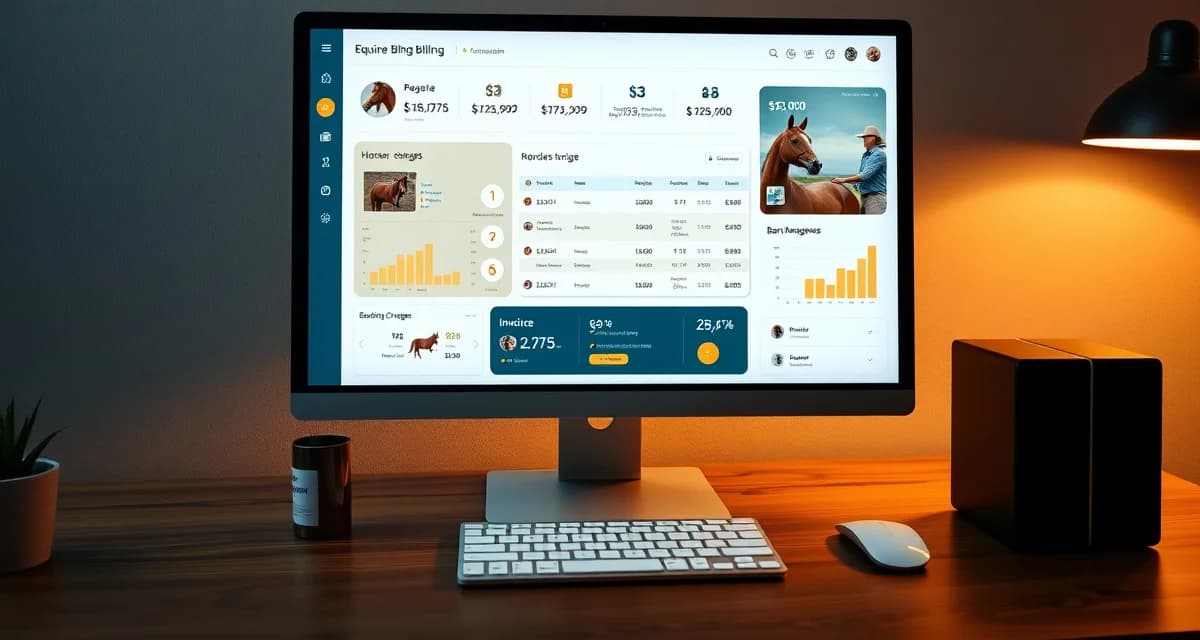
Equine Billing Software: What Barn Managers Need and What to Look For
General accounting software was not built for equestrian facilities. It does not understand that one client may own three horses in different care programs, that board charges recur monthly while farrier charges are event-based, or that services need to be logged per horse and billed per owner. Purpose-built equine billing software handles these nuances automatically.
What Equine Billing Software Needs to Do
Recurring Board Billing
Board charges are predictable and should be fully automated. The software should generate board invoices on a defined schedule based on each horse's boarding agreement, without requiring manual entry each month. Rate changes, mid-month arrivals or departures, and prorated partial months should all be handled by the system.
Service Charge Logging
Every service delivered needs to be logged against a specific horse and owner as it occurs. Farrier visits, veterinary services, additional feed, supplements, training sessions, lessons, and show-related charges all need a logging mechanism that ties each charge to the right horse and billing account.
Invoice Generation
The software should generate formatted, itemized invoices that clearly show all charges for the billing period. Invoices should be delivered by email and accessible through an owner portal. A paper invoice process is neither necessary nor efficient.
Payment Tracking
Payment tracking should record when each invoice was paid, how it was paid, and any outstanding balance. The system should automatically calculate which accounts are current and which are overdue.
Multi-Horse Owner Billing
Clients with multiple horses need a consolidated billing view. The software should track charges per horse internally while presenting a single invoice to the owner that itemizes charges by horse.
Financial Reporting
Monthly and annual financial reports should be available without custom data entry. Revenue by service type, outstanding receivables, payment history, and year-over-year comparisons are all reports that barn managers and owners need for business management.
Equine Billing Software vs. General Accounting Software
General accounting software like QuickBooks can be adapted for barn billing, but the adaptation requires significant manual configuration and ongoing maintenance. The horse-to-owner relationship, the per-horse service tracking, and the recurring board automation all require workarounds in general accounting software.
Purpose-built equine billing software starts from an equestrian facility data model, so the horse-owner-service relationship is built into the foundation rather than bolted on.
Integration with Health and Care Records
The most significant advantage of purpose-built equine billing software is the integration with the rest of your barn management system. When a farrier appointment is logged in BarnBeacon, it creates both a record in the horse's health file and a charge in the owner's billing account. There is no separate data entry step, and the risk of recording the service but forgetting to bill for it is eliminated.
This integration is not possible with standalone billing software or general accounting tools that do not connect to your horse management records.
Pricing Models
Equine billing software typically uses one of several pricing structures:
- Per horse per month: scales with your facility size
- Flat monthly fee with horse caps: predictable pricing with potential limits
- Percentage of revenue processed: scales with your billing volume
Evaluate pricing based on your current facility size and your growth trajectory. A per-horse pricing model can become expensive at larger facilities, while a flat fee structure may not make sense for small operations.
Making the Switch
If you are currently billing through spreadsheets or general accounting software, switching to purpose-built equine billing software requires migrating your existing client data, boarding agreements, and billing history.
The data migration guide covers how to prepare your existing records for import into BarnBeacon. The transition typically takes a few hours for active records and can be completed before your next billing cycle runs.
For a broader perspective on selecting the right platform for your facility, the equine software buyers guide covers how to evaluate billing tools alongside the other features your facility needs.
FAQ
What is Equine Billing Software: What Barn Managers Need and What to Look For?
Equine billing software is purpose-built financial management software designed specifically for barn managers and equestrian facilities. Unlike general accounting tools, it understands the unique billing structures of horse boarding operations — recurring board charges, per-horse service logging, multi-horse ownership, and event-based fees like farrier visits or training sessions. It automates invoice generation, tracks payments, and ties every charge to the correct horse and owner account, eliminating the manual workarounds that general software requires.
How much does Equine Billing Software: What Barn Managers Need and What to Look For cost?
Equine billing software pricing varies by provider and facility size. Most platforms use monthly subscription models ranging from roughly $30 to $150 per month, with larger or more feature-rich solutions priced higher. Some charge per-horse or per-user fees. Many offer tiered plans so small private barns and large commercial facilities can find an appropriate fit. Free trials are common, and the cost is typically offset quickly by time saved on manual invoicing and reduced billing errors.
How does Equine Billing Software: What Barn Managers Need and What to Look For work?
Equine billing software works by centralizing all horse and owner records in one system. Board charges are automated on a defined schedule based on each horse's boarding agreement. As services are delivered — farrier visits, vet calls, supplements, lessons — staff log them against the specific horse. At billing time, the software compiles all charges into itemized invoices per owner, delivers them by email, and tracks payment status. Reporting tools give managers a real-time view of revenue and outstanding balances.
What are the benefits of Equine Billing Software: What Barn Managers Need and What to Look For?
The core benefits include time savings through automated recurring billing, fewer errors from manual data entry, faster payment collection through online invoicing, and cleaner financial records. Barn managers gain a clear view of what each owner owes and which accounts are overdue. Owners receive professional, itemized invoices that build trust. Over time, the software reduces administrative overhead significantly, freeing managers to focus on horse care rather than chasing spreadsheets and unpaid invoices.
Who needs Equine Billing Software: What Barn Managers Need and What to Look For?
Any barn or equestrian facility that boards horses and bills clients for services needs equine billing software. This includes private boarding barns, training facilities, lesson programs, show barns, and large equestrian centers. It is especially valuable when managing multiple horses per owner, varied care programs, or high volumes of add-on services. Even smaller operations benefit from the time saved on invoicing and the reduction in payment disputes that comes from clear, itemized billing.
How long does Equine Billing Software: What Barn Managers Need and What to Look For take?
Setup time depends on facility size and data complexity. Most barns can get a basic system running — horse profiles, owner accounts, and recurring board billing — within a few hours to a few days. Migrating historical data or configuring complex rate structures may take longer. Ongoing, the software is designed to save time: once configured, monthly billing cycles that previously took hours of manual work can be completed in minutes.
What should I look for when choosing Equine Billing Software: What Barn Managers Need and What to Look For?
Look for automated recurring board billing, per-horse service logging, itemized invoice generation, online payment acceptance, and overdue account tracking. The system should handle prorated charges, mid-month arrivals and departures, and multiple horses per owner. Mobile-friendly logging is a strong advantage for barn staff working in the field. Also evaluate reporting capabilities, ease of use, customer support quality, and whether the software is built specifically for equine operations rather than adapted from a generic accounting platform.
Is Equine Billing Software: What Barn Managers Need and What to Look For worth it?
For most boarding barns, yes. The return on investment comes quickly through reduced administrative time, fewer billing errors, faster owner payments, and less time spent on collections. Barn managers who previously spent hours each month manually building invoices in spreadsheets typically reclaim that time within the first billing cycle. The professional invoicing also reduces payment disputes. For any facility billing more than a handful of clients regularly, purpose-built equine billing software pays for itself in efficiency alone.