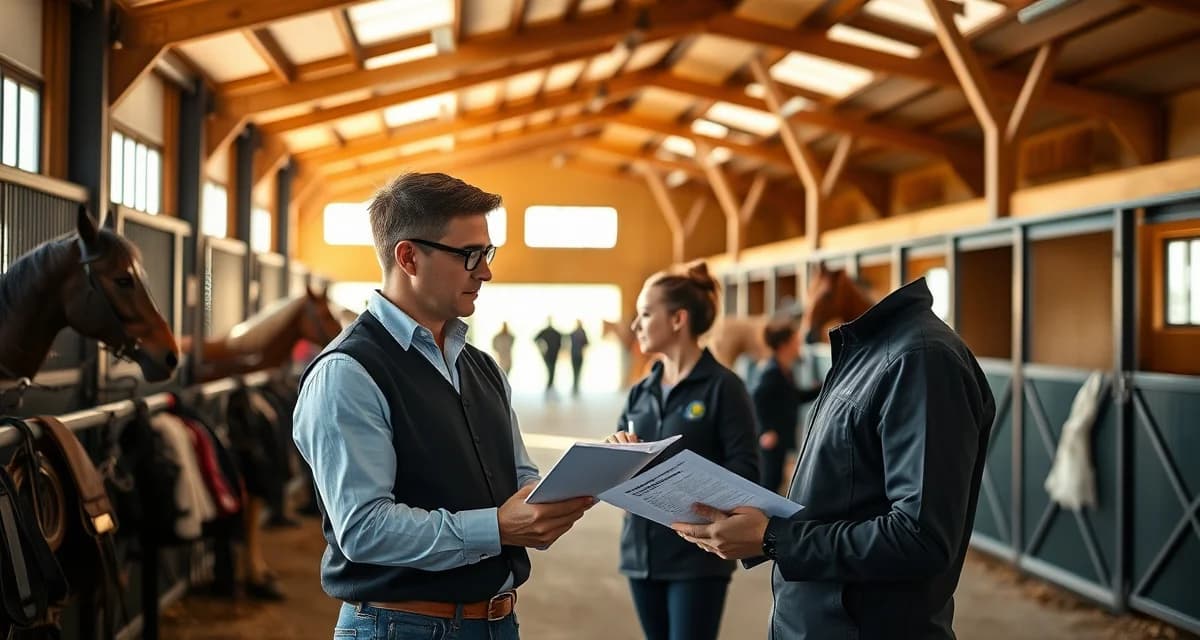
Eventing Barn Staff Management: Complete Guide for Facility Managers
Eventing horses have 3x higher vet call rates than other disciplines, and that statistic is one of many reasons that staff management at an eventing facility requires specific attention. The horses in your barn are under more physical stress, receive more veterinary attention, and have more complex care requirements than horses in most other disciplines. The staff responsible for their daily care need to understand what they're watching for, how to report concerns appropriately, and how to support a training program that spans three distinct phases.
TL;DR
- Staff management at equine facilities is complicated by non-standard hours, physical demands, and high turnover rates.
- Written protocols for every recurring task reduce errors when experienced staff are absent and newer workers cover shifts.
- Shift handover documentation is one of the most overlooked tools for maintaining continuity at multi-staff operations.
- Staff accountability improves when task completion is logged digitally rather than tracked by memory or verbal check-in.
- Training new barn staff is faster when procedures are documented and accessible on a phone rather than passed down verbally.
- BarnBeacon's staff task tools create a timestamped record of who did what and when, across every shift.
This guide covers how to build a staff team at an eventing facility that's trained, accountable, and capable of managing the specific demands of the sport.
The Staff Roles at an Eventing Facility
Eventing trainer. Responsible for all three phases of each horse's development. An experienced eventing trainer understands dressage technique, show jumping, and cross-country riding and fitness conditioning. They manage client relationships, competition planning, and the training program for each horse. Given the higher vet call rate, they also have a closer-than-average relationship with the facility veterinarian.
Assistant trainer or working student. Covers training rides and conditioning work that the head trainer can't get to. At eventing facilities, assistants often ride multiple horses in a day across all three phases, which requires genuine technical breadth. Working students who are developing as riders are common at eventing facilities, and managing their training while getting productive work from them is a specific management task.
Grooms. At eventing facilities, grooms need to understand post-exercise leg checks well enough to catch early signs of trouble. They're often the first person to notice that a horse's leg feels slightly different after a cross-country school. Training your grooms to do a meaningful health observation, and to report what they see accurately, directly affects your facility's health monitoring quality.
Barn staff. Feeding, stall cleaning, and basic care. At smaller eventing operations, grooms and barn staff may be the same people.
Training Your Staff for Eventing-Specific Care
The most important staff investment at an eventing facility is training grooms and barn staff to do meaningful health observations. A groom who can tell the difference between the normal post-work puffiness that clears overnight and a new filling that persists and warrants veterinary attention is an enormous asset.
Leg assessment training. Every groom should learn to palpate lower limbs and recognize normal vs. abnormal: what normal heat feels like, what filling feels like vs. normal soft tissue, and what changes since yesterday mean. This doesn't require veterinary knowledge, just consistent practice with feedback from the trainer.
What to report and how. Grooms and barn staff need clear guidance on what constitutes a reportable observation and who they report to. A chain where groom observes, reports to barn manager, who escalates to trainer if warranted, is cleaner than everyone texting the trainer directly for every minor observation.
Cross-country care protocols. Staff who attend events need to know the specific post-cross-country care protocol: how to cool out a horse properly after a gallop, what to check in the immediate post-course window, and what to do if they see something concerning.
Managing the Competition Calendar from a Staffing Perspective
Eventing competitions require significant staff resources. Depending on how many horses are going to an event, you may need grooms at the venue and a different crew covering the barn at home.
Event staffing assignment. Know well in advance who's going to each event and who's staying home. Build the home coverage plan at the same time you build the event crew assignment.
Competition-week workload. The week before an event is more intense than a normal week. More vet appointments, more farrier work, more preparation tasks. Your staff schedule needs to reflect that reality rather than assuming a standard week.
Post-event recovery management. The week after a major event is when horses (and often staff) are catching up from the intensity of the event. Scheduling reasonable workloads in the post-event week, rather than immediately returning to full programming, protects both horses and people.
Communication Across Shifts
Eventing horses under active health monitoring require consistent, unbroken shift communication. If a horse's legs felt slightly different at evening check and the morning groom doesn't know that, they're checking without context. If a horse was given a medication at 6 PM and the morning person doesn't know, there's a protocol and safety gap.
Build a daily horse log that captures any health observations at each check, any medications given, and any instructions from the trainer or vet. The log needs to be written at the time, readable by the next shift, and accessible to the trainer without requiring a phone call.
Using Software for Eventing Staff Management
BarnBeacon's barn management software includes task management and shift communication tools that let managers assign daily horse care tasks to specific staff members, track completion, and maintain a running log of health observations across shifts. For eventing facilities where post-exercise health checks are a critical daily task, the ability to log and track those checks digitally creates accountability and a historical record.
For a full view of how staff management connects to eventing facility operations, see the eventing barn operations guide.
Frequently Asked Questions
How do eventing barn managers handle staff management?
The most effective eventing barn managers invest significantly in training grooms to do meaningful health observations, create clear reporting chains for concerning findings, and plan competition staffing well in advance. Cross-shift communication through daily logs is particularly important given the higher health monitoring activity at eventing facilities.
What software do eventing facilities use for staff management?
Eventing facilities benefit from task assignment and completion tracking tools that create accountability for the daily health monitoring tasks that are critical at high-vet-call-rate facilities. BarnBeacon's staff management module supports task assignment, shift communication, and health observation logging.
What are the unique staff management challenges at eventing barns?
The 3x higher vet call rate means groom-level health observation is more important at eventing facilities than at most others: grooms who can do meaningful leg checks and report accurately are a genuine competitive advantage. Competition staffing coordination across events and home coverage is also more complex at eventing facilities that compete frequently.
How do I reduce errors during shift transitions at my barn?
Shift handover should follow a consistent written format that covers any health concerns observed during the outgoing shift, any horses that need monitoring, unfinished tasks, and any owner communications that are pending. A digital shift log that both the outgoing and incoming staff member review reduces the chance that important information is passed verbally and forgotten. Facilities with documented shift handover protocols report fewer missed medications and care tasks than those relying on verbal transfers.
What is a reasonable number of horses per barn staff member?
The standard ratio depends on the level of care: full-care boarding with individualized feeding and turnout typically supports 8 to 12 horses per staff member per shift. Facilities with significant show preparation, rehabilitation, or high-touch care needs may require lower ratios. Facilities where care is more uniform, such as pasture-board operations, can support higher ratios. Tracking task completion times in a digital system gives managers real data to evaluate whether staffing ratios are appropriate.
How do I build written protocols that staff actually follow?
Protocols are followed when they are specific, accessible, and tied to accountability. A protocol that says 'check water daily' is less followed than one that says 'check and refill all water buckets during morning rounds and log completion by 8 AM.' Making protocols accessible from a phone eliminates the excuse that the binder was in the office. Timestamped completion logging in a barn management system creates the accountability layer that makes written protocols more than suggestions.
What is Eventing Barn Staff Management: Complete Guide for Facility Managers?
This guide is a comprehensive resource for facility managers overseeing eventing barns. It covers the unique staffing challenges that come with managing horses competing across dressage, cross-country, and show jumping phases. Because eventing horses experience significantly higher physical stress and veterinary call rates than other disciplines, the guide addresses written protocols, shift handover documentation, digital task logging, and onboarding practices designed to maintain consistent, high-quality care across every shift and staff level.
How much does Eventing Barn Staff Management: Complete Guide for Facility Managers cost?
The guide itself is free to read on BarnBeacon. The staff management tools it references — including digital task tracking, shift handover logs, and timestamped completion records — are available through BarnBeacon's platform. Pricing depends on your facility size and the plan you choose. Visit BarnBeacon.com to review current pricing options and find a tier that fits your operation, whether you manage a small private yard or a large multi-staff eventing facility.
How does Eventing Barn Staff Management: Complete Guide for Facility Managers work?
The guide walks facility managers through building a structured staffing system tailored to eventing's demands. It explains how to create written protocols for recurring tasks, implement shift handover documentation to maintain continuity between staff, and use digital logging so task completion is recorded automatically. BarnBeacon's tools underpin this system by generating a timestamped record of who completed each task and when, reducing reliance on memory, verbal check-ins, or experienced staff always being present.
What are the benefits of Eventing Barn Staff Management: Complete Guide for Facility Managers?
Key benefits include reduced care errors through written protocols, faster onboarding of new staff using documented procedures accessible on a phone, and improved accountability through digital task logs. Shift handover documentation ensures nothing is missed between staff changes. For eventing facilities specifically, where horses require complex tri-phase care and have elevated vet call rates, these systems help maintain the consistent monitoring and reporting standards that keep horses healthy and competition-ready year-round.
Who needs Eventing Barn Staff Management: Complete Guide for Facility Managers?
This guide is essential for anyone managing staff at an eventing facility — from professional yard managers at large competition yards to owner-operators with part-time help. If your barn houses horses competing or training across dressage, cross-country, and show jumping, your care protocols need to reflect that complexity. It is especially valuable for facilities experiencing high staff turnover, inconsistent shift coverage, or gaps in communication between morning and evening teams.
Related Articles
- Endurance Barn Staff Management: Complete Guide for Facility Managers
- Hunter/Jumper Barn Staff Management: Complete Guide for Facility Managers
Sources
- Certified Horsemanship Association (CHA), equine facility manager credentialing and training
- American Horse Council, equine workforce and industry employment data
- Equine Business Association, professional development resources for equine facility managers
- Pennsylvania State University Extension, equine business and facility management programs
- Bureau of Labor Statistics, occupational outlook data for agricultural and animal care occupations
Get Started with BarnBeacon
BarnBeacon gives barn staff a mobile task interface designed for barn environments, with timestamped completion logging that creates accountability across every shift without micromanagement. Start a free 30-day trial and see how it fits your team's workflow.