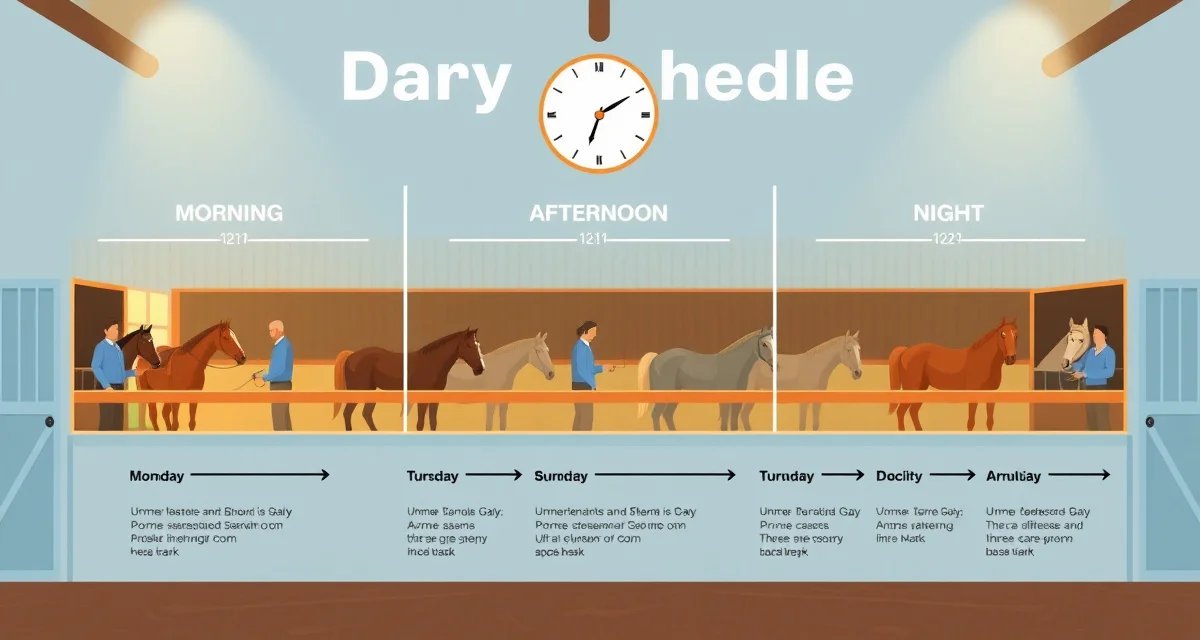
Horse Barn Shift Types: AM, PM, Night, and Split Shifts Explained
There's no universal shift structure for horse barns. A 15-horse private barn with two working students runs completely differently from a 100-horse commercial boarding facility with full-time staff and 24-hour coverage.
TL;DR
- Staff-to-horse ratios at boarding barns typically run 1 staff member per 8 to 15 horses depending on care level
- Clear task assignment with named accountability reduces both missed tasks and blame disputes between staff members
- Written shift handover protocols prevent the verbal information gaps where health changes go unreported between crews
- Staff turnover at equine facilities averages 35-40% annually; onboarding systems that document care protocols reduce the cost of each transition
- Digital task logs tell managers which tasks are consistently late or missed, enabling coaching before problems escalate
- staff communication tools that separate horse care updates from administrative messages reduce information overload
The shift structure you choose shapes everything: who knows what, when tasks get done, and how you catch problems before they become emergencies. Picking the wrong structure, or running the right structure without the right handover process, is how horses get missed.
Here's a breakdown of every shift type used in professional horse facilities, what they're suited for, and how to make each one work.
The AM Shift
The morning shift is the anchor of every barn's daily operations. It's when the most work happens and when the most observations are collected.
Typical AM shift hours: 6am–12pm or 6am–1pm
Standard AM tasks:
- First feeding (hay, grain, supplements)
- Health observations for every horse, attitude, appetite, manure in stall overnight, any visible physical changes
- stall cleaning protocols or mucking
- Turnout, moving horses to pastures or paddocks
- Water check, buckets filled and clean
- Any morning medications (pergolide, NSAIDs, daily supplements)
- Barn aisle sweep and organization
- Farrier or vet arrival coordination if scheduled
Why the AM shift sets the tone:
What the morning person observes, and documents, determines how the whole day goes. A horse that ate half her breakfast and has loose manure in the back corner of her stall might be fine by noon, or she might be starting a colic. The AM person's observation is the baseline every subsequent shift measures against.
In BarnBeacon, the AM shift log captures all observations with a timestamp, flags any abnormals, and makes that information available to every staff member for the rest of the day. When the afternoon person walks in, they don't need to be briefed, they open the app and see what the morning saw.
Who does AM: Your most experienced person, ideally. The AM person makes the most decisions about which horses need attention, which observations to flag, which calls to escalate.
The PM Shift
The afternoon/evening shift picks up where the morning left off and gets the barn ready for the night.
Typical PM shift hours: 12pm–6pm or 1pm–7pm
Standard PM tasks:
- Turnout return, bringing horses in from pastures
- Second feeding (afternoon or evening grain, supplements)
- Water bucket refill
- Any PM medications
- Health observations, comparison against AM flag notes
- Blanketing as temperature drops
- Night hay distributed
- Aisle check, equipment put away
- Night check preparation if there's no overnight staff
The PM person's most critical role:
Acting on what the AM person saw. If a horse was flagged for reduced appetite in the morning, the PM person needs to actively look at that horse and assess how they're doing. This requires the AM observations to actually reach the PM person, which is why verbal-only handovers fail.
A horse that was slightly off in the morning and still off by evening needs a veterinary call. A horse that was off in the morning but is eating well by evening is probably fine. That comparison only happens if both observations are documented and connected.
PM shift challenges:
The PM shift often runs with fewer staff than the AM. Light is fading, horses are being brought in, and the barn is busy with boarders arriving to ride. This is when things get skipped, not out of negligence but because there's a lot happening at once.
BarnBeacon's task list for the PM shift shows exactly what needs to happen in priority order. If you're short-staffed, the shift lead knows which tasks are time-critical (medications, water) and which can slip to the first thing in the morning.
The Night Shift / Night Check
Not all barns have overnight staff. For facilities that do, the night shift covers the hours between last PM tasks (typically 8–10pm) and the start of the AM shift (typically 5–7am).
Two types of night coverage:
Night check (not overnight): A staff member comes in once between 10pm–12am to do a final walk through. Checks every horse is standing or resting normally, no signs of colic or distress, water buckets adequate, blankets secure. Takes 30–45 minutes for a 40-horse barn. Then they go home.
Overnight shift: A staff member on-site from late evening through early morning. Common for breeding farms (foaling watch), facilities with horses post-surgery or in critical care, and high-end competition barns.
What to log on night check:
- Any horse showing signs of distress, pawing, or abnormal position
- Any horse not at their hay (particularly unusual for a horse who normally eats overnight)
- Water bucket status
- Temperature check, is it cold enough to have blankets on horses that don't have them?
- Any facility issues (loose latch, water line frozen, light out in a stall)
Night check observations in BarnBeacon are timestamped. If a horse that was fine at the 11pm night check is found in distress at the 6am AM shift, you have a 7-hour window to work with rather than a complete unknown. That information matters enormously for veterinary response.
Foaling watch as an extended night shift:
For breeding farms in foaling season, the night shift expands to continuous monitoring of mares in late gestation. BarnBeacon's foaling protocol includes timed observation alerts and a structured foaling record that captures onset time, duration, any complications, and foal assessments in the critical first hours.
The Split Shift
A split shift is a single workday divided into two separate blocks, typically early morning and evening, with hours off in the middle of the day.
Example split shift: 6am–10am, then 4pm–8pm
Why barns use split shifts:
Split shifts match the high-activity periods of the horse day (early morning feeding and turnout, evening return and feeding) without paying for staff to be present during the slower midday hours. For small barns where the barn manager can't afford full-time help, a split shift from one employee covers both feedings without requiring a second person.
The challenge of split shifts:
There's a 6-hour gap in the middle of the day where nobody is on shift. Anything that happens between 10am and 4pm, a horse in distress, a water line failure, a fence breach, may not be noticed until the evening shift starts.
If your barn runs split shifts without midday coverage, you need:
- Automatic or timed waterers that can go 6 hours without human intervention
- Pasture horses that can be observed from a distance (cameras help here)
- A clear escalation contact for the barn manager or owner if something is noticed by a boarder
Split shift handovers:
The split shift worker does their morning tasks and logs out. When they return for the evening block, they review what happened in the 6-hour window (anything entered by other staff or by the owner/barn manager checking in) before starting evening tasks. BarnBeacon's shift log supports this by maintaining a continuous record that the same person can return to after hours away.
Three-Shift Coverage (AM / PM / Night)
A 40–100+ horse facility may run three distinct shifts with separate staff on each.
Typical structure:
- AM shift: 6am–2pm (or 6am–1pm with overlap)
- PM shift: 1pm–9pm (or 2pm–8pm)
- Night shift: 9pm–6am
The advantage: Complete coverage, no gap periods, someone on-site at all times.
The complexity: Three shift transitions per day. Three points where information must be correctly transferred. In a barn with high horse count and active health management, any one of those transitions can drop a critical observation.
BarnBeacon for three-shift barns operates as a continuous log. The PM person who starts at 1pm doesn't need to call the AM person to find out what happened, they open the app and see the complete AM summary. The Night person who comes in at 9pm does the same.
Shift lead structure for three-shift barns:
Each shift needs a designated lead who owns the handover. In BarnBeacon, the shift lead completes the handover log at the end of their shift, confirming all tasks completed or noting what's been left for the next shift and why.
Flexible and Irregular Shifts
Some barns, particularly those with working students, part-time staff, or event-based schedules, don't run fixed shifts at all. Staff come in for specific tasks (feeding, turnout, riding) at irregular times.
Why this creates problems:
When there's no consistent shift structure, nobody owns the whole picture. Task completion is fragmented across multiple people, and the shift handover concept breaks down entirely.
What to do instead:
Even without formal shifts, build in two structured observation moments per day, one in the morning when the first person arrives, one in the evening before the last person leaves. These two observations give you the AM/PM health record you need and create a minimum accountability structure.
BarnBeacon supports this through daily task templates that trigger regardless of who's working. Whoever is there for the morning observation completes the morning template. Whoever is there for the evening observation completes the evening template. The record is still structured even if the staff schedule isn't.
Choosing the Right Shift Structure for Your Barn
| Barn Type | Recommended Shift Structure |
|-----------|----------------------------|
| Under 20 horses, 1–2 staff | AM/PM split shift, or two-person coverage |
| 20–50 horses, 3–5 staff | AM shift + PM shift, night check by AM lead |
| 50–100 horses, 6–10 staff | AM/PM shifts + dedicated night check person |
| 100+ horses | Three-shift coverage with shift leads |
| Breeding farm in foaling season | AM/PM + continuous overnight foaling watch |
| Show barn | AM/PM + event-based additional coverage around show weekends |
How does BarnBeacon compare to spreadsheets for barn management?
Spreadsheets require manual updates, lack real-time notifications, and create version control problems when multiple staff members are working from different files. BarnBeacon centralizes records, pushes alerts automatically based on logged events, and connects care records to billing and owner communication in one system. Most facilities report saving several hours per week after switching from spreadsheets.
What is the setup process like for BarnBeacon?
Most facilities complete the initial setup in under a week. Horse profiles, service templates, and billing configurations can be imported from existing records or entered directly. BarnBeacon's US-based support team is available to assist with setup, and most managers are running their first billing cycle through the platform within days of starting.
Can BarnBeacon support a barn with multiple staff members?
Yes. BarnBeacon supports multiple user accounts with role-based access, so barn managers, barn staff, and owners each see the information relevant to their role. Task assignments, completion logs, and communication history are all attached to the barn's account rather than to individual staff phones or email addresses.
FAQ
What is Horse Barn Shift Types: AM, PM, Night, and Split Shifts Explained?
Horse barn shift types refer to the structured work schedules used to organize staff coverage at equine facilities. The four main types — AM, PM, night, and split shifts — divide daily horse care tasks across teams or individuals. Each shift type determines who feeds, checks, and handles horses at specific times. The right structure depends on facility size, horse count, and care level required, ranging from small private barns with two staff to large commercial boarding operations with round-the-clock coverage.
How much does Horse Barn Shift Types: AM, PM, Night, and Split Shifts Explained cost?
Understanding horse barn shift structures costs nothing — it's operational knowledge every barn manager and working student benefits from. Implementing a formal shift system may require investment in scheduling software or digital task logs, but the foundational concepts are free to apply. The real cost savings come from reduced missed tasks, lower staff turnover friction, and catching health issues earlier. Facilities running structured shifts with written handover protocols typically avoid the expensive mistakes that come from informal, verbal-only communication between crews.
How does Horse Barn Shift Types: AM, PM, Night, and Split Shifts Explained work?
Horse barn shift systems work by dividing the day into defined coverage windows — typically AM (early morning feed and turnout), PM (afternoon checks and evening feed), night (overnight monitoring), and split shifts (two shorter windows with a midday break). Each shift has assigned tasks, named staff accountability, and a handover process where outgoing staff document horse status, health changes, and incomplete tasks for the incoming crew. Digital task logs or written protocols ensure nothing falls through the gaps between shifts.
What are the benefits of Horse Barn Shift Types: AM, PM, Night, and Split Shifts Explained?
A structured shift system improves horse health outcomes by ensuring consistent care timing and reducing missed checks. It creates clear staff accountability, cutting down on blame disputes when tasks are skipped. Written handover protocols close the verbal communication gaps where early signs of colic, injury, or illness go unreported. Managers gain visibility into which tasks are consistently late, enabling proactive coaching. For facilities with high staff turnover — averaging 35–40% annually in equine settings — documented shift protocols also dramatically reduce onboarding time and cost.
Who needs Horse Barn Shift Types: AM, PM, Night, and Split Shifts Explained?
Any horse facility with more than one staff member benefits from a defined shift structure. This includes private boarding barns, training yards, breeding operations, rehabilitation centers, and competition stables. Working students and part-time grooms need clear shift expectations just as much as full-time employees. Facilities with 24-hour horse monitoring requirements — such as foaling barns or post-surgery recovery yards — specifically need night shift protocols. Barn managers struggling with missed tasks, staff conflict, or inconsistent care are the most immediate candidates for formalizing their shift structure.
How long does Horse Barn Shift Types: AM, PM, Night, and Split Shifts Explained take?
Designing a shift structure for your barn typically takes one to two focused planning sessions once you understand the four core shift types. Implementing it — including writing task lists, setting handover protocols, and training staff — usually takes one to two weeks for a small facility and longer for larger operations. The learning curve for staff adjusting to new accountability systems is typically two to four weeks. Digital tools that replace verbal handovers can be fully adopted within a month with consistent management follow-through.
What should I look for when choosing Horse Barn Shift Types: AM, PM, Night, and Split Shifts Explained?
When evaluating shift structures, consider your horse-to-staff ratio (industry standard is 1 staff per 8–15 horses depending on care level), the specific care needs of your horses, and whether you require 24-hour coverage. Look for a structure that supports written handover protocols, not just verbal updates. Prioritize named task accountability over general shift duties. Ensure your chosen structure scales — what works at 15 horses may break down at 40. Also assess whether staff communication tools can separate horse care updates from administrative messages to reduce information overload.
Is Horse Barn Shift Types: AM, PM, Night, and Split Shifts Explained worth it?
Yes — for any barn where horse welfare depends on consistent, coordinated staff care, understanding and implementing a formal shift structure is absolutely worth it. The cost of a missed colic check, a skipped medication dose, or a health change that goes unreported between crews far exceeds any investment in scheduling systems or training time. Facilities that document shift protocols also handle staff turnover with less disruption. If your current system relies entirely on verbal handovers and individual memory, formalizing your shift structure is one of the highest-leverage operational changes you can make.
Sources
- American Association of Equine Practitioners (AAEP)
- American Horse Council
- Kentucky Equine Research
- UC Davis Center for Equine Health
- Penn State Extension Equine Program
Get Started with BarnBeacon
Staff accountability and care continuity depend on systems that work even when the barn manager is not present. BarnBeacon gives equine facilities the task assignment, completion logging, and shift handover tools to maintain care standards across every shift and through every staffing change. Start a free trial and see what your task completion picture looks like after two weeks on the platform.