AI Horse Health Anomaly Detection for Barn Managers
Medication errors are the third leading cause of preventable horse death, according to the American Association of Equine Practitioners. That statistic sits in the background of every barn manager's day, whether they're running a 6-horse private facility or a 60-stall commercial operation.
TL;DR
- Health observations logged at the point of care, not reconstructed at shift end, are the only reliable clinical record
- Daily baseline documentation for each horse creates the comparison point that makes anomaly detection meaningful
- medication tracking must include product name, dose, route, and withdrawal period for any horse in a regulated program
- Vet instructions delivered verbally during farm visits are frequently misremembered; written confirmation before the vet leaves is the standard
- Health alert protocols should remove judgment calls from staff: define triggers in writing so action is automatic
- Owner notification within 30 minutes of a health event, including a documented timeline, reduces disputes and builds confidence
AI horse health anomaly detection changes the equation. Instead of relying on memory, whiteboards, or spreadsheet rows that don't push alerts, modern barn management software watches for deviations in health patterns and flags them before a missed dose or early colic sign becomes a crisis.
The Problem Spreadsheets and Basic Software Can't Solve
Most barns still track medications and health observations in one of two ways: a paper log on the feed room wall or a shared spreadsheet. Both have the same fatal flaw. They're passive. They record what happened but never tell you what's about to go wrong.
A horse that missed its evening Omeprazole dose doesn't send a notification. A mare whose water intake dropped 30% over three days doesn't flag itself in a Google Sheet. The information exists, but no one is watching it continuously enough to catch the pattern.
Basic medication modules in some platforms offer a step up, but often stop at a simple checklist. You can log that a dose was given, but the system won't alert you if it wasn't, won't identify which staff member administered it, and won't correlate that missed dose with a behavioral change noted in the daily observation log two days later.
That gap is exactly where AI horse health anomaly detection earns its place in a barn management workflow.
What AI Anomaly Detection Actually Does
The term "AI" gets applied loosely in equine software marketing. In the context of health monitoring, it refers to a specific set of functions: pattern recognition across multiple data streams, threshold-based alerting, and trend analysis that surfaces problems a human reviewer might miss.
Here's what that looks like in practice.
Pattern Recognition Across Health Data
A horse's baseline is not a single number. It's a composite of dozens of variables: resting heart rate, gut sounds, manure output, water consumption, appetite scores, exercise tolerance, and behavioral observations logged by staff during daily checks.
AI anomaly detection ingests all of those data points and builds an individual baseline for each horse. When any variable drifts outside that horse's normal range, the system flags it. This is meaningfully different from a static threshold (e.g., "alert if temperature exceeds 101.5°F") because it accounts for individual variation. A Thoroughbred that normally drinks 12 gallons a day is showing a different signal at 8 gallons than a draft horse whose baseline is 10.
Alert Thresholds and How They're Configured
Good equine health monitoring software lets barn managers set alert thresholds at two levels: population-level defaults based on veterinary standards, and individual overrides for horses with known conditions.
A horse recovering from laminitis might have a custom threshold for digital pulse strength. A horse with a history of gastric ulcers might trigger an alert at a lower appetite deviation than the barn average. These configurations should be adjustable by the barn manager and ideally reviewed with the attending veterinarian during setup.
Thresholds typically cover:
- Temperature: Alert outside 99-101.5°F standard range, or custom per horse
- Heart rate: Alert above 44 BPM at rest for more than two consecutive checks
- Respiratory rate: Alert above 20 breaths per minute at rest
- Gut sounds: Alert on two consecutive "absent" or "reduced" observations
- Water intake: Alert on greater than 20% deviation from 7-day rolling average
- Manure output: Alert on zero output for more than 12 hours
- Appetite score: Alert on two consecutive scores below 50% of normal intake
Early Warning for Colic
Colic is the leading cause of death in horses, and early detection is the single most important factor in survival outcomes. Research published in the Equine Veterinary Journal found that horses treated within two hours of colic onset had significantly better outcomes than those where treatment was delayed beyond four hours.
AI anomaly detection contributes to early colic identification by correlating multiple soft signals before any single one crosses a hard threshold. A horse that's slightly off feed, has reduced gut sounds on the left flank, and has been observed pawing twice in the last six hours is showing a pattern. A human reviewing three separate log entries might not connect them. An AI system watching all three streams simultaneously will.
The alert that reaches the barn manager's phone at 11 PM isn't "your horse has colic." It's "three health indicators for Copper are outside normal range in the last 8 hours. Review recommended." That's the right level of signal: specific enough to act on, calibrated enough not to create alert fatigue.
Illness Detection Beyond Colic
Colic gets the most attention, but AI anomaly detection applies equally to respiratory illness, musculoskeletal issues, and metabolic conditions.
A horse developing a respiratory infection will often show a temperature elevation of 0.5-1°F for 24-48 hours before other clinical signs appear. If staff are logging temperature twice daily and the system is tracking the trend, that early signal is catchable. Without trend analysis, a temperature of 100.8°F looks normal in isolation. In the context of a 0.6°F rise over 36 hours, it's a flag.
Similarly, a horse with early-stage laminitis may show changes in weight distribution and movement reluctance before obvious lameness develops. If the barn uses a standardized movement observation scale and staff are logging daily, the system can detect a downward trend before the horse is visibly lame.
How BarnBeacon Approaches Anomaly Detection
BarnBeacon was built around a specific operational insight: the most dangerous moment in barn health management is the gap between when something should happen and when someone notices it didn't.
That insight drives two core features that distinguish the platform from basic medication modules.
Automatic Alerts Before Missed Doses
BarnBeacon sends automatic alerts before a dose window closes, not after it's missed. If a horse is scheduled for a 6 PM Pergolide administration and no administration has been logged by 5:45 PM, the assigned staff member receives a push notification. If the dose is still unlogged at 6:15 PM, the barn manager receives a secondary alert.
This is a fundamentally different model than a checklist you review at the end of the day. The alert is proactive, time-sensitive, and escalating. It treats a missed dose as an active risk, not a historical record.
For barn managers overseeing medication tracking across multiple horses and multiple daily administration windows, this alert architecture is the difference between catching a missed dose in real time and discovering it during a weekly audit.
Staff ID Logging on Every Administration
Every medication administration logged in BarnBeacon is tied to a staff ID. The record shows who administered the dose, at what time, and any notes they added. This creates an unbroken chain of accountability that serves three purposes.
First, it eliminates the "I thought you did it" problem that causes duplicate or missed doses in multi-staff barns. Second, it provides the barn manager with visibility into which staff members are consistently logging on time and which may need additional training or reminders. Third, it creates a complete medication audit trail that satisfies insurance documentation requirements and supports veterinary case reviews.
When a horse has a health event, the attending veterinarian can review the full medication history with timestamps and staff attribution. That context is often clinically relevant and is simply not available from a paper log or a basic checklist module.
Feature Breakdown: What to Look for in Equine Health Monitoring Software
Not all platforms that claim AI horse health anomaly detection deliver the same capabilities. Here's what to evaluate when comparing options.
Real-Time Data Ingestion
The system should accept health observations as they're logged, not batch-process them overnight. A colic alert that fires 12 hours after the relevant observations were entered is not useful. Look for platforms where staff can log observations from a mobile device in the stall and the system processes that data immediately.
Multi-Horse Dashboard
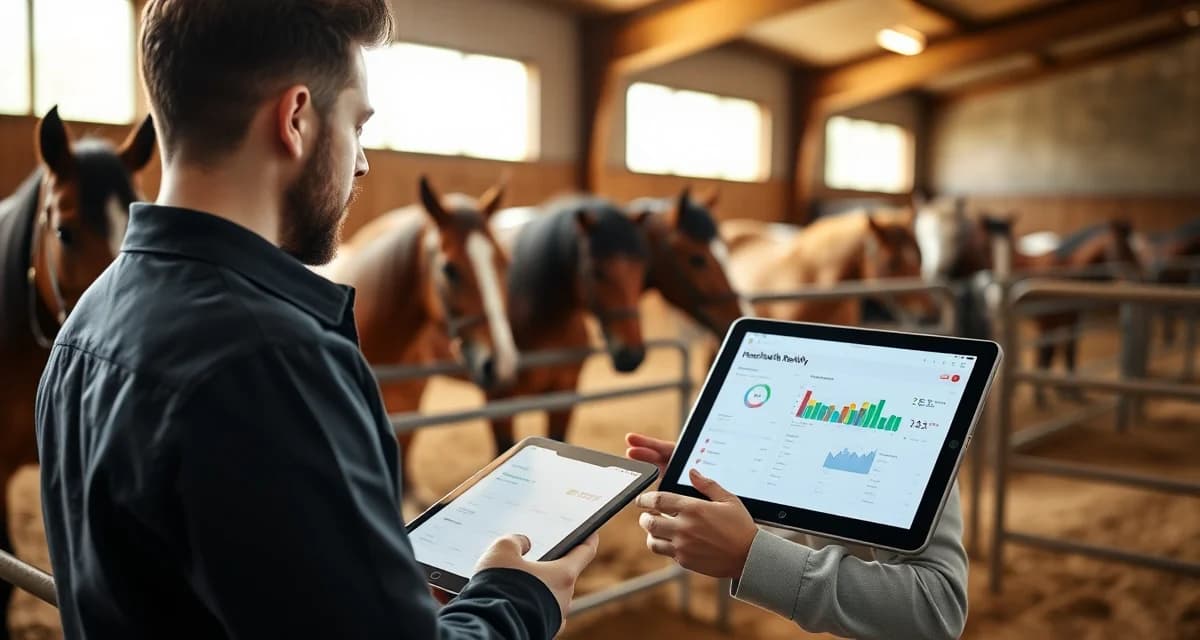
Barn managers are not monitoring one horse. They need a single view that shows the current health status of every horse in the barn, with visual indicators for any animals with active alerts or recent anomalies. Drilling into an individual horse record should be one tap from that dashboard.
Vet Integration and Scheduling
Anomaly detection is only valuable if it connects to action. The platform should allow barn managers to initiate a vet contact or schedule an examination directly from an alert. BarnBeacon's integration with vet scheduling means that when an alert fires, the barn manager can request a veterinary visit without leaving the platform, and the vet receives the relevant health data automatically.
Configurable Alert Routing
Different alerts should reach different people. A missed medication dose should alert the assigned staff member first, then the barn manager. A temperature spike should alert the barn manager and optionally the horse's owner. A pattern suggesting early colic should alert the barn manager and trigger an automatic prompt to contact the vet.
Alert routing that can't be configured by role and severity will either under-notify or create noise that staff learn to ignore.
Historical Trend Reporting
The system should generate health trend reports for individual horses over configurable time periods. These reports are useful for veterinary consultations, for tracking the effectiveness of a treatment protocol, and for identifying seasonal patterns in a horse's health.
A horse that shows respiratory anomalies every spring may have an environmental allergy. That pattern is invisible in a paper log. It's visible in 24 months of trend data.
Comparison: Spreadsheets vs. Basic Software vs. AI Anomaly Detection
| Capability | Spreadsheet | Basic Barn Software | AI Anomaly Detection |
|---|---|---|---|
| Medication logging | Manual entry | Checklist | Timestamped, staff ID |
| Missed dose alerts | None | End-of-day review | Real-time, escalating |
| Health observation tracking | Manual | Basic notes | Structured, multi-variable |
| Pattern recognition | None | None | Automated, per-horse baseline |
| Colic early warning | None | None | Multi-signal correlation |
| Audit trail | Partial | Basic | Complete, attributed |
| Vet integration | None | Limited | Direct scheduling |
| Mobile access | Limited | Varies | Full mobile logging |
The gap between a spreadsheet and AI anomaly detection is not incremental. It's the difference between a passive record and an active monitoring system.
Implementation: Getting Your Barn Set Up
Step 1: Build Your Horse Health Profiles
Before anomaly detection can identify deviations, it needs baselines. During onboarding, enter each horse's known health history, current medications, and any conditions that affect normal vital sign ranges. If you have historical vet records, import or manually enter the relevant data points.
Plan for two to four weeks of baseline data collection before the system's pattern recognition is fully calibrated. During this period, staff should log observations consistently and completely.
Step 2: Configure Medication Schedules
Enter every current medication for every horse: drug name, dose, frequency, administration route, and the staff member responsible for each administration window. Set alert timing based on your barn's workflow. Most barns find a 15-minute pre-window alert and a 10-minute post-window escalation works well.
Step 3: Set Alert Thresholds
Start with the system defaults, which are based on standard veterinary reference ranges. Then work through each horse with known conditions and apply individual overrides. Your veterinarian should be involved in setting thresholds for horses with complex health histories.
Step 4: Train Staff on Mobile Logging
The system is only as good as the data going in. Staff need to log observations at the time they're made, not at the end of a shift. Mobile logging from the stall is the key behavior to establish. Run a two-week training period where the barn manager reviews logging completeness daily and provides feedback.
Step 5: Review and Refine Alert Settings
After 30 days, review your alert history. If you're seeing frequent false positives for a particular horse, adjust that horse's thresholds. If alerts are firing too late to be actionable, tighten the pre-window timing. Anomaly detection systems improve with tuning.
Common Mistakes Barn Managers Make with Health Monitoring Software
Logging observations in batches at the end of the day. This defeats the purpose of real-time anomaly detection. A colic pattern that develops at 2 PM and is logged at 8 PM has lost six hours of response time.
Setting thresholds too wide to avoid alerts. Alert fatigue is real, but the solution is better threshold calibration, not wider ranges. Work with your vet to set thresholds that are clinically meaningful for each horse.
Not assigning staff IDs to every user. Shared logins eliminate the accountability that makes medication audit trails useful. Every staff member should have their own login.
Skipping the baseline period. Turning on anomaly detection without adequate baseline data produces unreliable alerts. Give the system time to learn each horse's normal before relying on its flags.
Not connecting alerts to action protocols. An alert that fires but has no defined response protocol is just noise. Before going live, define exactly what staff should do when each type of alert fires.
What is the best way to track horse medications in a barn?
The most reliable method combines structured digital logging with automated alerts. A dedicated medication tracking system that requires staff to log each administration with a timestamp and their staff ID eliminates the ambiguity of paper logs and shared spreadsheets. The critical feature is proactive alerting: the system should notify staff before a dose window closes, not after it's been missed. For multi-horse barns, a platform like BarnBeacon that handles medication tracking across the full barn roster with per-horse schedules and escalating alerts is significantly more reliable than any manual system.
How do I set medication reminders for multiple horses?
In BarnBeacon, you configure each horse's medication schedule individually: drug, dose, frequency, administration window, and responsible staff member. The system then generates reminders automatically based on those schedules. For a barn with 20 horses and multiple daily administration windows, this means the system is managing dozens of reminder triggers simultaneously without any manual intervention. Alert routing can be configured so that the assigned staff member receives the first reminder and the barn manager receives an escalation if the dose goes unlogged past the window.
Does barn management software create a medication audit trail?
Yes, when the software is designed to require staff attribution on every log entry. BarnBeacon records the staff ID, timestamp, dose administered, and any notes for every medication event. This creates a complete, unalterable audit trail that can be exported for veterinary consultations, insurance claims, or ownership records. Basic checklist-style modules in some platforms log that a dose was given but not who gave it or exactly when, which limits the audit trail's usefulness. A full audit trail is also essential for vet scheduling and case reviews, where the attending veterinarian needs to understand the complete medication history in context.
How should a barn manager respond when a horse's health observation is outside normal baseline?
Log the observation immediately with the time, specific findings, and the staff member's name. Contact the attending veterinarian if the deviation is outside the parameters defined in the horse's care plan. Notify the owner in writing, including what was observed and what action was taken. This sequence creates a defensible record and demonstrates appropriate professional response.
What should every horse's health record include at minimum?
At minimum, a horse's health record should include vaccination dates and products, deworming history, dental exam dates, farrier schedule, medication logs with product and dose, and any veterinary findings or diagnoses. For horses in regulated disciplines, drug testing withdrawal periods for recent treatments must also be tracked. A record that cannot be produced quickly during an inspection or a dispute is effectively no record at all.
How often should vital signs be checked for horses on stall rest or recovery programs?
Vital signs for stall rest or recovery horses should be checked at every feeding, at minimum twice daily. For horses in acute recovery or following surgery, more frequent checks may be required; follow the veterinarian's written protocol. Log temperature, respiration, and heart rate each time and flag any reading outside baseline before the next check.
FAQ
What is AI Horse Health Anomaly Detection for Barn Managers?
AI horse health anomaly detection is software that continuously monitors each horse's health data—vital signs, behavior patterns, feeding habits, and daily observations—and automatically flags deviations from that individual horse's established baseline. Rather than relying on staff memory or end-of-shift notes, the system watches for early warning signs in real time. Barn managers receive alerts when something looks off, allowing faster intervention before minor issues escalate into emergencies or medication errors occur.
How much does AI Horse Health Anomaly Detection for Barn Managers cost?
Pricing varies widely based on herd size and feature set. Entry-level barn management platforms with basic health tracking start around $30–$80 per month, while AI-driven anomaly detection modules designed for commercial operations can run $150–$500 per month or more. Most providers price per stall or per horse. Given that a single colic episode can cost $5,000–$10,000 or more to treat, many barn managers find even premium-tier software pays for itself after preventing one serious health event.
How does AI Horse Health Anomaly Detection for Barn Managers work?
The system establishes a unique health baseline for each horse by analyzing logged observations over time—temperature, gut sounds, appetite, manure output, gait, and behavior. Once a baseline exists, the AI compares each new data point against it and flags statistically significant deviations. Staff log observations at the point of care via a mobile app, and the platform processes that input continuously, pushing alerts to designated contacts when patterns suggest illness, injury, or medication inconsistency rather than normal variation.
What are the benefits of AI Horse Health Anomaly Detection for Barn Managers?
Key benefits include earlier detection of health problems, reduced medication errors through structured tracking with dose and withdrawal period fields, automatic owner notifications with documented timelines, and elimination of verbal-only vet instruction gaps. Staff no longer make judgment calls about whether something warrants escalation—the system defines the threshold and acts automatically. Consistent documentation also creates a defensible clinical record if liability questions arise, which is particularly valuable for boarding facilities and horses in regulated competition programs.
Who needs AI Horse Health Anomaly Detection for Barn Managers?
Any barn manager responsible for multiple horses benefits, but the strongest use cases are commercial boarding facilities, training barns, breeding operations, and competition yards where staff rotate across shifts. A missed observation at shift change is one of the most common points of failure in equine care. Facilities running 10 or more horses, or any operation where the owner is off-site, gain the most value because the system provides continuity of monitoring that no single employee can sustain alone.
How long does AI Horse Health Anomaly Detection for Barn Managers take?
Setup typically takes one to four weeks. The first phase involves entering each horse's profile and current health baselines. The AI then requires two to six weeks of consistent daily observations to build a reliable individual baseline before anomaly detection becomes meaningfully accurate. Staff training on mobile logging usually takes one shift. Facilities that already maintain structured health records transition faster. Plan for 30–60 days before the system is operating at full predictive value rather than expecting immediate anomaly detection on day one.
What should I look for when choosing AI Horse Health Anomaly Detection for Barn Managers?
Look for point-of-care mobile logging so observations are recorded in the moment, not reconstructed later. Confirm the system tracks medication by product name, dose, route, and withdrawal period. Evaluate whether alert thresholds are configurable per horse rather than using generic population averages. Check that owner notification is built in with timestamped logs. Ask whether vet instruction documentation is supported. Finally, confirm the platform integrates with your existing workflow rather than requiring a full operational overhaul to get value from the core health monitoring features.
Is AI Horse Health Anomaly Detection for Barn Managers worth it?
For most commercial and mid-size private barns, yes. Medication errors are the third leading cause of preventable horse death, and the cost of one serious preventable incident—financially, reputationally, and emotionally—typically exceeds years of software subscription fees. The deeper value is consistency: the system monitors every horse every day without fatigue, distraction, or shift handoff gaps. If your current process relies on whiteboards, memory, or spreadsheets with no alert function, AI anomaly detection closes a real operational risk that grows with every horse you add.
Sources
- American Association of Equine Practitioners (AAEP)
- United States Equestrian Federation (USEF)
- American Competitive Trail Horse Association (ACTHA)
- American Horse Council
- Kentucky Equine Research
Get Started with BarnBeacon
Health records that live on a clipboard in the barn aisle cannot protect your horses or your facility the way a real-time digital system can. BarnBeacon gives equine facilities the health logging, alert, and owner notification tools to document care at the point of service, catch anomalies early, and build a defensible record automatically. Start a free trial and see how your health tracking changes in the first two weeks.