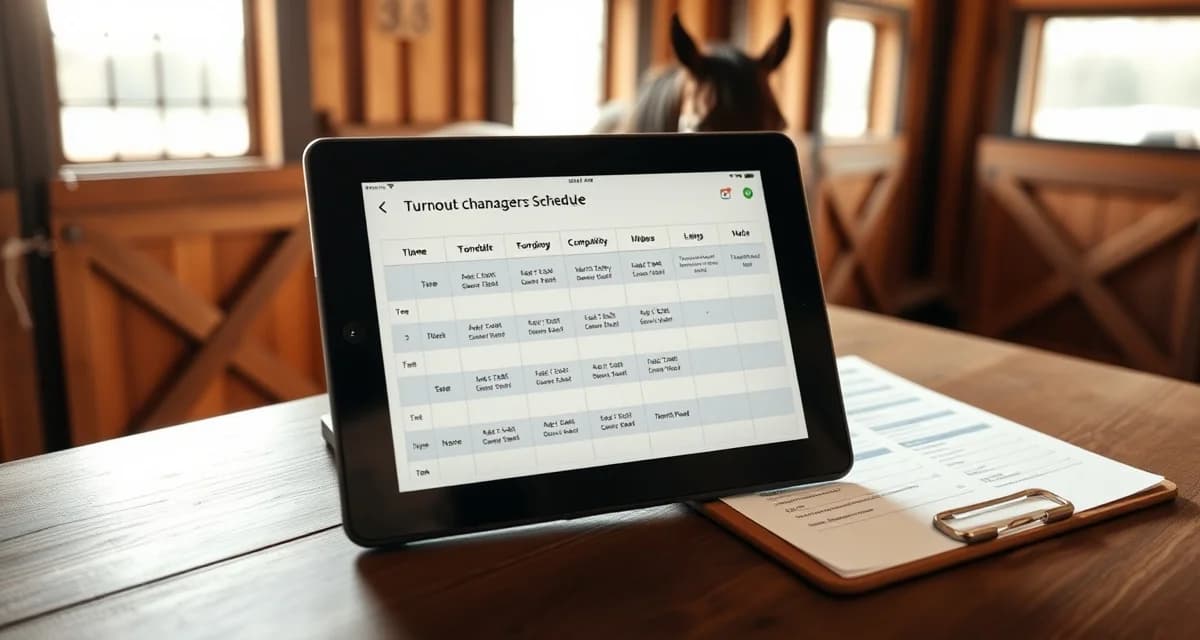
Horse Turnout Liability Documentation for Boarding Barns
Seventy-two percent of boarding disputes involve disagreements about turnout records. Who turned out which horse, when, with whom, and under what conditions. Without documentation, those disputes become your word against the owner's, and that is a losing position.
TL;DR
- Turnout scheduling decisions should be documented with the reasoning to protect the facility in liability situations
- Horse compatibility assessments before group turnout prevent injuries and reduce herd management emergencies
- Pasture rotation schedules based on grass recovery periods reduce overgrazing and maintain forage quality year-round
- Turnout injuries are among the most common sources of liability claims at boarding facilities
- Written turnout protocols signed by owners at move-in establish consent and reduce disputes about field decisions
- Tracking turnout hours per horse per day supports health monitoring and helps identify horses spending excessive time stalled
Horse turnout liability documentation is not a bureaucratic exercise. It is the paper trail that protects your barn when a horse gets injured, when an owner claims their horse was left in during a storm, or when a compatibility incident ends in a vet bill and a lawsuit.
Why Most Barns Are Exposed Right Now
Most boarding operations track turnout on whiteboards, paper logs, or not at all. Staff change shifts, notes get erased, and memory fills the gaps. That works fine until something goes wrong.
When an owner files a complaint or an attorney sends a letter, you need to show exactly what happened. A whiteboard photo from three weeks ago does not hold up. A dated, staff-attributed digital log does.
BarnBeacon addresses this directly by logging every turnout entry and exit with a staff ID, timestamp, and compatibility check, creating an audit trail that is defensible and complete. No other tool currently offers real-time turnout conflict alerts alongside that kind of documentation depth.
Step 1: Collect Signed Turnout Consent Forms Before the Horse Arrives
What the Form Must Cover
Every boarding agreement should include a standalone turnout consent section, not buried in general terms. It needs to specify:
- Approved turnout companions (by name or herd group)
- Turnout restrictions (no mares with stallions, no turnout during lightning, etc.)
- Owner preferences for weather thresholds
- Acknowledgment that group turnout carries inherent risk
Get this signed before the horse sets foot on your property. If an owner later claims they never agreed to group turnout, you need that signature.
Keep a Digital Copy Tied to the Horse's Profile
Paper forms get lost. Scan every consent form and attach it to the horse's profile in your barn management system. When a dispute arises, you should be able to pull that document in under 60 seconds.
Step 2: Log Every Turnout Event With Time, Staff, and Conditions
The Minimum Data Points for Each Entry
Every turnout event should capture:
- Date and time out / time in (not just the date)
- Staff member responsible (name or ID, not just initials)
- Paddock or pasture assigned
- Companions in the same space
- Weather conditions at time of turnout
- Any observations (horse was fresh, limping, showing heat, etc.)
This sounds like a lot. With the right system, it takes under 30 seconds per horse. Without it, you are reconstructing events from memory after the fact.
Why Timestamps Matter More Than You Think
An owner claims their horse was left outside during a thunderstorm on a Tuesday afternoon. You say your staff brought all horses in by 2 p.m. Without timestamps, you have no proof. With a time-stamped log tied to a staff ID, you have a record that is hard to dispute.
For barns managing daily turnout workflows across multiple staff members, this kind of structured logging is the difference between a resolved complaint and a protracted dispute.
Step 3: Document Weather Conditions at the Time of Each Decision
Use Objective Data, Not Recollection
Weather is one of the most common flashpoints in equine boarding turnout liability disputes. Owners have strong opinions about rain, heat, mud, and lightning. Your staff makes judgment calls every day.
Document the actual conditions. Pull from a weather app or station and log temperature, precipitation, and any weather alerts at the time of turnout. If you made a call to keep horses in due to a heat index above 95°F, write that down.
Create a Written Weather Policy
Your barn should have a written policy that defines the conditions under which horses are kept in. Share it with owners at sign-up and reference it in the consent form. When your staff follows the policy and documents it, you have a defensible decision-making chain.
Step 4: Record Compatibility Notes and Flag Conflicts Before They Happen
Build a Compatibility Profile for Each Horse
Not every horse can go out with every other horse. Document known issues: horses that kick, horses that are bullied, mares that cycle aggressively, horses that cannot be near a specific individual. This information should live in the horse's profile, not in a staff member's head.
When a new horse arrives or a herd group changes, those compatibility notes should be reviewed before the first turnout. BarnBeacon's real-time conflict alerts flag incompatible pairings before a staff member opens a gate, which is a capability most barn software does not offer.
Log Every Incident, Even Minor Ones
A kick that leaves a small mark today can become a serious injury next month if the pairing continues. Log every incident with the date, horses involved, staff present, and outcome. This creates a pattern record that justifies future separation decisions and protects you if an owner questions why their horse was moved to a different paddock.
Step 5: Maintain an Audit Trail Across Shift Changes
Shift Handoffs Are Where Documentation Breaks Down
The most common gap in turnout records happens at shift changes. The morning crew knows what they did. The afternoon crew assumes. Horses end up in the wrong paddock, or a note about a horse being lame never gets passed on.
Build a formal handoff process. The outgoing staff member should sign off on current turnout status, any horses with restrictions, and any incidents from their shift. The incoming staff member should acknowledge receipt.
Use a System That Tracks Who Did What
A shared paper log does not tell you which staff member made which decision. A digital system with individual logins does. When a question arises about a specific turnout decision, you need to know who was responsible. That is not about blame, it is about accuracy.
For barns building out a structured turnout rotation system, staff accountability at each step is what makes the rotation defensible when it matters.
Common Documentation Mistakes to Avoid
Logging turnout in bulk at the end of the day. Times become approximations, conditions get forgotten, and the record loses credibility. Log in real time or as close to it as possible.
Using first names only or no staff attribution. "Sarah" does not hold up if you have two Sarahs or if Sarah no longer works there. Use full names or staff IDs.
Skipping documentation on uneventful days. Liability does not only arise from incidents. An owner may dispute routine turnout practices. You need records for normal days too.
Failing to update compatibility notes after an incident. A one-time note that never gets acted on is worse than no note, because it shows you knew about a risk and continued the pairing anyway.
How do I create a turnout rotation for 30+ horses?
Start by grouping horses by compatibility, not just by owner preference. Assign each group a primary paddock and a backup. Build the rotation around your paddock count and rest schedule, then document the rotation in writing so every staff member follows the same plan. Software that tracks paddock assignments in real time makes this significantly easier to manage at scale.
How do I track paddock assignments across shifts?
Use a system where paddock status is updated in real time and visible to all staff, not just the person who made the assignment. Each shift should begin with a review of current assignments and any horses with active restrictions. A digital board or barn management platform that shows live paddock occupancy eliminates the guesswork that causes errors between shifts.
What factors affect horse turnout compatibility?
The main factors are sex (mares, geldings, and stallions generally need separation), herd hierarchy and known aggression, age and size differences, health status (a recovering horse should not be in a high-energy group), and individual history with specific horses. Seasonal changes in mare behavior and new horse introductions are the most common triggers for compatibility problems, so those moments require extra documentation attention.
How does BarnBeacon compare to spreadsheets for barn management?
Spreadsheets require manual updates, lack real-time notifications, and create version control problems when multiple staff members are working from different files. BarnBeacon centralizes records, pushes alerts automatically based on logged events, and connects care records to billing and owner communication in one system. Most facilities report saving several hours per week after switching from spreadsheets.
What is the setup process like for BarnBeacon?
Most facilities complete the initial setup in under a week. Horse profiles, service templates, and billing configurations can be imported from existing records or entered directly. BarnBeacon's US-based support team is available to assist with setup, and most managers are running their first billing cycle through the platform within days of starting.
Can BarnBeacon support a barn with multiple staff members?
Yes. BarnBeacon supports multiple user accounts with role-based access, so barn managers, barn staff, and owners each see the information relevant to their role. Task assignments, completion logs, and communication history are all attached to the barn's account rather than to individual staff phones or email addresses.
FAQ
What is Horse Turnout Liability Documentation for Boarding Barns?
Horse turnout liability documentation is the systematic recording of when each horse goes out, which pasture or paddock they use, who they're turned out with, weather and ground conditions, and who made the decision. For boarding barns, this paper trail is the primary defense when an owner disputes a turnout decision, a horse is injured in the field, or a compatibility incident leads to a vet bill or legal claim. It turns "he said, she said" disputes into verifiable records.
How much does Horse Turnout Liability Documentation for Boarding Barns cost?
Creating a turnout documentation system costs very little. A paper logbook runs under $20. Spreadsheet templates are free. Barn management software with turnout tracking typically runs $50–$150 per month depending on herd size and features. The more relevant cost comparison is against what you stand to lose: a single liability claim from a turnout injury can reach thousands to tens of thousands of dollars. Documentation is one of the lowest-cost risk management tools available to a boarding facility.
How does Horse Turnout Liability Documentation for Boarding Barns work?
Turnout documentation works by recording key data points at each turnout event: horse name, date and time out and in, field location, companions in the group, staff member responsible, and any notable conditions or incidents. Compatibility assessments are logged before horses are grouped together. Pasture rotation schedules are tracked separately. Owners sign a turnout protocol at move-in establishing consent for standard field decisions. Together, these records create a complete, timestamped account of every turnout decision your barn makes.
What are the benefits of Horse Turnout Liability Documentation for Boarding Barns?
The primary benefit is liability protection. Documented turnout records give you a factual defense against owner disputes and injury claims. Secondary benefits include better herd management through compatibility tracking, improved pasture health through rotation records, staff accountability, and owner trust built through transparency. Facilities that document turnout also tend to catch health patterns earlier, since hours-in-field data reveals when a horse is spending unusual amounts of time stalled, which can signal illness or behavioral issues.
Who needs Horse Turnout Liability Documentation for Boarding Barns?
Any boarding barn that turns out horses in groups, rotates pastures, or makes field decisions on behalf of horse owners needs turnout liability documentation. This includes private boarding facilities, lesson barns with boarded horses, training facilities, and retirement farms. The larger the herd and the more staff involved in daily turnout, the more critical formal documentation becomes. Solo-owner private farms with one or two horses and no staff have less exposure, but any facility with paying boarders carries real liability risk.
How long does Horse Turnout Liability Documentation for Boarding Barns take?
Setting up a basic turnout documentation system takes a few hours: drafting a daily log format, creating a compatibility assessment form, and writing a turnout protocol for owners to sign at move-in. Ongoing daily logging takes two to five minutes per turnout event once staff are trained on the process. The upfront time investment is modest relative to the protection it provides. Digital systems with pre-built templates reduce setup time significantly and make historical record retrieval faster when you actually need it.
What should I look for when choosing Horse Turnout Liability Documentation for Boarding Barns?
Look for a system that captures the right data points without creating excessive staff burden. It should record who, what, where, when, and under what conditions for each turnout. Compatibility assessments should be a separate, structured process. Owner consent documentation should be collected at move-in, not after an incident. If using software, prioritize ease of daily data entry and reliable record retrieval. Paper systems are valid but require disciplined storage. Whatever format you choose, consistency matters more than sophistication.
Is Horse Turnout Liability Documentation for Boarding Barns worth it?
Yes. Seventy-two percent of boarding disputes involve turnout disagreements, and turnout injuries are among the most common sources of liability claims at boarding facilities. A documentation system that takes five minutes a day to maintain can mean the difference between a defensible position and an indefensible one when an owner hires an attorney. Beyond legal protection, documented processes build owner confidence, improve staff consistency, and support better horse health outcomes. The time investment is minimal. The risk of not documenting is not.
Sources
- American Association of Equine Practitioners (AAEP)
- American Competitive Trail Horse Association (ACTHA)
- American Horse Council
- UC Davis Center for Equine Health
- Penn State Extension Equine Program
Get Started with BarnBeacon
Turnout decisions carry real liability, and documentation is the difference between a defensible record and an exposed facility. BarnBeacon gives equine facilities the tools to log turnout schedules, document compatibility assessments, and record any incidents with timestamps and staff identification. Start a free trial and build your turnout documentation system before you need it.