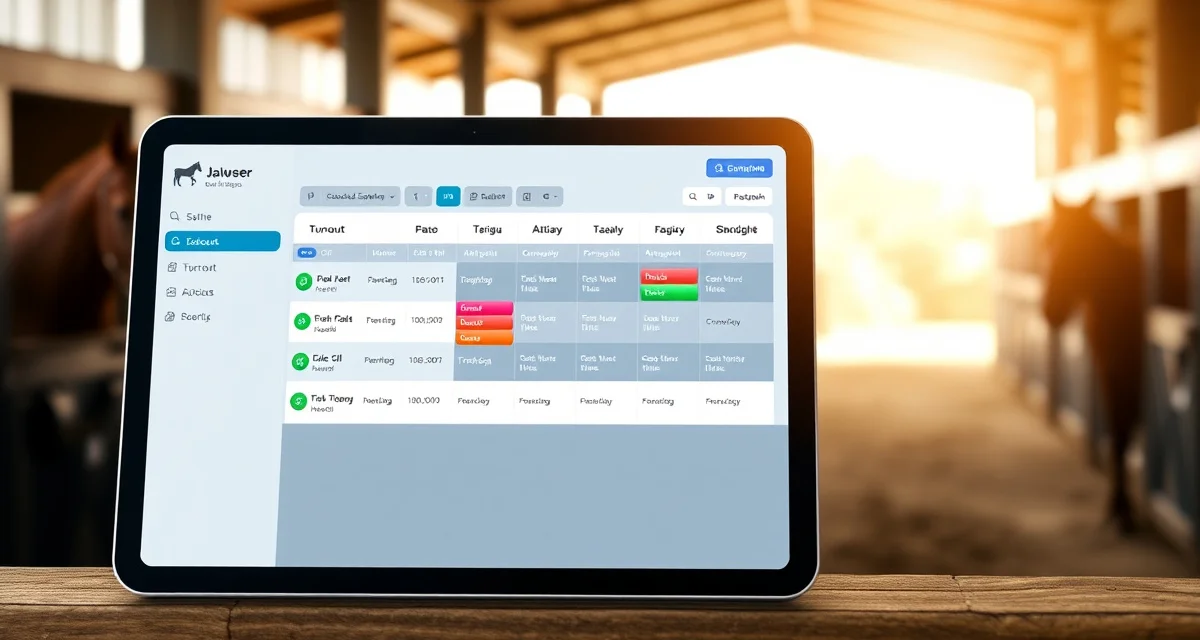
Horse Turnout Tracking App: Digital vs Paper Schedules
Paper turnout logs fail at the worst possible moment: when two incompatible horses end up in the same paddock because the afternoon staff didn't see the morning crew's handwritten note. According to industry surveys, 72% of boarding disputes involve disagreements about turnout records, and most of those disputes come down to one question: who put which horse where, and when?
TL;DR
- Turnout scheduling decisions should be documented with the reasoning to protect the facility in liability situations
- Horse compatibility assessments before group turnout prevent injuries and reduce herd management emergencies
- Pasture rotation schedules based on grass recovery periods reduce overgrazing and maintain forage quality year-round
- Turnout injuries are among the most common sources of liability claims at boarding facilities
- Written turnout protocols signed by owners at move-in establish consent and reduce disputes about field decisions
- Tracking turnout hours per horse per day supports health monitoring and helps identify horses spending excessive time stalled
This comparison breaks down exactly what separates a dedicated horse turnout tracking app from paper schedules, whiteboards, and generic spreadsheets, so you can decide what your operation actually needs.
TL;DR Verdict
| Feature | Paper / Whiteboard | Spreadsheet | Horse Turnout Tracking App (BarnBeacon) |
|---|---|---|---|
| Real-time updates across shifts | No | Partial | Yes |
| Paddock conflict alerts | No | No | Yes |
| Staff ID + timestamp audit trail | No | No | Yes |
| Compatibility checks before turnout | No | No | Yes |
| Accessible on mobile in the field | No | Partial | Yes |
| Liability documentation | Weak | Moderate | Strong |
| Setup time | Minutes | Hours | Under 30 min |
If you manage more than 10 horses across multiple paddocks with rotating staff, paper is not a system. It's a liability.
Paper Schedules: Where They Work and Where They Break
Paper and whiteboards have one genuine advantage: zero learning curve. Any staff member can read a handwritten note. For a private barn with three horses and one owner doing all the work, paper is perfectly adequate.
The problems start the moment you add complexity. A second shift, a new horse with aggression history, a paddock that floods in wet weather, a horse on stall rest that someone forgot to mark. Paper doesn't alert you to any of these conflicts. It just sits there.
The Liability Gap
When a horse gets injured during turnout and the owner asks for documentation, a smudged whiteboard entry from three weeks ago is not going to hold up. You need to know which staff member turned out which horse, at what time, and whether the paddock assignment matched the horse's compatibility profile.
Paper cannot provide that. Most spreadsheets can't either, unless someone is disciplined enough to log every entry manually with their initials and a timestamp, every single time, without exception.
The Shift Handover Problem
Boarding facilities with morning and evening staff face a specific failure point: the handover. If the morning crew changes a paddock assignment due to a muddy field or a horse showing signs of lameness, that information needs to reach the afternoon crew before they turn horses out, not after.
A note on a clipboard travels as far as whoever picks it up. A digital update reaches every device on the property the moment it's saved.
Spreadsheets: Better Than Paper, Still Not Enough
Shared spreadsheets (Google Sheets, Excel) solve the accessibility problem. Multiple staff members can view the same document from their phones. That's a real improvement.
What spreadsheets don't do is think. They don't know that Horse A and Horse B have a documented aggression history. They don't flag that Paddock 3 is already at capacity. They don't record who made a change or when. And they don't send an alert when someone is about to make a scheduling error.
Version Control Is a Hidden Risk
When two staff members edit a shared spreadsheet at the same time, conflicts happen. One person's update overwrites another's. There's no notification. The wrong version becomes the working document, and nobody knows until something goes wrong in the field.
For an equine turnout schedule app built specifically for barn operations, this is a solved problem. Changes are logged, conflicts are flagged, and the most current information is always what staff see.
What a Horse Turnout Tracking App Actually Does Differently
BarnBeacon was built around one principle: every turnout event should be documented with enough detail to be defensible. That means staff ID, timestamp, paddock assignment, and a compatibility check, all recorded automatically at the point of action.
Real-Time Conflict Alerts
Before a horse is assigned to a paddock, the app checks three things: current paddock occupancy, the horse's compatibility flags, and any active health or movement restrictions. If any of those conditions create a conflict, the staff member gets an alert before the horse leaves the stall.
This is the feature that paper and spreadsheets fundamentally cannot replicate. No other tool in this category currently offers pre-turnout conflict detection as a built-in function.
Audit Trail with Staff Accountability
Every entry and exit is logged with the staff member's ID and an exact timestamp. If a dispute arises, you can pull a complete history for any horse, any paddock, or any staff member for any date range.
This matters for insurance claims, owner disputes, and internal performance reviews. A barn manager who can produce a clean, timestamped audit trail is in a completely different position than one handing over a folder of handwritten notes.
Compatibility Profiles Built Into the Workflow
Each horse in BarnBeacon carries a compatibility profile: which horses it can share a paddock with, which it cannot, and any conditional flags (mares in season, horses recovering from injury, horses new to the herd). These profiles are checked automatically every time a turnout assignment is made.
You can build a structured turnout rotation directly within the app, and the system will flag any rotation step that violates a compatibility rule before it's confirmed.
Mobile-First Field Access
Staff don't manage turnout from a desk. They're in the barn aisle, at the gate, in the paddock. BarnBeacon is designed for one-handed use on a phone, with large tap targets and offline capability for areas with poor signal. Updates sync the moment connectivity is restored.
Head-to-Head: Paper vs App for Common Barn Scenarios
Scenario 1: New Horse Arrives Mid-Week
Paper: Someone writes the horse's name on the whiteboard, maybe notes it's a stallion or has a kicking history. That note may or may not be seen by every staff member before the next turnout.
App: The horse is added to the system with a full profile. Every subsequent turnout assignment is checked against that profile automatically. No staff member can accidentally turn the new horse out with an incompatible paddock mate without receiving an alert.
Scenario 2: Paddock Rotation Across 30 Horses
Managing a rotation for a large herd on paper means a chart that someone has to update manually, redistribute, and hope everyone reads. Errors compound over time.
With a structured digital rotation, the system tracks which horses have had access to which paddocks, flags horses that haven't had adequate turnout time, and adjusts suggestions based on current paddock availability. The barn daily checklist integration means turnout tasks are tied directly to the day's workflow rather than managed as a separate document.
Scenario 3: Owner Dispute Over Turnout Time
An owner claims their horse hasn't been turned out in three days. With paper records, you're searching through handwritten logs hoping someone wrote it down correctly.
With a horse turnout tracking app, you pull the horse's record in under 30 seconds. Every turnout event is there: date, time, paddock, duration, staff member. The conversation ends quickly.
Who Should Use Each System
Stick With Paper If:
- You manage fewer than 5 horses
- You are the only person handling turnout
- You have no shift handovers
- Liability documentation is not a concern
Move to a Spreadsheet If:
- You have 5-15 horses and a small team
- You need basic shared visibility across staff
- You're not ready to invest in dedicated software
- Compatibility conflicts are rare or non-existent
Use a Dedicated Horse Turnout Tracking App If:
- You manage 15+ horses with rotating staff
- You have horses with documented compatibility issues
- You need a defensible audit trail for liability purposes
- You've had a turnout incident or owner dispute in the past 12 months
- You operate a boarding facility where turnout is a contracted service
How do I create a turnout rotation for 30+ horses?
Start by grouping horses into compatible herds based on temperament, sex, and social history. Assign each group a primary paddock and a rotation sequence that accounts for pasture rest periods. In a dedicated app, you can build this rotation once and let the system manage daily assignments, flagging any conflicts before they happen. For a detailed walkthrough, see the guide on turnout rotation.
How do I track paddock assignments across shifts?
The core requirement is a system that updates in real time and is accessible to all staff on any device. Paper and static spreadsheets fail here because they depend on someone physically updating a shared document and every other staff member seeing that update before acting. A horse turnout tracking app solves this by making the current state of every paddock visible to all users simultaneously, with changes logged by staff ID so there's no ambiguity about who made what decision.
What factors affect horse turnout compatibility?
The main factors are sex (stallions, mares, and geldings often need separation), established herd hierarchy, individual aggression or anxiety history, health status (horses recovering from injury or illness may need solo turnout), and time of year (mares in season can disrupt group dynamics). New horses should always be introduced gradually, with initial turnout in adjacent paddocks before direct contact. Compatibility profiles in an equine turnout management app let you document all of these factors and enforce them automatically at the point of assignment.
How does BarnBeacon compare to spreadsheets for barn management?
Spreadsheets require manual updates, lack real-time notifications, and create version control problems when multiple staff members are working from different files. BarnBeacon centralizes records, pushes alerts automatically based on logged events, and connects care records to billing and owner communication in one system. Most facilities report saving several hours per week after switching from spreadsheets.
What is the setup process like for BarnBeacon?
Most facilities complete the initial setup in under a week. Horse profiles, service templates, and billing configurations can be imported from existing records or entered directly. BarnBeacon's US-based support team is available to assist with setup, and most managers are running their first billing cycle through the platform within days of starting.
Can BarnBeacon support a barn with multiple staff members?
Yes. BarnBeacon supports multiple user accounts with role-based access, so barn managers, barn staff, and owners each see the information relevant to their role. Task assignments, completion logs, and communication history are all attached to the barn's account rather than to individual staff phones or email addresses.
FAQ
What is Horse Turnout Tracking App: Digital vs Paper Schedules?
A horse turnout tracking app is a digital tool that replaces paper logs, whiteboards, and spreadsheets for managing which horses go out, when, where, and with whom. It captures real-time turnout records, compatibility flags, and pasture rotation schedules in one accessible place. The comparison between digital and paper scheduling helps barn managers evaluate which system better prevents miscommunication between staff shifts, reduces liability exposure from undocumented decisions, and supports accurate health monitoring through consistent turnout hour tracking.
How much does Horse Turnout Tracking App: Digital vs Paper Schedules cost?
Dedicated horse turnout tracking apps typically range from free basic tiers to $30–$80 per month for barn management platforms with full scheduling features. Cost varies by barn size, number of horses, and whether the tool includes broader features like health records or billing. Paper systems have near-zero direct cost but carry hidden costs in staff time, dispute resolution, and liability exposure from incomplete records. Most facilities recoup software costs quickly by reducing a single insurance or boarding dispute.
How does Horse Turnout Tracking App: Digital vs Paper Schedules work?
A turnout tracking app lets staff log each horse's turnout in real time via smartphone or tablet, recording the paddock used, start and end times, companions, and any compatibility notes. Automated alerts flag scheduling conflicts or incompatible pairings before they happen. Managers can view daily schedules, run pasture rotation plans, and pull historical records instantly. Unlike paper logs, all entries are timestamped, attributed to a specific staff member, and accessible to anyone with account access regardless of shift.
What are the benefits of Horse Turnout Tracking App: Digital vs Paper Schedules?
Digital turnout tracking eliminates the communication gaps that cause incompatible horses to share paddocks due to missed handwritten notes. Benefits include real-time visibility across all staff, automatic conflict detection, documented decision trails that protect facilities during liability claims, pasture rotation scheduling to prevent overgrazing, and health monitoring support through daily turnout hour logs. Owners also gain confidence when facilities can provide accurate, timestamped turnout histories rather than relying on memory or partial paper records.
Who needs Horse Turnout Tracking App: Digital vs Paper Schedules?
Any boarding, training, or breeding facility managing multiple horses across multiple paddocks benefits from structured turnout tracking. Facilities with more than five horses or more than two staff members handling turnout are especially vulnerable to the miscommunication paper systems allow. Barn managers dealing with compatibility-sensitive herds, layup horses with restricted turnout, or clients who have signed specific turnout protocols need documented records most urgently. Larger operations with shift changes are at highest risk when relying on informal paper or whiteboard systems.
How long does Horse Turnout Tracking App: Digital vs Paper Schedules take?
Switching from paper to a digital turnout tracking app typically takes one to two weeks for full adoption. Initial setup involves entering horse profiles, paddock maps, and compatibility groupings, which takes a few hours depending on barn size. Staff training on mobile logging is usually completed in a single session. Most facilities run paper and digital systems in parallel for the first week before cutting over. The ongoing time investment is minimal — logging a turnout entry takes under a minute per horse.
What should I look for when choosing Horse Turnout Tracking App: Digital vs Paper Schedules?
Look for real-time logging with staff attribution so every entry is timestamped and traceable. Compatibility flagging that alerts staff before an unsafe pairing is scheduled is essential. Pasture rotation tracking helps manage grass recovery. Check whether the app integrates with health records so restricted turnout orders follow the horse automatically. Mobile accessibility matters for staff working without desk access. Finally, confirm the system stores historical records in a format you can export, which is critical for liability documentation and owner dispute resolution.
Is Horse Turnout Tracking App: Digital vs Paper Schedules worth it?
For facilities managing more than a handful of horses across multiple paddocks with rotating staff, a dedicated turnout tracking app is worth the investment. The 72% rate of boarding disputes tied to turnout records means the liability protection alone justifies the cost for most operations. Paper logs fail exactly when accuracy matters most — during shift changes and emergencies. Digital tools provide the documented decision trail, compatibility safeguards, and health monitoring support that protect both horses and facilities from preventable incidents.
Sources
- American Association of Equine Practitioners (AAEP)
- American Competitive Trail Horse Association (ACTHA)
- American Horse Council
- UC Davis Center for Equine Health
- Penn State Extension Equine Program
Get Started with BarnBeacon
Turnout decisions carry real liability, and documentation is the difference between a defensible record and an exposed facility. BarnBeacon gives equine facilities the tools to log turnout schedules, document compatibility assessments, and record any incidents with timestamps and staff identification. Start a free trial and build your turnout documentation system before you need it.