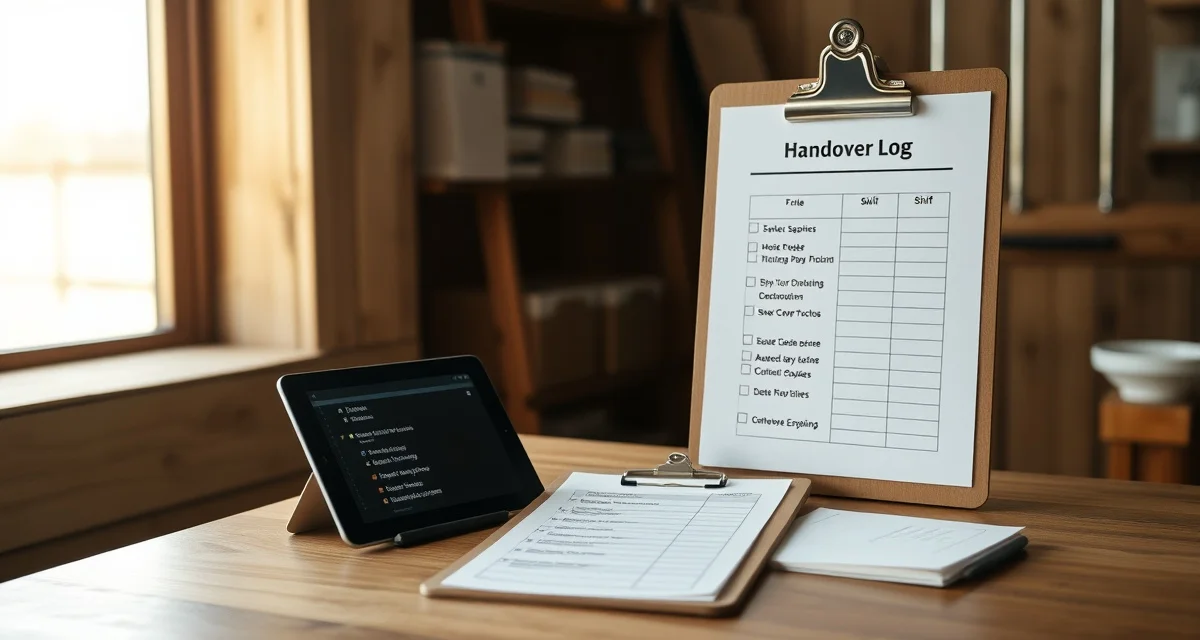
Maintaining a Shift Handover Log at Your Barn
A shift handover log is the written record of what happened during a shift and what the incoming crew needs to know. Done well, it is one of the most useful documents in a well-run barn. Done poorly, or not done at all, it is a source of gaps in care and a liability when things go wrong.
What a Handover Log Is and Is Not
A handover log is not a diary. It does not need to document every routine task that was completed as expected. The morning crew fed horses, watered them, and cleaned stalls. Those things do not need to be written unless something was different.
A handover log is a record of deviations, observations, and information transfer. It captures what was not normal, what was done about it, and what needs to happen next. It is also a communication tool for instructions that need to be passed from one crew to the next, from an owner, or from a vet.
The goal is a log that can be read in five minutes and leave the incoming crew fully informed. Longer is not better if the length comes from routine filler. Shorter is not better if it omits health flags.
Format for a Shift Handover Log
A basic log entry includes:
Date and shift - Which shift is logging (morning, afternoon, evening, night check).
Crew on shift - Who was present. This matters when questions arise later.
Horse observations - Any horse that was not normal. The entry should include the horse's name or stall number, what was observed, when it was observed, and any action taken.
Medications and treatments - For every horse that received medication or treatment beyond routine care: horse name, medication or treatment, dose or duration, time, who administered it.
Owner and vet communications - Any contact with owners or vets during the shift, any instructions given, any follow-up pending.
Facility notes - Equipment issues, supply shortages, anything that affects the next crew's ability to do their job.
Handoff tasks - Anything the outgoing crew did not complete that the incoming crew needs to handle, with enough context to understand why.
Keeping the Log Current During the Shift
The best handover logs are built throughout the shift, not written in a rush at the end. When a staff member observes something unusual, they log it immediately with the time. When a medication is administered, it goes in the log right then.
This approach produces more accurate notes, reduces the risk of forgetting something at the end of a long shift, and creates a time-stamped record that is more reliable for health tracking and liability purposes.
It also makes the end-of-shift handover faster. If observations are logged as they happen, the outgoing crew lead only needs to review and summarize, not reconstruct the entire shift from memory.
Physical Log vs. Digital Log
A physical logbook is better than nothing. It is accessible, requires no technology, and creates a tangible record. The drawbacks are that it is only accessible to people who are physically present, it cannot be reviewed remotely, and it is vulnerable to being misplaced, damaged, or illegible.
A digital log solves these problems. The barn manager can review the overnight handover from home at 10pm. The incoming morning crew can read the evening's notes before arriving. If a vet calls with a question about what was observed two days ago, the record is searchable and accessible immediately.
BarnBeacon's shift log creates structured, time-stamped handover records accessible from any device. Staff log observations during their shift, and the completed log is available to incoming crews and management before the next shift begins. The barn manager gets visibility into all shift handovers across the facility without needing to be physically present.
Common Mistakes in Handover Logging
Vague health notes. "Horse seemed off" is not useful. "Bay gelding in stall 8 left half her evening hay, drank normally, no visible swelling or heat in legs, gut sounds present on both sides, 4:30pm observation" is useful.
Missing medication entries. Every medication administered needs to be logged. A horse on daily phenylbutazone that misses a log entry could receive a double dose from the next crew if they check records to confirm before dosing.
Logging only negatives. A horse that has been flagged for observation needs a note confirming they were checked and observed, even when the observation is "no change, same as yesterday." Silence in the log for a flagged horse is ambiguous.
Letting the log lapse on busy days. The days when the log is hardest to maintain are the days when it matters most. Build the expectation that the log is completed regardless of workload.
A well-maintained shift handover log is one of the clearest markers of a professionally managed barn. It protects horses, protects staff, and gives the barn manager the information they need to run a safe and responsive operation. See also: shift handover guide and shift handoff documentation.
FAQ
What is Maintaining a Shift Handover Log at Your Barn?
A shift handover log is a written record passed between barn crews at the end of each shift. It captures deviations from routine, health observations, vet instructions, and anything the incoming crew needs to act on. Unlike a general diary, it focuses only on what was different or unresolved. A good log can be read in five minutes and leave the next crew fully informed, reducing care gaps and protecting the barn from liability when questions arise later.
How much does Maintaining a Shift Handover Log at Your Barn cost?
A shift handover log costs nothing to implement in its basic form. A simple paper template or shared digital document is free. Barn management software with built-in handover features may carry a monthly subscription, typically ranging from low to mid double digits per month depending on the platform. The more relevant cost is the time investment per shift, which should be minimal if the log is kept focused on deviations and action items rather than routine task checklists.
How does Maintaining a Shift Handover Log at Your Barn work?
At the end of each shift, the outgoing crew fills in a structured entry covering the date, shift time, staff present, any horse health flags, tasks left incomplete, and instructions for the next crew. The incoming crew reads it before beginning work. Entries focus on what was abnormal, what was done, and what still needs attention. Some barns use paper logs in a binder; others use shared apps or spreadsheets accessible from a phone.
What are the benefits of Maintaining a Shift Handover Log at Your Barn?
A well-maintained handover log improves continuity of care, reduces verbal miscommunication, and creates a paper trail when health issues develop. Staff turnover becomes less disruptive because knowledge is written down rather than held in one person's head. Vets and owners can leave instructions that survive shift changes. Over time, the log also becomes a health history reference, helping identify patterns in a horse's behavior or recurring issues that might otherwise go unnoticed.
Who needs Maintaining a Shift Handover Log at Your Barn?
Any barn with more than one person caring for horses across multiple shifts needs a handover log. This includes boarding facilities, training barns, breeding operations, and private properties with employed staff. Even small operations with two part-time helpers benefit from a written record. If your barn has ever experienced a care gap because someone forgot to mention a lame horse or an unfinished task, a handover log directly addresses that problem.
How long does Maintaining a Shift Handover Log at Your Barn take?
Filling out a shift handover log should take five to ten minutes per shift when done consistently. The key is writing only what matters: deviations from normal, health observations, unfinished tasks, and instructions. Logs that take longer are usually capturing routine completions that do not need to be recorded. Reading the incoming log should also take under five minutes. The time investment is small relative to the care problems it prevents.
What should I look for when choosing Maintaining a Shift Handover Log at Your Barn?
Look for a format that is structured but not burdensome. It should have clear fields for date, shift, staff, horse-specific notes, and follow-up items. Avoid templates so long that staff skip them. Digital tools should be mobile-friendly and accessible without a laptop. Paper logs should live in a consistent, visible location. The best system is the one your team will actually use every shift, not the most sophisticated one that gets abandoned after two weeks.
Is Maintaining a Shift Handover Log at Your Barn worth it?
Yes. A shift handover log is one of the highest-return habits a barn can establish. The setup cost is low, the daily time cost is minimal, and the benefits compound over time. Missed medications, undetected injuries, and miscommunicated vet instructions are all preventable with a consistent log. For barns that have experienced a serious care gap or a dispute over who knew what and when, the value becomes especially clear. It is a simple tool that makes a barn meaningfully safer.
Related Articles
- Shift Management at Breeding Barns: [staff scheduling and Handover](/shift-management-breeding-barn)
- Shift Management at Layup Barns: [staff scheduling and Handover](/shift-management-layup-barn)