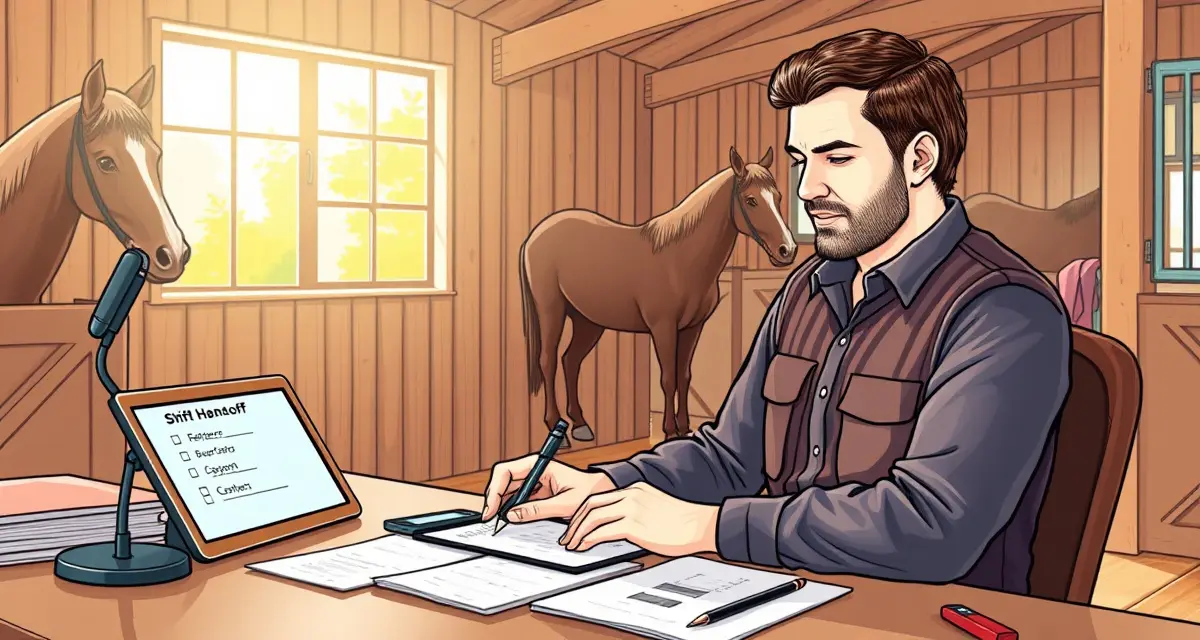
Barn Shift Management by Facility Size: 1 to 20 Staff Members
The biggest operational gap I see in boarding barns isn't the horses, it's the handover between people.
TL;DR
- The gap between morning and afternoon shifts is the most common point where critical horse care information is lost.
- Every shift handoff needs a written or digital checklist covering health flags, deferred tasks, and owner follow-ups.
- Assigning specific names (not roles) to every task creates accountability and prevents tasks from falling through the cracks.
- By Size facilities need shift protocols tailored to their specific horse population and care intensity.
- Digital shift logs create a searchable record that paper sign-off sheets cannot provide.
You had a perfect morning. Every horse checked, every med given, the mare in stall 7 who's been a little off got an extra look and her hay was soaked. Then your afternoon person arrives, and within three hours they've missed the soaked hay and given the mare in stall 7 her evening grain on schedule without knowing she didn't eat well all day.
Not because they're careless. Because nobody told them.
Shift management is the system you use to make sure what one person knows at the end of their shift becomes what the next person knows at the start of theirs. How you build that system depends almost entirely on how many people you're managing.
1–2 Staff: Just You (and Maybe One Other Person)
Most small barns, under 20 horses, run on one person or one person plus occasional help. Shift management at this level is mostly about what happens when you're not there.
The problem isn't daily operations. You know this barn. You know these horses. The problem is the Saturday when you have a horse show and your working student is covering, or the Sunday your assistant is sick and your neighbor's daughter fills in.
What shift management looks like at this size:
A per-horse care card in the feed room. Not a binder, a single laminated card per horse with:
- Feed type, amount, timing
- Any current medications with exact doses
- Any special notes ("soaks hay," "needs fly mask before turnout," "don't grain until vet confirms")
- Emergency contacts (owner phone, vet phone)
This is your shift handover system. When you're not there, whoever is covering reads the cards and follows them.
BarnBeacon at this size works as a mobile version of those cards. Your covering staff opens the app, sees their task list for the current shift, and works through it. You get a notification when tasks are marked complete. You can check in from your phone at the horse show and see that the evening feeding happened.
The key habit to build: Log every deviation from normal, even small ones. The horse that ate slowly. The one that had loose manure this morning. You'll forget these details in three days. BarnBeacon won't.
2–5 Staff: The Communication Minefield
A barn running 2–5 staff members is in the hardest position. You have enough people that you can't personally track what everyone knows, but not enough people to have formal managers and supervisors.
At this size, the most common failure mode is: someone knew something, but they didn't tell the right person.
Morning staff noticed the gray gelding wasn't drinking well. They meant to mention it at handover. They got distracted. Evening staff didn't know to watch him. By 9pm he's colicking.
Building a real shift handover process:
The handover between shifts needs to be a structured event, not a casual conversation in the aisle.
At minimum, a shift handover at this size covers:
- Any horse with an abnormal observation during the shift
- Any medication that wasn't given as scheduled (and why)
- Any tasks left incomplete for the incoming shift to finish
- Any upcoming events the incoming shift needs to know about (vet call at 2pm, farrier arrives at 3)
- Any owner calls or messages the incoming shift should be aware of
In BarnBeacon: The shift handover log captures all of this automatically from the observations and task completions logged during the shift. When the PM person opens BarnBeacon at the start of their shift, they see a summary of what happened on AM. No conversation required, though a quick in-person handover using the log as an agenda is best practice.
Staff communication tools at this size: A shared group text works for urgent items. BarnBeacon handles structured handovers. Don't mix them, urgent issues go on the phone, structured records go in BarnBeacon.
5–10 Staff: Multiple Roles, Split Shifts, and Coordination Complexity
At this size you probably have:
- A full-time barn manager (you)
- 2–3 full-time grooms
- 1–2 part-time or working student staff
- Possibly a separate person handling lessons or training
Shifts at this size typically look like:
- AM shift: 6am–12pm (feeding, stall cleaning, turnout)
- PM shift: 12pm–5pm (turnout return, afternoon check, second feeding)
- Evening shift: 5pm–8pm (evening hay, night check, blanketing)
Each shift transition is a potential information failure point. With three transitions per day and 5–10 staff cycling through, you have 15–20 potential handover moments per week where something critical can get lost.
What BarnBeacon does at this size:
Every task completion is attributed to a specific staff member. When the morning person marks the gray gelding's water bucket as "low, horse not drinking well," that observation is live in the system the moment it's entered. The PM person who logs in at noon sees it immediately. They don't have to be told. The flag is already there.
The barn manager view at this size: BarnBeacon's manager dashboard shows task completion across all shifts in real time. If it's 11am and the morning stall cleaning isn't marked complete, you know. If a medication wasn't confirmed, you get an alert. You're not hovering, you're monitoring.
Building shift accountability without micromanaging:
The shift log creates accountability without requiring you to supervise every task. When tasks are in the system and completions are attributed, staff are naturally more careful. It's not surveillance, it's a professional record of what happened. Most good staff members appreciate working in a system where their work is documented.
10–15 Staff: Formal Role Structures Required
At 10–15 staff, shift management requires formal role definitions. Who is the shift lead? Who escalates to the barn manager? Who makes the call at 2am when a horse is showing signs of colic?
Roles to define clearly:
- Barn Manager, Strategic oversight, client communication, veterinary relationships, staff hiring and training
- Shift Lead, Responsible for shift completion and handover, escalates health concerns, assigns tasks to other shift staff
- Groom, Executes assigned tasks, logs observations, escalates to shift lead
- Working Student, Supervised task execution, limited independent authority
BarnBeacon's role-based access aligns with this structure. Each role sees a customized view with their assigned tasks. Shift leads see their full shift task list plus health observation flags for every horse. Grooms see their assigned horses' tasks. The barn manager sees the whole operation.
The escalation protocol: When a groom flags an abnormal observation in BarnBeacon, it automatically routes to the shift lead's alert queue. The shift lead assesses and either handles it or escalates to the barn manager. This creates a documented escalation trail that's valuable for insurance purposes and for post-incident review.
15–20 Staff: Enterprise Shift Management
A 15–20 person barn team is running a small enterprise. You likely have:
- Multiple managers with distinct domains (barn manager, training manager, breeding manager)
- Multiple concurrent shifts
- A mix of full-time, part-time, seasonal, and working student staff
- High enough horse count (80–150+) that task volume requires formal planning tools
Shift structure at this size:
- 24/7 coverage with formal shift schedules
- Weekly manager review of shift completion metrics
- Formal onboarding process for new staff to learn BarnBeacon before unsupervised shifts
- Escalation protocols documented and posted
What BarnBeacon adds at this size:
- Multi-manager dashboard access
- Shift completion reporting by staff member
- Trend analysis on health observations (catching the horse whose baseline observations have been slowly changing over two weeks)
- Integration exports for payroll systems tracking hours worked by role
Common Shift Management Mistakes at Any Size
No written record of what was observed. Verbal-only handovers rely on memory and context. One tired employee, one distraction in the aisle, and the critical information doesn't transfer.
Using group texts as your shift log. Text threads are great for urgent communication. They're terrible for searchable, structured records. You can't pull up "what were Ranger's observations over the past two weeks" from a WhatsApp thread.
Skipping the handover when shifts overlap. Some barns run overlapping shifts where AM and PM are both on-site for 30–60 minutes. It's tempting to skip the formal handover because "we'll just talk about it." Don't. Write it down anyway.
Not assigning a shift lead. Collective responsibility is no responsibility. Every shift needs one person who is accountable for the handover.
Related Articles
- Equine Facility Staff Management: Complete Operations Guide
- Eventing Barn Staff Management: Complete Guide for Facility Managers
- Hunter/Jumper Barn Staff Management: Complete Guide for Facility Managers
- Polo Barn Staff Management: Complete Guide for Facility Managers
FAQ
How does barn shift management work for a 3-person barn team?
With 3 staff, you likely run morning and evening shifts with occasional overlap. The most important thing is a written handover, not verbal only. At the end of each shift, the outgoing person documents: any horse with an abnormal observation, any medication that wasn't given, any task left incomplete, and anything the incoming person needs to know. BarnBeacon's shift log prompts for all of this and sends the summary to the incoming person's app before their shift starts.
Can BarnBeacon manage shifts for a 15-person barn staff?
Yes. BarnBeacon supports unlimited staff accounts with role-based access, shift-specific task views, and a multi-manager dashboard. For a 15-person team, you'd typically set up 3–4 roles (manager, shift lead, groom, working student), assign each staff member a role, and build shift templates that populate the right tasks for each shift type. The barn manager gets a daily completion summary and real-time exception alerts.
What BarnBeacon features are most important for shift management in a small barn?
For a small barn (2–5 staff), the three most valuable shift management features are: the shift handover log (captures what happened during the shift for the incoming person to review), exception flags (marks horses with abnormal observations so they're visible at the top of the next shift's view), and task attribution (shows who completed what and when, creating accountability without micromanagement).
What should a shift handoff checklist include at a by size facility?
A shift handoff checklist at a by size facility should cover any horses showing health concerns since the last check, tasks that were deferred and why, supply or equipment issues needing follow-up, and any owner communications that need a response before the next shift ends. The handoff document should take no more than five minutes to complete and should be a digital record, not a verbal summary, so the receiving shift has a reference they can return to during their work.
How do I ensure staff actually complete shift handoffs consistently?
Make the handoff completion a required step before a shift can be logged as finished in your barn management system. When handoff checklists are optional, they become the first thing dropped under time pressure. Building the handoff into the shift-close workflow creates the habit without requiring management enforcement of each individual shift.
What is Barn Shift Management by Facility Size: 1 to 20 Staff Members?
Barn Shift Management by Facility Size: 1 to 20 Staff Members is a practical guide for boarding barn operators covering how to structure staff handoffs based on team size. It addresses the most common breakdown in horse care operations—the gap between shifts where critical health information gets lost. The article provides size-specific shift protocols, from solo operators up to 20-person teams, including checklist frameworks, task accountability systems, and digital logging strategies to ensure consistent horse care across every shift change.
How much does Barn Shift Management by Facility Size: 1 to 20 Staff Members cost?
Barn Shift Management by Facility Size: 1 to 20 Staff Members is a free educational article published on BarnBeacon. There is no cost to read it. BarnBeacon provides barn management resources, guides, and operational frameworks at no charge to help facility owners and managers run safer, more organized equine operations regardless of their budget or facility size.
How does Barn Shift Management by Facility Size: 1 to 20 Staff Members work?
Barn Shift Management by Facility Size: 1 to 20 Staff Members works by breaking down shift handoff protocols according to how many staff members a facility employs. Each size tier gets tailored guidance on written or digital checklists, named task assignments, health flag communication, and owner follow-up tracking. The framework ensures that critical information—like a horse that didn't eat well or received a medication adjustment—transfers reliably from one caregiver to the next at every shift change.
Sources
- American Association of Equine Practitioners (AAEP)
- American Horse Council
- United States Equestrian Federation (USEF)
- University of Minnesota Extension Equine Program
- The Horse magazine
Get Started with BarnBeacon
Shift management at a by size facility depends on every crew working from the same current information -- not from what the previous shift remembered to mention. BarnBeacon's digital handoff tools ensure that health flags, deferred tasks, and owner follow-ups are visible to each incoming shift without relying on verbal relay. If your by size barn is still losing critical information between shifts, BarnBeacon gives your teams the structure to close that gap.