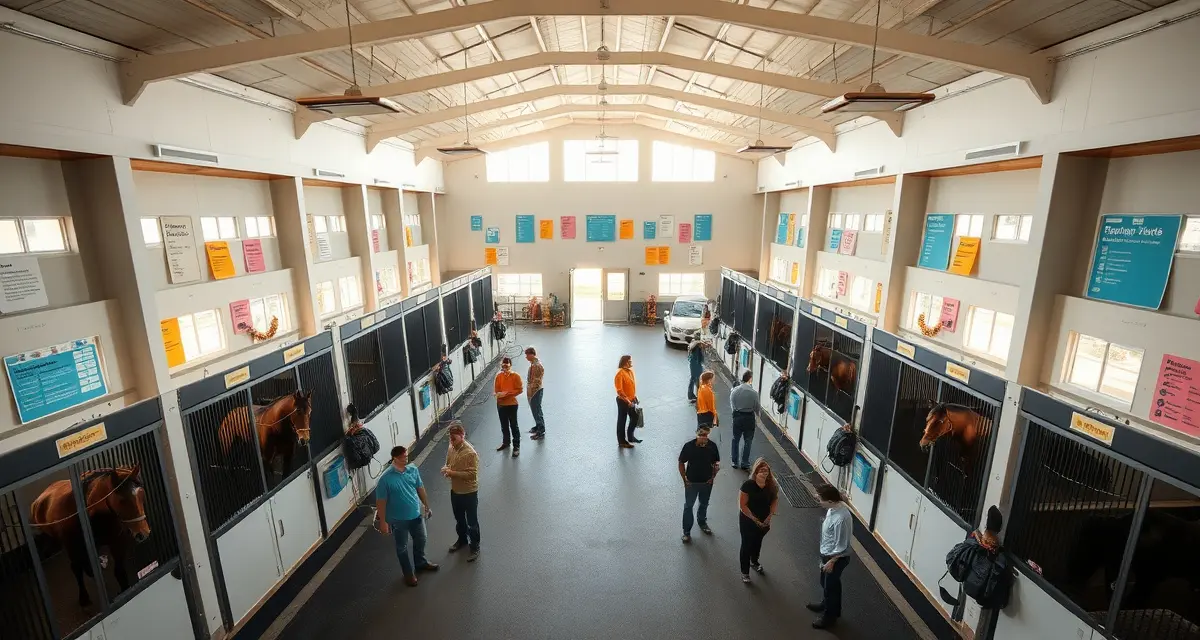
Barn Management Checklist for 100-Horse Facilities
Running a 100-horse barn without a structured checklist system is how things fall through the cracks. Feed schedules get missed, medication logs go unsigned, and billing disputes surface weeks after the fact. A barn management checklist built for this scale keeps every task accountable, every day.
TL;DR
- The average barn manager loses an estimated 2.4 hours daily to fragmented tools, consolidating into one system recovers that time.
- At 100 horses, checklists must be built around staff roles, not individual names, so coverage survives turnover and sick days.
- Daily checklists should be split by shift (morning, afternoon, evening) with specific task ownership assigned to each role.
- Weekly tasks like medication audits and billing reviews need designated owners, not a "whoever has time" approach.
- Digital tracking creates automatic timestamps and searchable audit trails, critical when a vet needs a horse's history at 2 a.m.
- Monthly checklists are where most large facilities fall behind; building a calendar trigger into your system prevents that gap.
- Checklist fatigue is a real risk at this scale, role-specific views that show each staff member only their tasks reduce skimming and missed items.
The average barn manager juggles 6+ separate tools to track health records, invoices, schedules, and communications. That fragmentation costs an estimated 2.4 hours daily, time that should go toward horses and clients, not chasing down spreadsheets.
The Problem With Generic Checklists at Scale
A checklist that works for a 20-horse private barn breaks down fast at 100 horses. The volume of daily tasks multiplies, staff roles split into specialties, and the margin for error shrinks. You need delegation built into the system, not added as an afterthought.
At this scale, you also need an audit trail. When a horse colics at 2 a.m. and the vet asks what it ate and when it was last checked, you need that answer in seconds, not minutes.
Step 1: Build Your Daily Checklist by Shift
Morning Shift (6:00 a.m. to 12:00 p.m.)
Assign each task to a specific staff role, not just "staff." Ambiguity is how tasks get skipped.
- Feeding: Confirm each horse's feed type and quantity against the current feed chart. Flag any refusals immediately.
- Health check: Visual assessment of all 100 horses. Note any lameness, swelling, discharge, or behavioral changes.
- Stall condition: Record stall cleanliness status per horse. Flag any abnormal manure output.
- Water check: Confirm automatic waterers are functioning or buckets are filled and clean.
- Turnout log: Record which horses went out, at what time, and into which paddock.
Afternoon Shift (12:00 p.m. to 6:00 p.m.)
- Midday feed and supplements: Cross-reference supplement schedules. Errors here are common and costly.
- Paddock check: Walk all turnout areas. Check fencing, water, and horse behavior.
- Appointment tracking: Confirm any vet, farrier, or trainer visits scheduled for the day are logged and communicated to relevant staff.
- Stall prep: Begin bringing horses in per the turnout schedule. Confirm bedding is adequate.
Evening Shift (6:00 p.m. to 10:00 p.m.)
- Evening feed: Final feed round with supplement confirmation.
- Night check log: Document final visual on all horses. Note any concerns for the morning team.
- Barn security: Confirm all doors, gates, and feed rooms are secured.
- Incident log: Any issues from the day get written up before staff leaves.
Step 2: Build Your Weekly Checklist
Weekly tasks at a 100-horse facility require assigned ownership, not a rotating "whoever has time" approach.
- Medication audit: Cross-check all medications on hand against the treatment log. Flag anything running low.
- Equipment inspection: Check all grooming equipment, tack, and shared tools for damage or wear.
- Farrier and vet schedule review: Confirm upcoming appointments for the next two weeks. Notify owners at least 72 hours in advance.
- Stall deep clean rotation: Rotate through a quarter of the barn each week so every stall gets a full strip and bed every month.
- Staff schedule review: Confirm coverage for the coming week. Identify any gaps before they become emergencies.
- Billing review: Check that all board, training, and service charges are logged and invoices are queued. Unlogged charges are revenue lost. Automated billing and invoicing eliminates the manual reconciliation step entirely.
Step 3: Build Your Monthly Checklist
Monthly tasks are where most facilities fall behind because there is no trigger to start them.
- Full health record audit: Every horse should have an updated record including vaccinations, deworming, dental, and farrier history.
- Owner communication review: Confirm every owner received at least one formal update in the past 30 days. Silence breeds complaints.
- Facility inspection: Walk the entire property with a maintenance lens. Check roofing, drainage, fencing, lighting, and fire safety equipment.
- Feed and supply inventory: Full count of all feed, bedding, and medical supplies. Place orders before you hit critical levels.
- Financial reconciliation: Match all invoices sent against payments received. Identify overdue accounts and follow up.
- Staff performance check-in: Brief one-on-one with each team member. Catch problems before they become turnover.
Step 4: Assign Every Task to a Role, Not a Person
At 100 horses, staff turnover is a reality. If your checklist says "Sarah checks the water," you have a problem the day Sarah calls in sick.
Build your checklists around roles: barn manager, head groom, assistant groom, night check staff, office manager. When a new person fills a role, the checklist transfers with it.
Document who completed each task and when. This is the audit trail that protects you legally, operationally, and in client billing disputes.
Step 5: Move From Paper to Digital Tracking
Paper checklists at this scale create three problems: they get lost, they cannot be accessed remotely, and they produce no searchable history.
Digital tracking solves all three. When a task is completed in a digital system, it timestamps automatically, assigns to the logged-in user, and becomes part of a searchable record. If a horse had a health flag three weeks ago, you can pull that in 10 seconds.
Barn management software built specifically for equine facilities connects your daily checklists to health records, billing, and owner communication in one place. That integration is what most standalone checklist tools cannot offer.
Common Mistakes at 100-Horse Facilities
Treating all horses the same on the checklist. Horses with medical conditions, special diets, or behavioral flags need a separate protocol layer. Build that into the system.
No escalation path. If a groom finds a horse with a swollen leg, what happens next? Who do they call? In what order? If that is not documented, response time suffers.
Checklist fatigue. When a checklist has 80 items, staff start skimming. Break checklists into role-specific views so each person only sees what they are responsible for.
Ignoring billing as part of operations. Billing is not a back-office function at a large facility. It is directly tied to what services were logged, what appointments happened, and what supplies were used. Disconnecting billing from daily operations creates reconciliation problems every month. Facilities that integrate daily service logging with invoicing eliminate most of those end-of-month discrepancies before they start.
Related Articles
- Barn Fire Safety Checklist for Horse Facilities
- Barn Management Automation Guide for Horse Facilities
FAQ
What is the most important thing a barn manager can do to improve operations?
Standardize task ownership. Every recurring task should have a designated role responsible for completing it, a defined frequency, and a documented completion record. Without that structure, even experienced staff default to informal habits that create inconsistency at scale.
How do I reduce time spent on barn administration?
Consolidate your tools. Most barn managers use separate systems for scheduling, health records, billing, and communication. Switching to an integrated platform eliminates duplicate data entry and manual cross-referencing, which is where most administrative time disappears. Facilities that consolidate report saving over two hours per day.
What tools do professional barn managers use?
Professional managers at large facilities increasingly use purpose-built equine management platforms that handle health records, owner communication, staff scheduling, and billing in one system. Generic project management tools and spreadsheets work at small scale but create serious gaps at 100 horses, particularly around audit trails and compliance documentation.
How do I handle checklist compliance when staff resist new systems?
Start with role-specific views rather than a single master list. When each staff member only sees the tasks assigned to their role, the checklist feels manageable rather than overwhelming. Pairing that with a digital system that timestamps completions automatically removes the burden of manual sign-offs, which is often the friction point that drives resistance.
What should an escalation path look like for a health concern found during a routine check?
A basic escalation path should define three tiers: the staff member who discovers the issue documents it immediately in the system, the barn manager or head groom is notified within a set window (typically 15 minutes for anything acute), and the attending veterinarian is contacted if the barn manager determines it warrants professional assessment. Every step should be logged with a timestamp so there is a clear record of response time if the situation becomes serious.
How often should the checklist system itself be reviewed and updated?
At minimum, review the full checklist structure quarterly. Horses move in and out, staff roles shift, and seasonal conditions change what needs daily attention. A checklist built in January may be missing critical summer heat and hydration checks by June. Assign the quarterly review to the barn manager as a standing calendar item so it does not get skipped.
What is Barn Management Checklist for 100-Horse Facilities?
A Barn Management Checklist for 100-Horse Facilities is a structured, role-based task system designed to keep large equine operations running without gaps. It organizes daily responsibilities by shift—morning, afternoon, and evening—while assigning weekly tasks like medication audits and billing reviews to specific owners. At this scale, checklists prevent feed misses, unsigned medication logs, and billing disputes by creating clear accountability across staff roles rather than relying on individuals.
How much does Barn Management Checklist for 100-Horse Facilities cost?
The Barn Management Checklist for 100-Horse Facilities is a framework and operational guide, not a paid product—so there is no direct cost to the checklist itself. However, implementing it effectively at scale typically requires barn management software to handle digital tracking, timestamps, and audit trails. Software costs vary widely, from free basic tools to enterprise platforms ranging $100–$500+ per month depending on features like health records, invoicing, and staff scheduling.
Sources
- American Association of Equine Practitioners (AAEP), guidelines on equine health record keeping and veterinary documentation standards
- United States Equestrian Federation (USEF), facility management and horse care standards for licensed competition and boarding facilities
- University of Minnesota Extension, Horse Program, research and practical guidance on equine facility operations and staff management
- Rutgers Equine Science Center, publications on equine nutrition management and feeding record protocols at multi-horse facilities
- Occupational Safety and Health Administration (OSHA), agricultural workplace safety standards applicable to large equine facility operations
Get Started with BarnBeacon
BarnBeacon is built specifically for boarding barns operating at the scale covered in this article, role-based task assignment, digital audit trails, shift-by-shift checklists, and billing that connects directly to daily service logs. If your facility is still running on paper checklists or a patchwork of spreadsheets, the free trial gives you a working system without a long onboarding commitment.