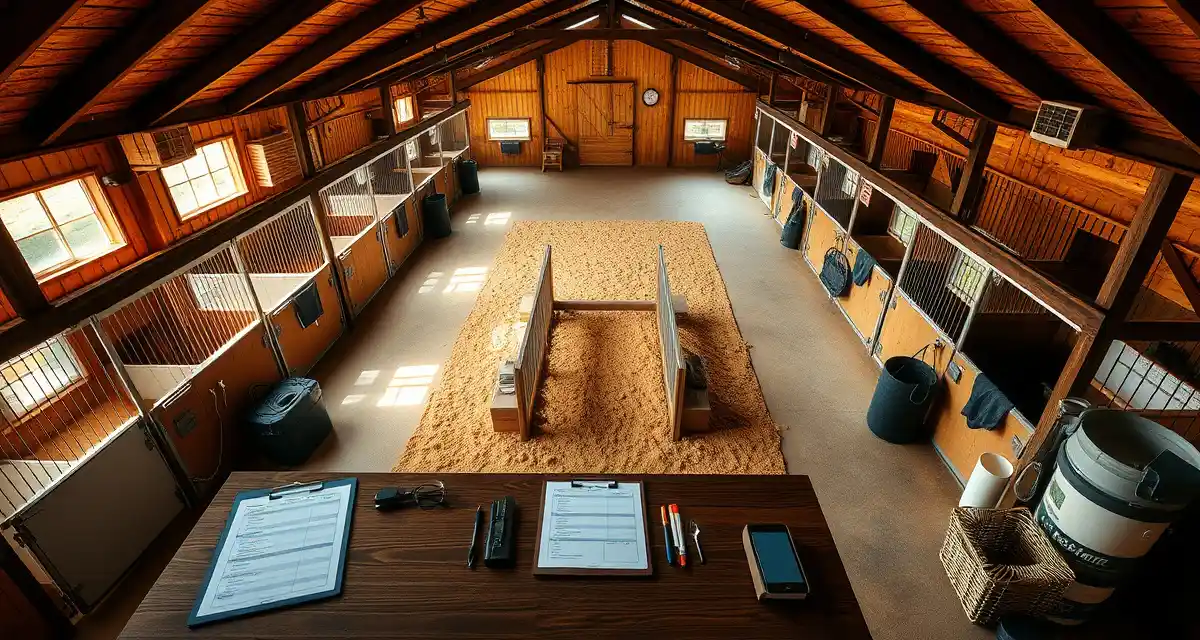
Barn Operations: A Practical Guide for Equestrian Facility Managers
Barn operations is the sum of everything that needs to happen at your equestrian facility to keep horses healthy, owners satisfied, and the business financially viable. It's feeding and watering, yes, but it's also billing, staff coordination, scheduling, facility maintenance, health record management, and client communication. This guide covers how to think about operations as a system and what tools make that system reliable.
The Core Operational Areas
Daily horse care: The recurring cycle of feeding, watering, turnout, stall cleaning, blanketing, and health monitoring that is the core product of a boarding operation. This needs to happen consistently, at high quality, regardless of which staff member is on duty. See barn daily operations for the detailed framework.
Health record management: Tracking vaccinations, Coggins tests, dental care, farrier visits, vet appointments, and medications for every horse. Accurate health records protect your horses, meet regulatory requirements, and protect your liability when something goes wrong.
Billing and finance: Monthly invoicing for board and services, payment collection, late payment management, and the financial records needed for tax compliance. See barn billing invoicing for a complete billing framework.
Staff management: Hiring, training, scheduling, and supervising barn staff. In most equestrian facilities, staff are the most significant expense and the biggest determinant of care quality. See barn staff management.
Owner communication: Keeping boarders informed and engaged without consuming all of the barn manager's time. See barn owner communication.
Facility maintenance: Keeping stalls, fencing, water systems, arenas, and equipment in safe, functional condition. Deferred maintenance in an equine facility is a liability risk. See barn maintenance scheduling.
Scheduling: Coordinating farrier visits, vet appointments, lesson blocks, and staff shifts in a shared system that prevents conflicts and missed appointments.
What Good Operations Looks Like
A well-run equestrian facility has a few defining characteristics:
Consistency: Care standards hold whether the barn manager is on-site or not, whether it's a Tuesday in March or a Sunday in December. This requires written procedures, trained staff, and accountability systems.
Information accessibility: Staff can look up any horse's feeding instructions, medications, or care notes without having to call someone. Owners can check their horse's care log without calling the barn.
Financial clarity: The barn manager knows at any time what revenue is expected this month, what's been collected, and what's outstanding. Billing runs on schedule without manual intervention.
Proactive maintenance: Facility repairs are caught early and scheduled before they become safety issues. Water systems, fencing, and stall hardware are checked regularly.
Building Systems That Hold Up Under Stress
The test of your operations systems is what happens when something goes wrong: a key staff member calls in sick, a horse develops a health issue, a major piece of equipment fails. If your systems depend on a specific person's institutional knowledge, they're fragile. If they're documented and accessible to the whole team, they're resilient.
BarnBeacon supports this resilience by making horse records, care instructions, checklists, and communication tools accessible to the whole team, not locked in a specific person's head or on their personal phone.
For how operations management integrates with software tools, see barn operations management and barn management software.
FAQ
What is Barn Operations: A Practical Guide for Equestrian Facility Managers?
Barn Operations: A Practical Guide for Equestrian Facility Managers is a comprehensive resource covering every operational dimension of running an equestrian facility. It addresses daily horse care routines, health record management, billing and invoicing, staff coordination, facility maintenance, and client communication. Rather than treating these as isolated tasks, the guide frames them as an interconnected system, helping barn managers build reliable processes that work consistently regardless of who is on duty.
How much does Barn Operations: A Practical Guide for Equestrian Facility Managers cost?
This guide is free to read on BarnBeacon. There is no purchase required or paywall. The content is provided as an educational resource for equestrian facility managers looking to improve their operations. Some barn management software tools referenced or recommended within the guide may carry their own subscription costs, but the guide itself is publicly accessible at no charge.
How does Barn Operations: A Practical Guide for Equestrian Facility Managers work?
The guide works by breaking barn operations into distinct functional areas—daily horse care, health records, billing, scheduling, and facility maintenance—and explaining how each area should be structured as a repeatable system. It provides frameworks, checklists, and practical recommendations so managers can audit their current processes, identify gaps, and implement improvements that hold up even when staffing or circumstances change.
What are the benefits of Barn Operations: A Practical Guide for Equestrian Facility Managers?
The primary benefit is operational reliability. When barn operations run as a coordinated system rather than a collection of ad hoc tasks, horses receive consistent care, clients stay satisfied, and financial records stay clean. Managers spend less time firefighting and more time running a stable business. Secondary benefits include reduced liability exposure through proper health recordkeeping and smoother staff handoffs when procedures are clearly documented.
Who needs Barn Operations: A Practical Guide for Equestrian Facility Managers?
This guide is written for anyone responsible for managing an equestrian boarding facility—whether a sole-operator running a small private barn or a team managing a large multi-discipline facility. It is also useful for barn owners transitioning from informal to more professional operations, staff members stepping into management roles for the first time, and anyone evaluating barn management software or looking to systemize their current workflows.
How long does Barn Operations: A Practical Guide for Equestrian Facility Managers take?
Reading the core guide takes roughly 15 to 30 minutes. Implementing the frameworks it describes is an ongoing process that varies by facility size and current operational maturity. A small barn with informal systems might take a few weeks to build out consistent procedures. Larger facilities with staff teams may invest a month or more in training, documentation, and software setup before seeing fully systematized operations.
What should I look for when choosing Barn Operations: A Practical Guide for Equestrian Facility Managers?
When evaluating this type of operational guide, look for practical specificity over generic advice. Good barn operations content should address real workflows—not just principles—and link to deeper resources on billing, health records, daily checklists, and staffing. Check whether the guide is written for facility managers rather than horse owners, and whether it accounts for both the care side and the business side of running a barn.
Is Barn Operations: A Practical Guide for Equestrian Facility Managers worth it?
Yes, for any barn manager serious about running a reliable, professional facility, this guide is worth the time investment. Barn operations failures—missed medications, billing errors, poor client communication—are expensive and damaging to reputation. A structured operational framework reduces those risks significantly. Even experienced managers often find value in reviewing a systematic approach, since informal systems that worked at small scale frequently break down as a facility grows.