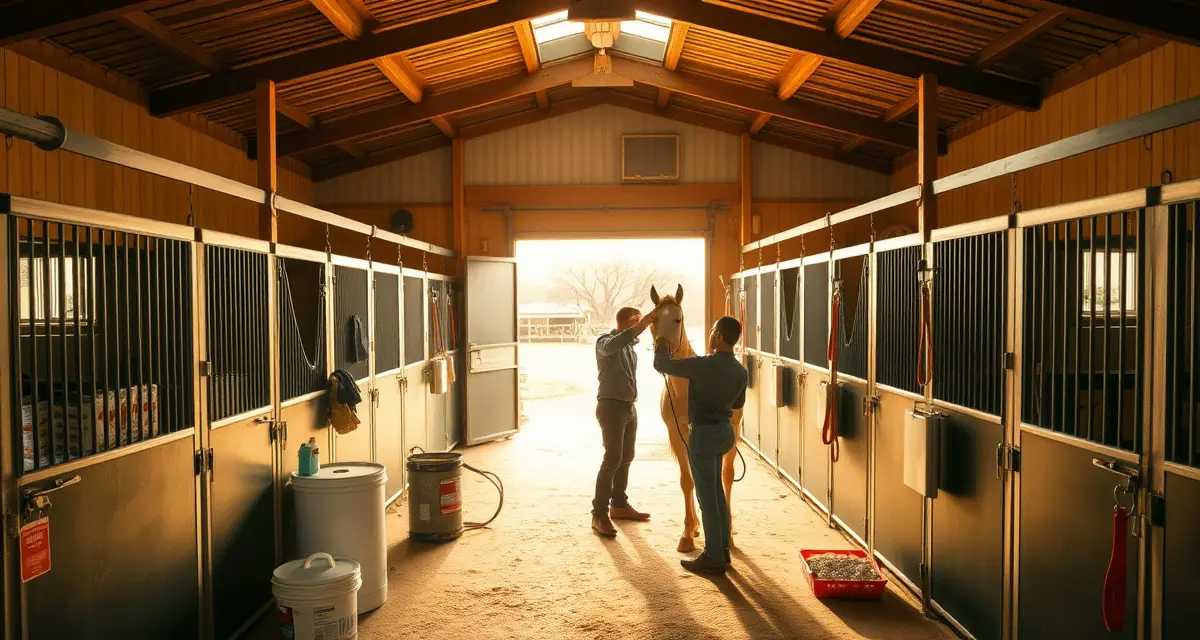
Equine Daily Care Management: Running a Full Barn Every Day
The daily care routine at a boarding or training facility is deceptively complex. From the outside it looks like feeding horses and cleaning stalls. From the inside it is a precision operation with individual feed programs, medications, turnout rotations, blanketing decisions, and a dozen small judgment calls happening before most people are awake. When it runs well, it is invisible. When it breaks down, horses miss meals, medications get skipped, and owners notice.
The Morning Routine
The morning feed and check is the most critical part of the daily care cycle. Every horse should be observed at morning feed. The person doing rounds needs to be looking at each horse, not just filling buckets. Observations that should trigger a flag: a horse not at the door for grain, a horse showing signs of discomfort, loose manure or no manure in the stall, water bucket empty or untouched, any new swelling or injury.
A structured morning routine typically runs in a consistent order: visual check of every horse, fresh water if needed, grain distribution, hay, medications to horses that receive AM meds, and then stall cleaning. Some barns turn out before cleaning, others clean first. Either approach works as long as it is consistent, because horses adapt to routine and deviations cause stress.
Individual Feed Programs
The part of daily care management that creates the most complexity is individual feed programs. At a barn with 30 horses, you may have 30 different feeding instructions. Some horses get straight hay with no grain. Others are on senior feed, performance rations, or therapeutic diets. Supplements range from a joint product added to grain to a complicated multi-supplement stack that takes three minutes per horse to prepare.
Each horse's feeding instructions should be written down, current, and accessible to every staff member. A feeding chart that has not been updated since last year is a liability. When a horse changes feed due to a metabolic issue, injury, or age, the chart needs to change that day.
Feeding charts should include:
- Hay type and quantity per feeding
- Grain type, brand, and quantity
- Each supplement with the exact amount
- Any medications mixed into feed
- Water or soaking instructions if applicable
- Notes on slow feeders, hay nets, or ground feeding requirements
Turnout Management
Turnout schedules are another source of daily complexity. Horses that cannot be turned out together due to social aggression, injury protocols, or owner preferences need separate fields or rotation schedules. A horse that kicks at the fence gate and injures itself requires a protocol change immediately, which then ripples through the turnout schedule.
Document the current turnout groupings and any exceptions. When the schedule changes, update the documentation and communicate the change to all staff before the next turnout. Verbal communication alone does not work when you have multiple staff members working different shifts.
Medication Administration
Daily medication administration is a task that requires particular care. Errors can harm horses and create liability for the facility. Best practices:
- Every medication should be stored with a clearly labeled instruction card including dose, frequency, and duration
- Medications should be checked off on a task list at each administration, not simply given and assumed
- Any medications requiring specific timing (for instance, a drug that must be given with feed or away from feed) should note this explicitly
- Completed and refilled prescriptions should be documented in the horse's health record, not just in a logbook
For controlled substances or medications given by injection, facilities should have a protocol that defines who is authorized to administer and what documentation is required.
End-of-Day Checks
The evening feed and check is the second anchor of daily care. Each horse should be observed again. This is when PM medications are administered, blankets go on if conditions require it, and any issues noticed during the day get communicated to the owner if warranted.
An end-of-day check should also confirm: fresh water in every stall, adequate hay for overnight, stall doors and gate latches secured, any equipment put away from turnout, and any incidents or observations logged.
BarnBeacon gives staff a structured way to log daily observations and complete care tasks with accountability, so the manager does not have to rely on memory or end-of-day verbal reports to know what happened with each horse.
Communicating with Horse Owners
Daily care management has a communication component that extends beyond the barn. Owners want to know their horse is well. Proactive communication about minor issues, changes in feed or turnout, or vet observations builds trust and reduces the volume of "how is my horse doing?" texts.
For more on structuring owner communication as part of daily operations, see equine facility management. For connecting daily care records to health tracking, see equine health tracking.
Daily care that runs consistently and is documented properly is the foundation everything else in a barn operation is built on. Get this right before expanding into more complex services.
FAQ
What is Equine Daily Care Management: Running a Full Barn Every Day?
Equine daily care management refers to the structured, repeatable system used to care for horses at a boarding or training facility every day. It encompasses morning and evening checks, individual feed programs, stall cleaning, turnout rotations, blanketing decisions, and medication administration. When done well, this routine keeps horses healthy, reduces stress, and ensures nothing is missed — from a skipped meal to an early sign of colic. It is the operational backbone of any well-run barn.
How much does Equine Daily Care Management: Running a Full Barn Every Day cost?
Daily equine care management is not a product with a set price — it is a service built into boarding or training fees. Full-care boarding typically ranges from $400 to over $2,000 per month depending on location, facility quality, and included services. Facilities with detailed individual feed programs, medication management, and attentive daily observation command higher rates. The cost reflects labor intensity: a full barn requires consistent, skilled staff performing dozens of individual tasks every single day.
How does Equine Daily Care Management: Running a Full Barn Every Day work?
Equine daily care management works by following a consistent, structured routine that covers every horse at every feeding. Staff perform visual health checks, distribute individualized grain and hay, administer medications, clean stalls, manage turnout, and adjust blanketing based on weather. Detailed records — often a daily care log or barn management software — track what each horse received and flag anything unusual. The system relies on clear communication between staff, written protocols, and individual horse records to prevent errors.
What are the benefits of Equine Daily Care Management: Running a Full Barn Every Day?
The primary benefit is horse health and safety. Consistent daily care catches problems early — a horse off feed, subtle lameness, or an unusual behavior pattern — before they become emergencies. For owners, it provides peace of mind that their horse is being watched with genuine attention. For barn managers, a well-run daily care system reduces staff errors, supports accurate billing, and builds the reputation that attracts and retains quality clients over the long term.
Who needs Equine Daily Care Management: Running a Full Barn Every Day?
Any horse owner who boards their animal at a professional facility depends on equine daily care management. Barn managers, barn staff, and grooms need a working knowledge of these systems to execute them reliably. Facility owners benefit from understanding the operational structure to hire correctly, set pricing, and maintain standards. Even horse owners who keep horses at home benefit from applying these same principles — consistent routines, individual records, and daily observation are best practices regardless of scale.
How long does Equine Daily Care Management: Running a Full Barn Every Day take?
The daily care routine itself typically takes three to five hours in the morning and one to two hours in the evening for a full barn. However, building a reliable system — writing feed charts, establishing turnout rotations, training staff, and implementing a health observation protocol — takes weeks to develop and refine. Maintaining it is an ongoing daily commitment. There are no shortcuts: the time invested directly reflects the standard of care horses receive.
What should I look for when choosing Equine Daily Care Management: Running a Full Barn Every Day?
When evaluating a facility's daily care program, look for evidence of individual attention: does each horse have a written feed program, a current medication list, and a documented health history? Ask how morning checks are structured and who is responsible for flagging health concerns. Look for consistent staffing rather than frequent turnover. A barn that uses a daily care log or management software and can show you records is demonstrating accountability — that transparency is a meaningful sign of operational quality.
Is Equine Daily Care Management: Running a Full Barn Every Day worth it?
For horses in professional boarding or training, quality daily care management is not optional — it is the foundation everything else is built on. A horse that is fed correctly, observed closely, and handled consistently will stay healthier, perform better, and have a longer useful life. For barn owners, investing in strong daily care systems reduces liability, builds client trust, and separates a professionally run operation from one that merely survives. The return on a well-structured daily care routine is measured in healthier horses and fewer emergencies.