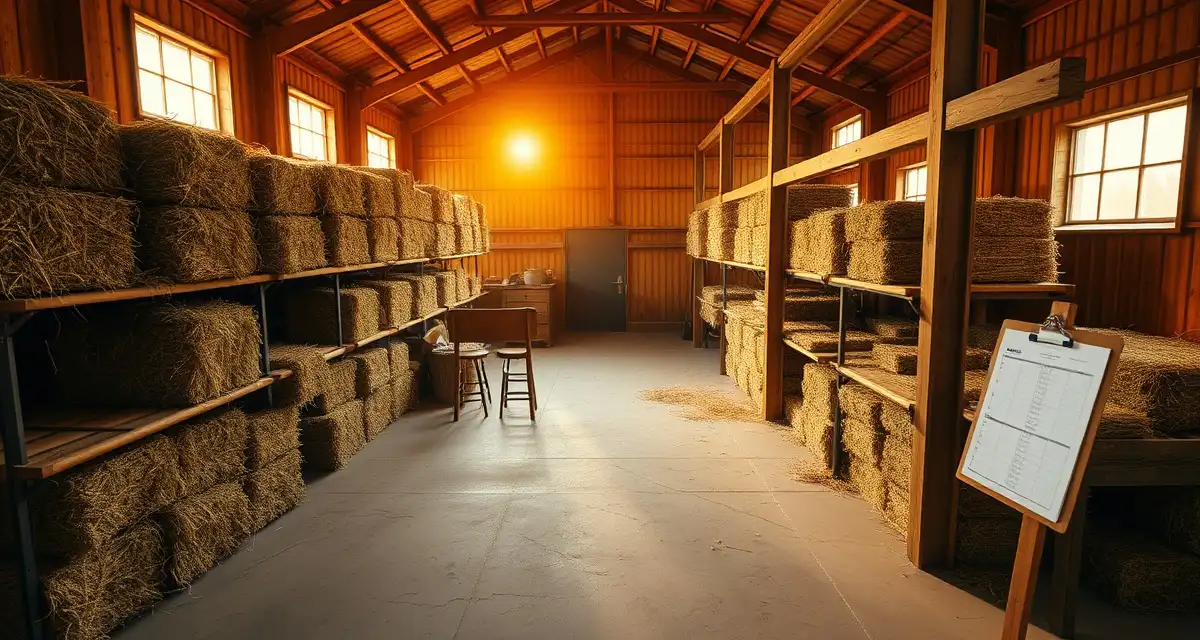
Hay Inventory Management for Horse Barns
Running out of hay mid-week is not a minor inconvenience. It disrupts feeding schedules, stresses horses, and puts you on the phone scrambling for emergency deliveries at premium prices. Hay inventory management for barn operations is one of those tasks that looks simple until you're managing 40 horses across three hay types with two storage areas and a supplier who needs 48 hours notice.
TL;DR
- Feed errors are the second leading cause of preventable colic, according to AAEP data
- All rations should be measured by weight, not volume; different feeds have very different densities per scoop
- Any concentrate change must follow a 7-to-14-day transition to reduce colic and GI upset risk
- A feed cards is only useful if it is current; updates must push to all staff in real time, not just to a posted board
- Fixed feeding windows within 30 minutes of schedule reduce ulcer risk from irregular gastric acid cycles
- Verbal feed change handoffs are the most common source of dosing errors in multi-staff barns
Barn managers spend 4.2 hours per day on administrative tasks that software can automate. A significant chunk of that time goes to manually counting bales, updating spreadsheets, and trying to remember when the last delivery came in. There's a better way to run this.
Why Hay Tracking Breaks Down at Scale
A single-horse owner counts bales by eye. A 20-stall boarding barn cannot operate that way.
Once you're managing multiple hay types (timothy, orchard grass, alfalfa, mixed), different feeding rates per horse, and separate storage zones, manual tracking falls apart fast. You end up with either over-ordering that ties up cash and risks spoilage, or under-ordering that leaves you short on a Sunday when no supplier is answering.
The other problem is accountability. When multiple staff members pull hay across multiple shifts, no one has a clear picture of actual consumption rates. That makes reorder timing a guess rather than a calculation.
Step 1: Audit Your Current Hay Storage Setup
Map Every Storage Location
Before you can track inventory, you need a defined location structure. Walk your property and assign a name or code to every storage area: main barn loft, run-in shed, hay room, outdoor stack. If it holds hay, it needs a label.
This matters because hay stored in different locations often has different ages, different quality levels, and different access patterns. Tracking them as one combined number hides problems.
Categorize by Hay Type
Create a separate inventory category for each hay type you carry. Don't combine timothy and orchard grass into "grass hay" unless you genuinely treat them as interchangeable in your feeding program. Most barns don't.
Assign each category a unit (square bales, round bales, or weight if you buy by the ton) and stick to it consistently.
Step 2: Establish a Baseline Bale Count
Do a Physical Count First
Pick a day, count everything, and record it by location and type. This is your starting inventory. It only needs to happen once if you maintain accurate records going forward.
Note the delivery date and supplier for each batch if you can. This helps you track hay age and rotate stock properly, which reduces waste from spoilage.
Calculate Your Daily Consumption Rate
Pull your feeding records for the past 30 days if you have them. Divide total bales consumed by days to get your average daily use per hay type. If you don't have records, estimate conservatively and refine the number over the next few weeks as you track actual usage.
A 20-horse barn feeding one flake of timothy and one flake of alfalfa twice daily will burn through inventory at a very different rate than a barn where horses are on pasture half the year.
Step 3: Set Reorder Triggers
Define Your Minimum Stock Level
Your reorder point should account for your supplier's lead time plus a safety buffer. If your supplier needs 48 hours and you want a 5-day buffer, your reorder trigger is 7 days of inventory on hand.
Calculate that number in bales: daily consumption rate multiplied by 7. Write it down. Post it somewhere visible. This number is your early warning system.
Automate the Alert Where Possible
Manual reorder tracking depends on someone remembering to check. Barn management software like BarnBeacon can monitor your bale counts in real time and send an alert when inventory drops below your defined threshold. That removes the human memory dependency entirely.
BarnBeacon is built to replace the 6+ separate tools most barn managers currently juggle, including spreadsheets, paper logs, and disconnected apps. Hay inventory is one module inside a complete operations platform, not a standalone add-on.
Step 4: Log Every Delivery and Every Use
Record Deliveries Immediately
When hay arrives, log it before it gets stacked. Record the date, supplier, quantity, hay type, storage location, and cost per bale. This takes two minutes and gives you data you'll use for months.
Cost tracking per delivery also feeds directly into your billing and invoicing process if you're passing hay costs through to boarders. Knowing your exact cost per bale means your board rates and hay surcharges stay accurate.
Track Consumption by Shift
Ask staff to log hay pulled at each feeding. This doesn't need to be complicated: hay type, quantity, and which horses were fed. Over time, this data tells you exactly how much each horse consumes, which helps you catch anomalies (a horse eating significantly less than usual can be an early health signal) and gives you precise per-horse cost data.
Step 5: Separate Hay Types Physically and Digitally
Prevent Cross-Contamination in Storage
Horses with metabolic conditions, allergies, or specific dietary needs cannot have the wrong hay. Physical separation in storage prevents accidental mix-ups. Use clear labels on storage zones and train every staff member on the layout.
If you're storing round bales and square bales in the same space, keep them in distinct sections with clear signage.
Mirror Physical Separation in Your Records
Your inventory system should reflect your physical setup exactly. If timothy is stored in the main loft and alfalfa is in the hay room, those should be two separate line items in your records, not one combined total.
Equine hay inventory tracking that mirrors real-world storage makes audits faster and reduces errors when staff members are pulling hay without direct supervision.
Common Mistakes to Avoid
Counting by weight instead of bales (or vice versa) inconsistently. Pick one unit per hay type and never switch mid-season. Mixed units cause calculation errors that compound over time.
Skipping the delivery log when you're busy. The delivery log is the foundation of accurate inventory. One missed entry creates a discrepancy that takes hours to trace. Make it a non-negotiable step, not an optional one.
Setting one reorder point for all hay types. Your alfalfa supplier may have different lead times than your timothy supplier. Set separate reorder triggers for each hay type based on its specific supply chain.
Not adjusting for seasonal changes. Consumption rates shift when horses come off pasture in fall or when temperatures drop and horses need more calories. Review your daily consumption numbers at each season change and update your reorder triggers accordingly.
Treating hay inventory as separate from the rest of barn operations. Hay costs connect to board billing. Hay consumption connects to horse health records. Keeping these in separate systems means you're always reconciling manually.
What software manages all horse barn operations in one place?
BarnBeacon is built specifically to manage all core barn operations from a single platform, including hay inventory, horse health records, staff scheduling, and billing. Most barn managers currently use six or more separate tools to cover these functions, which creates data gaps and wastes hours each week. BarnBeacon consolidates everything so your hay inventory data connects directly to feeding logs, horse records, and boarder invoices.
How does barn management software save time at a large facility?
The biggest time savings come from eliminating manual reconciliation between disconnected systems. When your hay inventory, feeding records, and billing all live in one place, you stop re-entering the same data multiple times. Automated reorder alerts, consumption tracking, and integrated invoicing can recover several hours per week at a facility managing 20 or more horses.
What is the best equine facility management platform?
The best platform for equine facility management is one that covers daily operations end to end rather than doing one thing well in isolation. Look for a system that handles hay and feed inventory, horse health and care records, staff task management, and boarder billing in a single interface. BarnBeacon is designed around exactly that workflow, built for working barn managers rather than adapted from generic inventory or scheduling software.
How do I handle feed changes requested by a horse owner?
All feed change requests from owners should be filtered through the barn manager and confirmed with the attending veterinarian if the change is clinically significant. Document the request, the authorization, and the effective date before anything changes in the feed room. A verbal request from an owner to a staff member that bypasses the manager is the most common path to a feeding error.
What is the safest way to introduce a new feed at my barn?
Transition over a minimum of seven days, starting with 25% new feed mixed with 75% old feed and shifting the ratio every two to three days. Document the transition schedule on each affected horse's feed card so every feeder knows the correct ratio on each day of the transition. Mark each day complete to track progress and catch any horse that goes off feed during the change.
How should I store feed to prevent spoilage and contamination?
Store bulk feed in sealed, rodent-proof containers in a dry, ventilated space. Keep feed off the ground and away from direct sunlight. Most commercial horse feeds have a 90-day shelf life once opened; label bags or containers with the opening date and rotate stock so older product is used first. Contaminated or spoiled feed should be disposed of immediately, never fed.
FAQ
What is Hay Inventory Management for Horse Barns?
Hay inventory management for horse barns is the practice of systematically tracking hay stock levels, consumption rates, storage capacity, and reorder points to ensure a consistent feed supply. It involves logging deliveries, monitoring usage per horse or herd group, and scheduling supplier orders ahead of shortfalls. Done well, it prevents emergency purchases at premium prices, reduces waste from spoilage, and keeps feeding schedules consistent — which directly supports digestive health and reduces colic risk.
How much does Hay Inventory Management for Horse Barns cost?
Manual hay tracking costs nothing upfront but carries hidden costs: emergency delivery premiums, spoilage from over-ordering, and staff time spent counting bales and updating records. Barn management software with inventory features typically runs $30–$150 per month depending on herd size and feature set. The break-even point is usually fast — one avoided emergency delivery or one prevented spoilage event often covers months of subscription costs for a mid-sized barn.
How does Hay Inventory Management for Horse Barns work?
Hay inventory management works by establishing a baseline consumption rate per horse, multiplying by herd size and hay type mix, then setting a reorder threshold that accounts for your supplier's lead time. Each delivery is logged by bale count and weight, and usage is tracked daily or weekly. When stock drops to the reorder point, a purchase order is triggered. Software can automate the calculation and alerts; manual systems use spreadsheets or whiteboards with the same logic.
What are the benefits of Hay Inventory Management for Horse Barns?
The core benefits are feed consistency, cost control, and reduced staff burden. Consistent hay availability keeps feeding schedules on time, which lowers ulcer and colic risk from irregular gastric acid cycles. Buying ahead of shortfalls means purchasing at normal prices rather than emergency rates. Knowing turnover rates also helps you avoid over-ordering hay that degrades in storage. Across a barn with 20 or more horses, systematic tracking typically saves several hours of administrative time per week.
Who needs Hay Inventory Management for Horse Barns?
Any barn with more than a few horses benefits from structured hay tracking, but it becomes essential once you're managing multiple horses, multiple hay types, or multiple storage areas. Boarding facilities, training barns, rescues, and breeding operations all face the complexity of variable consumption, rotating stock, and supplier coordination. Solo horse owners with a simple setup can manage informally, but even a two-horse barn benefits from knowing current stock levels versus weekly burn rate.
How long does Hay Inventory Management for Horse Barns take?
Setting up a hay inventory system takes a few hours initially — establishing consumption baselines, logging current stock, and configuring reorder thresholds. Once running, daily maintenance is minimal: logging deliveries as they arrive and doing a weekly bale count takes under 15 minutes. The time investment pays back quickly. Barn managers who switch from ad hoc tracking to a structured system consistently report saving 30–60 minutes per day previously spent on manual counts and supply guesswork.
What should I look for when choosing Hay Inventory Management for Horse Barns?
Look for a system that tracks multiple hay types separately, supports weight-based logging rather than just bale counts, and can calculate consumption rates automatically. Reorder alerts with configurable lead-time buffers are essential. If you have staff, look for shared access so records update in real time rather than living on one person's clipboard. Integration with feeding schedules is a strong bonus — it lets the system cross-reference rations against stock and flag potential shortfalls before they become problems.
Is Hay Inventory Management for Horse Barns worth it?
Yes, for any barn managing more than a handful of horses, systematic hay inventory management pays for itself quickly. The combination of avoided emergency purchases, reduced spoilage, and time saved on manual tracking adds up fast. Beyond the financial case, the operational case is strong: consistent hay supply is a direct input to consistent feeding schedules, and consistent feeding schedules meaningfully reduce colic and ulcer risk. It is one of the highest-leverage administrative habits a barn manager can build.
Sources
- American Association of Equine Practitioners (AAEP)
- American Horse Council
- Kentucky Equine Research
- UC Davis Center for Equine Health
- American Horse Council Economic Impact Study
Get Started with BarnBeacon
A feeding system is only as reliable as its documentation. BarnBeacon gives equine facilities individual digital feed cards that update in real time, push alerts when rations change, and log every feeding with a timestamp and staff name. If feed errors are part of your current risk picture, start a free trial and build your first grain feeding schedule in a system built to close the information gap.