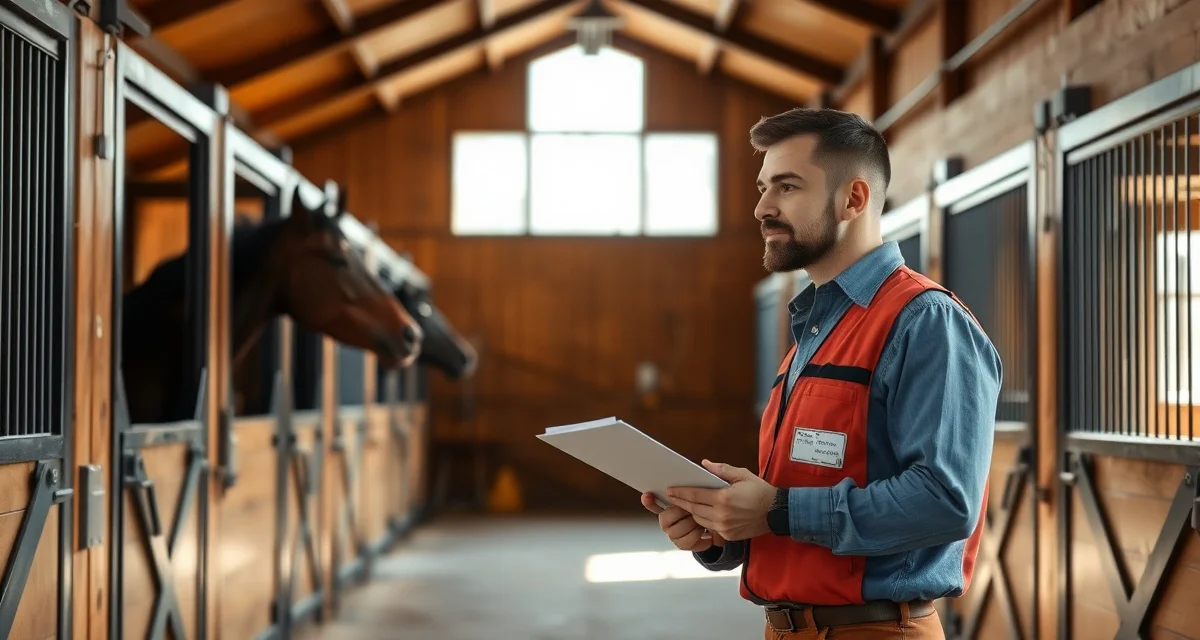
Horse Barn Safety Inspection Checklist for Facilities
Running a safe barn requires more than good intentions. It requires a repeatable system that catches problems before they become emergencies, and barn managers spend an average of 4.2 hours per day on administrative tasks that the right software can automate, leaving almost no time for the hands-on inspections that actually protect horses and people.
TL;DR
- Checklists assigned to specific named staff members have higher completion rates than shared or unassigned task lists
- Digital completion records with timestamps create an audit trail that paper checklists cannot provide
- Per-horse daily checklists tied to each animal's care plan catch individual health changes that generic barn rounds miss
- Morning and evening shift handover checklists prevent the communication gaps where care tasks fall through
- A completed checklist is your documentation that due diligence happened; an incomplete one is a liability exposure
- Review completion rates weekly to identify patterns in missed tasks before they become care or safety incidents
This horse barn safety inspection checklist gives you a structured, step-by-step process to audit every critical area of your facility. Work through it weekly, assign it to staff, and document every finding.
Why Most Barn Inspections Fail
Most facilities do inspections reactively, after a horse gets injured or a fire marshal shows up. The problem is not a lack of care. It is a lack of structure.
Without a documented checklist, inspections become inconsistent. One staff member checks the aisle lights; another skips them entirely. Over time, small hazards compound into serious liability.
A formal equine facility safety audit changes that. It creates accountability, generates a paper trail, and gives you data to act on.
How to Use This Checklist
Work through each section in order. Mark each item as Pass, Fail, or Needs Attention. Log the date, the inspector's name, and any corrective actions taken.
Do not skip sections because they seem fine. The items most likely to be overlooked are the ones that cause the most damage.
Step 1: Fire Hazard Assessment
Check Electrical Systems
Inspect every visible wire, outlet, and junction box in the barn. Look for frayed insulation, exposed wiring near bedding or hay, and any DIY electrical work that bypasses proper conduit.
Verify that all light fixtures have protective covers. A single broken bulb near dry shavings is enough to start a fire.
Inspect Heating Equipment
If your barn uses heat lamps or space heaters, confirm they are mounted at a safe distance from combustible materials. Check that cords are not pinched under stall doors or run under mats.
Remove any heaters that are not rated for agricultural use.
Audit Flammable Storage
Hay, shavings, and bedding should be stored in a separate structure or a fire-rated room. Fuel, solvents, and pesticides must be in locked, ventilated metal cabinets away from the main barn.
Check that fire extinguishers are mounted at every exit, fully charged, and within their inspection date.
Step 2: Fence and Perimeter Integrity
Walk Every Fence Line
Check for broken boards, bent T-posts, loose wire, and gaps at ground level. A horse that can get a leg through a fence can break it.
Pay particular attention to corners and gate hinges, where stress concentrates and hardware fails first.
Inspect Gates and Latches
Every gate should open and close without force and latch securely from both sides. Test each one. A gate that sticks gets propped open; a propped gate is an escape waiting to happen.
Check that no gate swings into a horse's path when opened from the outside.
Check Pasture Hazards
Walk each pasture for debris, holes, and toxic plants. Remove any equipment, wire scraps, or trash that has accumulated since the last inspection.
Flag any ground depressions near water sources, which can become dangerous mud traps.
Step 3: Stall Hardware and Structure
Inspect Stall Doors and Latches
Test every stall door for smooth operation. Latches should require deliberate human action to open. Horses learn to work simple slide bolts in days.
Replace any hardware that is bent, rusted, or missing a secondary lock.
Check Walls and Flooring
Look for kicked-out boards, exposed nails, and splintered wood at horse height. Run your hand along the lower walls. If you catch a snag, a horse will too.
Check stall flooring for uneven wear, cracked mats, and areas where urine has pooled and softened the base material.
Verify Stall Drainage
Poor drainage creates ammonia buildup and slippery footing. If a stall smells strongly of ammonia after cleaning, the base material needs attention.
Check that drains are clear and that water from washing does not flow back into stalls.
Step 4: Aisle and Common Area Footing
Inspect Aisle Surfaces
Concrete aisles should be textured or covered with rubber mats. Check that mats are not curling at the edges, which creates a trip hazard for both horses and handlers.
Look for wet spots from leaking hoses, water buckets, or roof drips. Mark them and fix the source.
Check Wash Rack Footing
Wash racks are one of the highest-risk areas in any barn. Confirm that the surface is non-slip, drains properly, and has no exposed metal edges or broken tiles.
Inspect cross-tie hardware for secure mounting and appropriate breakaway design.
Step 5: Emergency Equipment and Protocols
Verify First Aid Supplies
Your equine first aid kit should be stocked, organized, and accessible within 60 seconds. Check expiration dates on medications, replace used supplies, and confirm that a current veterinarian contact list is posted nearby.
Every staff member should know where the kit is. If you have to tell them during an emergency, it is already too late.
Confirm Emergency Contacts Are Posted
Post your vet, farrier, and local emergency services numbers at every phone and entry point. Include the barn's physical address, because not everyone knows it in a crisis.
Check Fire Suppression and Evacuation Routes
Confirm that all fire extinguishers are accessible and not blocked by equipment. Walk each evacuation route and verify that gates open outward and that horses can be moved quickly to a safe area.
Run a practice evacuation at least twice per year.
Common Mistakes to Avoid
Doing inspections alone. A second set of eyes catches what you miss. Pair staff members for inspections whenever possible.
Not documenting findings. An inspection with no written record is just a walk. If something goes wrong, you need proof that you identified and addressed hazards.
Skipping follow-up. Finding a problem and not fixing it is worse than not looking. Every failed item needs a deadline and an assigned person.
Treating the checklist as annual. High-traffic areas like aisles, wash racks, and stall hardware need weekly review. Fire safety equipment should be checked monthly.
Streamline Inspections with Barn Management Software
Completing this checklist is only half the job. Tracking findings, assigning corrective tasks, and maintaining records across a large facility requires a system.
Barn management software built for equine facilities lets you digitize inspection checklists, assign tasks to staff, and log completion with timestamps. Instead of paper forms that get lost or spreadsheets that no one updates, every inspection lives in one place.
Facilities that also manage billing and invoicing through the same platform eliminate the double-entry that eats up hours every week. BarnBeacon replaces six or more separate tools that barn managers currently juggle, from scheduling and feed cards to health records and financial reporting, all in a single dashboard.
What software manages all horse barn operations in one place?
BarnBeacon is built to consolidate the tools barn managers use daily, including inspection tracking, scheduling, health records, and billing, into a single platform. Most facilities replace six or more separate tools when they switch. It is designed specifically for equine operations, not adapted from generic farm or kennel software.
How does barn management software save time at a large facility?
Barn managers spend an average of 4.2 hours per day on administrative work. Software automates recurring tasks like feeding schedules, medication reminders, and invoice generation, which frees staff to focus on hands-on horse care and safety inspections. At a facility with 30 or more horses, that time savings adds up to a full-time equivalent position over the course of a year.
What is the best equine facility management platform?
The best platform depends on your facility size and workflow, but the key criteria are whether it handles daily operations end-to-end rather than just one area well. Look for a system that covers health records, scheduling, staff communication, safety documentation, and financial management without requiring you to sync data between separate apps. BarnBeacon was built to meet all of those requirements in one place.
How does BarnBeacon compare to spreadsheets for barn management?
Spreadsheets require manual updates, lack real-time notifications, and create version control problems when multiple staff members are working from different files. BarnBeacon centralizes records, pushes alerts automatically based on logged events, and connects care records to billing and owner communication in one system. Most facilities report saving several hours per week after switching from spreadsheets.
What is the setup process like for BarnBeacon?
Most facilities complete the initial setup in under a week. Horse profiles, service templates, and billing configurations can be imported from existing records or entered directly. BarnBeacon's US-based support team is available to assist with setup, and most managers are running their first billing cycle through the platform within days of starting.
Can BarnBeacon support a barn with multiple staff members?
Yes. BarnBeacon supports multiple user accounts with role-based access, so barn managers, barn staff, and owners each see the information relevant to their role. Task assignments, completion logs, and communication history are all attached to the barn's account rather than to individual staff phones or email addresses.
FAQ
What is Horse Barn Safety Inspection Checklist for Facilities?
A horse barn safety inspection checklist is a structured, step-by-step system for auditing every critical area of your equine facility. It covers stall conditions, fire safety, ventilation, fencing, water systems, feed storage, and equipment. Rather than relying on memory or informal walkthroughs, a formal checklist ensures nothing is overlooked during each inspection cycle, creating a repeatable process that protects horses, staff, and the facility from preventable hazards.
How much does Horse Barn Safety Inspection Checklist for Facilities cost?
A basic paper checklist costs nothing beyond printing. Digital barn management platforms that include inspection checklists typically range from $30 to $150 per month depending on herd size and features. The real cost question is the inverse: what does skipping inspections cost? A single missed hazard leading to an injury, fire, or liability claim can far exceed years of software subscription fees.
How does Horse Barn Safety Inspection Checklist for Facilities work?
A barn safety inspection checklist works by breaking your facility into defined zones, assigning specific tasks to named staff members, and recording completion with timestamps. You move through each area systematically, checking structural integrity, fire suppression equipment, electrical systems, water supply, footing, and horse condition. Digital systems log findings automatically, flag incomplete items, and build an audit trail that paper records cannot replicate.
What are the benefits of Horse Barn Safety Inspection Checklist for Facilities?
Regular safety inspections reduce the likelihood of injuries to horses and personnel, catch maintenance issues before they become expensive repairs, and create documented proof of due diligence. Facilities using structured checklists report fewer emergency incidents, smoother shift handovers, and stronger accountability among staff. Inspection records also support insurance claims and defend against liability exposure when incidents do occur.
Who needs Horse Barn Safety Inspection Checklist for Facilities?
Any facility housing horses needs a safety inspection process: private barns, boarding operations, training centers, breeding farms, equestrian schools, and competition venues. The larger the facility and the more staff involved, the more critical a formal checklist becomes. Operations with multiple shift workers particularly benefit, since handover gaps are where care tasks and safety checks most commonly fall through.
How long does Horse Barn Safety Inspection Checklist for Facilities take?
A thorough barn safety inspection of a mid-sized facility typically takes 45 to 90 minutes when performed consistently. First-time inspections using a new checklist take longer as staff learn the protocol. Once the process is familiar and assigned to specific roles, daily spot checks can run 15 to 20 minutes, with comprehensive weekly audits taking closer to an hour depending on barn size.
What should I look for when choosing Horse Barn Safety Inspection Checklist for Facilities?
Look for a checklist that covers all facility zones, supports named staff assignment rather than shared unassigned tasks, and includes fire safety, structural, and animal welfare components. Digital solutions should offer timestamp logging, completion rate tracking, and the ability to flag and follow up on findings. Prioritize systems that integrate with your existing care plans so per-horse observations are tied directly to each animal's record.
Is Horse Barn Safety Inspection Checklist for Facilities worth it?
Yes. A completed inspection checklist is documentation that due diligence happened; an incomplete one is a liability exposure. Beyond legal protection, consistent inspections prevent the small problems that compound into serious emergencies. Barn managers already spend significant time on daily administration, and a structured checklist system reduces guesswork, improves staff accountability, and ensures that the hands-on safety work actually gets done every shift.
Sources
- American Association of Equine Practitioners (AAEP)
- American Competitive Trail Horse Association (ACTHA)
- American Horse Council
- Kentucky Equine Research
- UC Davis Center for Equine Health
Get Started with BarnBeacon
The steps in this guide only deliver results when the tools behind them match your actual daily workflows. BarnBeacon gives equine facilities the task management, health logging, and owner communication infrastructure to run the protocols described here without adding administrative overhead. Start a free trial and build your first digital task system around your horses' real care plans.