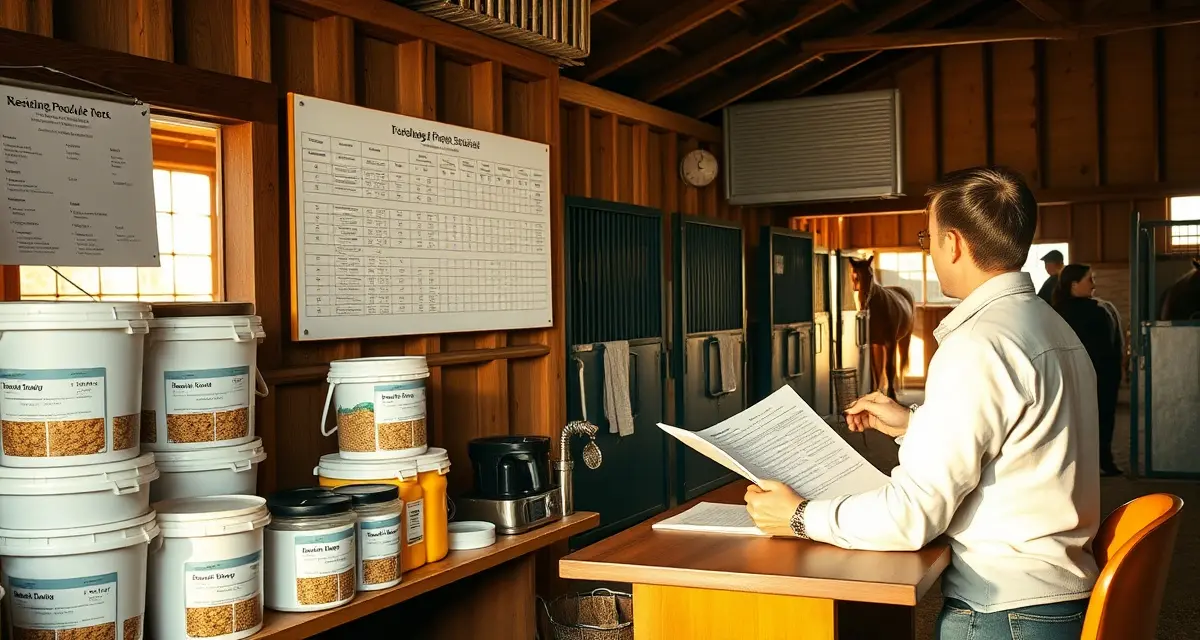
Horse Feeding Management at Training Facilities: Complete Guide
Horse feeding management at a training barn is nothing like feeding a boarding stable. Horses in active work have shifting caloric needs, strict supplement protocols, and dietary requirements that change week to week as their training load increases or tapers. One missed feed or a mislabeled supplement can affect performance, health, and your client relationships.
TL;DR
- Feed errors are the second leading cause of preventable colic, according to AAEP data
- All rations should be measured by weight, not volume; different feeds have very different densities per scoop
- Any concentrate change must follow a 7-to-14-day transition to reduce colic and GI upset risk
- A feed cards is only useful if it is current; updates must push to all staff in real time, not just to a posted board
- Fixed feeding windows within 30 minutes of schedule reduce ulcer risk from irregular gastric acid cycles
- Verbal feed change handoffs are the most common source of dosing errors in multi-staff barns
Training facilities represent a distinct segment with unique management needs, and most generic barn management advice doesn't account for that. This guide covers how to build a feeding system that actually works under the pressure of a working training operation.
Why Training Barn Feeding Is More Complex
A boarding barn feeds horses to maintain condition. A training barn feeds horses to perform. That distinction drives everything.
Horses in heavy work can require 25-30% more digestible energy than horses at rest. Their forage-to-concentrate ratios shift constantly. Horses coming off injury need different protocols than horses peaking for competition. You may have 20 horses in the barn with 20 different feed programs, all managed by multiple staff members across multiple daily feeding shifts.
The margin for error is narrow. A horse that gets the wrong feed before a competition, or misses a timed electrolyte dose, is a problem you'll be explaining to a client.
Step 1: Build Individual Feed Profiles for Every Horse
Capture the Full Picture Upfront
Every horse in your training program needs a documented feed profile before it takes its first meal in your barn. This isn't just a feed card on a stall door. It's a complete record that includes current body weight, body condition score, workload classification, forage type and quantity, concentrate type and quantity, and every supplement with exact dosing instructions.
Workload classification matters here. A horse doing light flatwork three days a week has different energy demands than one doing two-a-day conditioning sets five days a week. Build a simple tiered system (light, moderate, heavy, competition prep) and assign each horse a tier that updates as training progresses.
Document Supplement Protocols Precisely
Supplements are where training barn feeding gets complicated fast. A single horse might be on a joint supplement, a gastric support product, an omega-3 source, an electrolyte, and a performance vitamin pack. Each has its own dose, timing, and administration method.
Write out every supplement instruction in plain language. "One scoop" is not a protocol. "One level 30ml scoop of Product X mixed into the grain at the morning feeding only" is a protocol. The difference matters when a new staff member is doing the 6am feed alone.
Step 2: Create a Structured Feed Schedule
Anchor Feeding Times to Training Schedules
Training barns run on ride schedules, not just feed schedules. Horses shouldn't be fed large grain meals within an hour of hard work, and post-exercise feeding windows matter for recovery. Your feed schedule needs to be built around your training calendar, not the other way around.
Map out your typical training day. Identify when horses are being worked and build feeding windows around those blocks. For most training operations, this means an early morning feed before work begins, a midday check with targeted feedings for horses not working that day, and an evening feed after the last rides are done.
Account for Competition and Travel Days
Feed schedules break down during show weeks. Horses leave at different times, return at different times, and may have altered appetites from stress and travel. Build a separate protocol for competition prep and travel days that your staff can follow without improvisation.
This includes pre-travel feeding cutoff times, what horses get on the road, and how to handle a horse that returns from a show off feed. Having this written down before show season starts saves real problems.
Step 3: Set Up a Staff Instruction System
Make Feed Instructions Impossible to Misread
The best feed program in the world fails if staff can't execute it consistently. Every horse's feeding instructions need to be written at the level of the least experienced person who might be doing that feeding.
Use a standardized feed sheet format for every stall. Include the horse's name, owner, workload tier, all feeds with exact quantities (by weight, not scoops), all supplements with exact doses and timing, and any current dietary restrictions or veterinary notes. Laminate them. Update them immediately when anything changes.
Train Staff on the Why, Not Just the What
Staff who understand why a horse is on a particular protocol make better decisions when something unexpected happens. A groom who knows that a horse has a history of gastric ulcers will handle a missed feeding differently than one who just knows to put a scoop of powder in the bucket.
Run brief feeding orientation sessions when new staff start. Cover the basics of equine nutrition for horses in work, how to read a feed sheet, what to do if a horse isn't eating, and who to contact when something looks off. This is also where you connect your feeding system to your broader training barn operations guide so staff understand how feeding fits into the full daily workflow.
Step 4: Track and Adjust Feed Programs Over Time
Monitor Body Condition Consistently
Feed programs that aren't monitored drift. A horse that was in ideal condition at the start of a training program may be losing weight six weeks in as workload increases, or gaining weight if training has lightened. Body condition scoring every two to four weeks gives you objective data to make adjustments before a client notices a problem.
Keep a log of body condition scores alongside feed records. When you adjust a feed program, note the date, what changed, and why. This creates an audit trail that's useful for veterinary consultations and client conversations.
Build Supplement Inventory Into Your Tracking
Running out of a critical supplement mid-protocol is an avoidable problem. Track supplement inventory as part of your feeding management system. Know how many doses you have on hand for each horse, when you need to reorder, and who is responsible for placing orders.
Using barn management software that integrates feed records with inventory tracking eliminates the manual counting and the gaps that come with it. BarnBeacon, for example, adapts its features specifically to training facility workflows, including billing structures that tie supplement costs back to individual horse accounts automatically.
Common Mistakes in Training Barn Feeding Management
Using one feed sheet for the whole barn. A single whiteboard or shared list doesn't scale past a handful of horses. Individual horse records are non-negotiable.
Updating feed programs verbally. If a vet calls and recommends a dietary change, that change needs to be in writing on the feed sheet before the next feeding. Verbal updates get missed.
Ignoring forage quality variation. Concentrate programs are often carefully managed while hay quality varies significantly between loads. Test your hay at least seasonally and adjust concentrate programs accordingly.
Not accounting for horses coming off competition. Horses returning from shows often need a transition period with reduced concentrate and increased forage before returning to their full training diet. Build this into your standard post-show protocol.
Letting supplement protocols go stale. A supplement added six months ago for a specific issue may no longer be needed. Review every horse's supplement list quarterly with your veterinarian.
How do I handle feed changes requested by a horse owner?
All feed change requests from owners should be filtered through the barn manager and confirmed with the attending veterinarian if the change is clinically significant. Document the request, the authorization, and the effective date before anything changes in the feed room. A verbal request from an owner to a staff member that bypasses the manager is the most common path to a feeding error.
What is the safest way to introduce a new feed at my barn?
Transition over a minimum of seven days, starting with 25% new feed mixed with 75% old feed and shifting the ratio every two to three days. Document the transition schedule on each affected horse's feed card so every feeder knows the correct ratio on each day of the transition. Mark each day complete to track progress and catch any horse that goes off feed during the change.
How should I store feed to prevent spoilage and contamination?
Store bulk feed in sealed, rodent-proof containers in a dry, ventilated space. Keep feed off the ground and away from direct sunlight. Most commercial horse feeds have a 90-day shelf life once opened; label bags or containers with the opening date and rotate stock so older product is used first. Contaminated or spoiled feed should be disposed of immediately, never fed.
FAQ
What is Horse Feeding Management at Training Facilities: Complete Guide?
Horse Feeding Management at Training Facilities: Complete Guide is a comprehensive resource covering the unique nutritional and operational demands of feeding horses in active training programs. Unlike boarding barns, training facilities must adapt rations to shifting workloads, manage strict supplement protocols, and prevent costly errors like mislabeled feeds or missed meals. The guide addresses feed card systems, transition protocols, scheduling, and staff communication to protect horse health and client trust.
How much does Horse Feeding Management at Training Facilities: Complete Guide cost?
The guide itself is free educational content published on BarnBeacon. There are no purchase costs. However, implementing the systems it describes — such as digital feed card software, weight-based measuring tools, or barn management platforms — may carry associated costs depending on the tools you choose. Many of the core practices, like standardizing feeding windows and using written protocols, can be adopted at little to no expense.
How does Horse Feeding Management at Training Facilities: Complete Guide work?
The guide works by breaking horse feeding management into actionable components: measuring feed by weight rather than volume, following 7-to-14-day concentrate transitions, maintaining real-time feed cards accessible to all staff, and holding fixed feeding windows within 30-minute tolerances. It walks through each element with the reasoning behind it, helping barn managers understand not just what to do but why each practice reduces colic risk, ulcer incidence, and dosing errors.
What are the benefits of Horse Feeding Management at Training Facilities: Complete Guide?
Key benefits include reduced colic risk, fewer supplement dosing errors, improved ulcer prevention through consistent feeding windows, and stronger client confidence. Training facilities that implement these systems see fewer health incidents tied to feed mistakes, smoother staff handoffs, and more predictable horse performance. Because feed errors are the second leading cause of preventable colic according to AAEP data, a well-designed feeding system directly protects both horses and your business reputation.
Who needs Horse Feeding Management at Training Facilities: Complete Guide?
Any barn manager, trainer, or stable owner operating a facility where horses are in active work needs this guide. It is especially relevant for multi-staff operations where verbal handoffs create dosing error risk, and for barns managing horses with varying training loads, competition schedules, or individualized supplement protocols. Equine facility managers transitioning from boarding to training operations will find it particularly valuable for understanding where generic barn advice falls short.
How long does Horse Feeding Management at Training Facilities: Complete Guide take?
Reading the guide takes roughly 15 to 30 minutes. Implementing a basic version of the systems described — standardized feed cards, weight-based measuring, and fixed feeding windows — can be done within a few days. Full implementation, including staff training, digital feed card setup, and optimized supplement protocols, typically takes two to four weeks depending on barn size and current systems already in place.
What should I look for when choosing Horse Feeding Management at Training Facilities: Complete Guide?
Look for guides that are specific to training facilities rather than general boarding barns, since the demands differ significantly. Prioritize content that covers weight-based rationing, transition timelines, real-time staff communication for feed updates, and ulcer prevention through scheduling consistency. The best resources cite credible sources like AAEP guidelines, address multi-staff operational realities, and provide practical tools like feed card templates rather than generic advice that doesn't hold up under daily barn pressure.
Is Horse Feeding Management at Training Facilities: Complete Guide worth it?
Yes. For any training facility managing horses in active work, a structured feeding system is one of the highest-return investments you can make. Feed errors causing colic or supplement mistakes affecting performance carry costs — veterinary bills, lost training days, damaged client relationships — that far outweigh the time spent building proper protocols. The practices in this guide are proven, low-cost to implement, and directly tied to measurable outcomes in horse health and barn operations.
Sources
- American Association of Equine Practitioners (AAEP)
- United States Equestrian Federation (USEF)
- American Competitive Trail Horse Association (ACTHA)
- American Horse Council
- Kentucky Equine Research
Get Started with BarnBeacon
A feeding system is only as reliable as its documentation. BarnBeacon gives training barns individual digital feed cards that update in real time, push alerts when rations change, and log every feeding with a timestamp and staff name. If feed errors are part of your current risk picture, start a free trial and build your first grain feeding schedule in a system built to close the information gap.