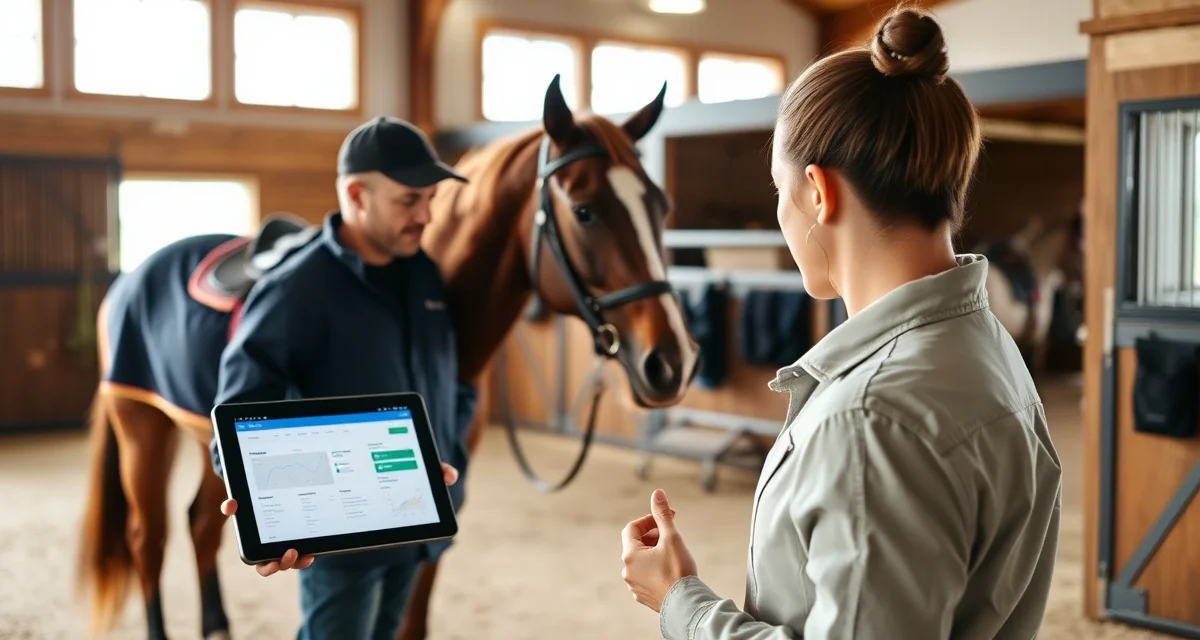
[training barn operations guide](/training-barn-operations-guide) for Equine Facilities
Running a training barn means managing horses, staff, clients, schedules, billing, and show prep simultaneously. Barn managers spend an average of 4.2 hours per day on administrative tasks that software can automate, which means nearly half a working day disappears before anyone sets foot in the arena. This training barn operations guide covers every major operational area, from daily exercise scheduling to invoicing training rides, so you can build systems that actually hold up under pressure.
TL;DR
- Most training barn operational problems come from vague task assignments and poor shift transitions, not lack of effort.
- Separating training tasks from maintenance tasks and assigning specific names to both reduces missed work at busy facilities.
- A three-tier health alert system (monitor, notify manager, call vet) reduces both under-reporting and over-reporting by staff.
- Proactive owner communication on a consistent schedule prevents the reactive dynamic where calls only happen after problems arise.
- A monthly operations review focused on failures rather than successes identifies system weak points before they become expensive.
The facilities that run well are not the ones with the most staff. They are the ones with the tightest processes.
The Real Cost of Disconnected Operations
Most training barns run on a patchwork of tools: a spreadsheet for scheduling, a group text thread for owner updates, a paper board for stall assignments, a separate invoicing app, and someone's personal calendar for show entries. Each tool works in isolation. None of them talk to each other.
When a horse's training schedule changes, that update needs to ripple through six different places. It rarely does. Missed rides, double-billed training sessions, and owners who feel out of the loop are almost always symptoms of disconnected systems, not incompetent staff.
The solution is not to work harder. It is to consolidate. Barn management software built specifically for equine facilities eliminates the handoff errors that cost training barns money and client trust every week.
Daily Exercise Scheduling: Building a System That Holds
The Scheduling Problem at Scale
A barn with 30 horses in training might have 40+ individual ride slots per day when you account for multiple riders, turnout rotations, and horses on modified work schedules due to injury or show prep. Coordinating that manually is a full-time job on its own.
The core challenge is not creating the schedule. It is maintaining it when things change, and things always change. A horse comes up lame at 7 a.m. A trainer calls in sick. A client calls to say their horse needs a light day before a vet appointment. Every one of those changes has a downstream effect on the rest of the day.
How to Structure Daily Exercise Scheduling
Start with a master schedule built around each horse's individual training program, not around rider availability. The horse's program is the fixed point. Rider assignments flex around it.
Assign each horse a priority tier: competition horses in active show prep, horses in foundational training, horses on maintenance programs, and horses in rehabilitation. When scheduling conflicts arise, this hierarchy tells your staff exactly how to resolve them without escalating to management every time.
Build buffer time into the schedule. A 45-minute ride slot for a 45-minute ride leaves no room for a horse that needs extra grooming, a tack issue, or a rider who needs to debrief with a trainer. Fifteen minutes of buffer per session prevents cascade delays that throw off the entire afternoon.
Use software that lets you view the day's schedule by horse, by rider, and by arena simultaneously. If you can only see one dimension at a time, you will miss conflicts.
Owner Communication: Keeping Clients Informed Without Burning Out Your Staff
Why Owner Updates Break Down
Owner communication is one of the highest-value activities at a training barn and one of the most time-consuming. A client who feels informed is a client who renews their board contract, refers their friends, and trusts your judgment on training decisions. A client who feels ignored pulls their horse.
The problem is that personalized updates at scale are exhausting. A barn with 25 horse owners, each expecting weekly progress notes, ride reports, and show prep updates, can easily consume 10+ hours of staff time per week if done manually.
Building a Communication System That Scales
Standardize your update format. A brief ride report with three fields, what was worked on, how the horse responded, and any notes for the owner, takes two minutes to complete and gives owners exactly what they want. Consistency matters more than length.
Automate the delivery. Software that sends ride reports directly to owners after each session removes the manual step of compiling and emailing updates. Owners get real-time visibility. Staff spend two minutes on a form instead of twenty minutes on an email.
Separate routine updates from urgent communications. Routine ride reports go through the platform. Anything involving health, injury, or a significant training decision gets a direct phone call. Owners learn quickly which channel means what, and they stop flooding your phone with questions that a ride report would have answered.
Photo and video updates have a measurable impact on client retention. Facilities that send weekly media updates report significantly higher client satisfaction scores than those that rely on text alone. A 30-second video of a horse nailing a new movement is worth more than three paragraphs of description.
Show Prep Management: Coordinating the Chaos Before a Competition
What Show Prep Actually Involves
Show prep is not just extra rides. It is a coordinated sequence of tasks that spans weeks and involves every department in your barn. Training schedules shift. Veterinary appointments stack up. Farrier timing becomes critical. Equipment needs to be checked, cleaned, and packed. Entry deadlines do not move.
A missed entry deadline can cost a client a full show season. A horse that arrives at a show without a current Coggins test gets turned away at the gate. These are not hypothetical risks. They happen at facilities that manage show prep on whiteboards and group texts.
Building a Show Prep Checklist System
Create a standardized show prep timeline that works backward from the competition date. For a horse showing in six weeks, the timeline should include: entry submission (five weeks out), farrier appointment (two weeks out), veterinary health certificate and Coggins (one week out), equipment audit (one week out), packing list completion (two days out), and departure logistics (day before).
Assign each task to a specific person with a specific deadline. Shared responsibility is no responsibility. When the farrier appointment is "someone's job," it does not get made.
Track show prep status at the horse level, not the show level. A barn taking eight horses to a three-day show has eight separate prep checklists running simultaneously. Viewing them by show gives you a false sense of progress. Viewing them by horse tells you exactly which animals are behind.
Document the horse's show history in the same system where you track training. Patterns emerge over time. A horse that consistently underperforms in its first class of the day might need a different warm-up protocol. A horse that gets anxious in stabling might need a specific supplement started two weeks before travel. That institutional knowledge lives in your head right now. It needs to live in your system.
Training Ride Billing: Getting Paid Accurately for Every Session
The Billing Gap in Training Barns
Billing errors are endemic in training barns. The most common problem is not fraud or negligence. It is that the person who rides the horse is not the person who creates the invoice, and the handoff between those two roles is broken.
A trainer completes 22 rides in a month. The billing staff invoices for 19. The three missing rides represent real revenue that disappears because there was no reliable way to capture them at the point of service. Multiply that across a barn with five trainers and 40 horses, and the monthly revenue leak becomes significant.
Capturing Every Billable Ride
The fix is to record the ride at the time it happens, not at the end of the month. When a trainer logs a completed session in your scheduling system, that log should automatically create a billable line item. No separate data entry. No end-of-month reconciliation from memory.
Differentiate your billing rates at the service level. A basic conditioning ride, a training session with a specific skill focus, a lesson with the owner present, and a show prep school are four different services at four different price points. Your system needs to support that granularity, or you will default to billing everything at the same rate and undercharging for high-value work.
Billing and invoicing software designed for equine facilities should let you attach notes to each billable session, so owners can see exactly what they are paying for. Itemized invoices reduce billing disputes and increase on-time payment rates. Clients who understand their bill pay it faster.
Set up automatic invoice generation on a fixed cycle. Monthly billing is standard in the industry, but some facilities bill bi-weekly for clients with high training volumes. Whatever your cycle, automation ensures the invoice goes out on time regardless of how busy the end of the month gets.
Staff Coordination: Managing Riders, Grooms, and Barn Staff
The Coordination Challenge
A mid-size training barn might employ two to four trainers, three to six grooms, a barn manager, and part-time help on weekends. Each role has different responsibilities, different schedules, and different information needs. A groom needs to know which horses are being ridden and when. A trainer needs to know which horses have veterinary restrictions. The barn manager needs to know all of it.
When information lives in different places, people make decisions based on incomplete data. A groom tacks up a horse that has a vet hold. A trainer rides a horse that was supposed to have a light day. These mistakes are not careless. They are the predictable result of a system where critical information is not visible to the people who need it.
Building Staff Communication That Works
Centralize horse status information. Every horse in your barn should have a current status that is visible to all staff: in full work, modified work, vet hold, turnout only, or show prep. That status should update in real time and be accessible from a phone. A groom checking the morning feed list should be able to see at a glance which horses have restrictions.
Create role-specific views of the same data. Trainers need to see their ride schedule and each horse's training notes. Grooms need to see tack requirements and any special handling instructions. The barn manager needs to see everything. One platform with role-based access controls gives each person exactly what they need without overwhelming them with irrelevant information.
Document staff performance and horse assignments over time. Knowing that a particular horse goes better for one rider than another is valuable information. So is knowing which staff members consistently complete their tasks on time. That data helps you make better scheduling decisions and identify training needs before they become performance problems.
Handling Shift Handoffs
The transition between morning and afternoon staff is where information most commonly falls through the cracks. A horse that had an unusual reaction during the morning ride needs that information passed to the afternoon groom. A veterinarian who called with test results needs that message to reach the barn manager before end of day.
Build a formal handoff process. A brief written log at shift change, completed in your management platform, creates a record and ensures nothing gets lost in verbal communication. It takes five minutes and prevents hours of problems.
Veterinary and Farrier Coordination
Scheduling and Record-Keeping
Training barns have complex veterinary and farrier schedules. Horses cycle through routine maintenance appointments, and any horse in active training will have periodic lameness evaluations, dental work, and performance-related treatments. Keeping track of what each horse needs and when is a significant administrative burden.
Maintain a complete health record for each horse within your management system. Vaccination dates, Coggins results, dental records, farrier cycles, and any ongoing treatments should be accessible in one place. When a client asks when their horse was last seen by the vet, you should be able to answer in 30 seconds.
Set automated reminders for recurring appointments. A horse on a six-week farrier cycle should generate a scheduling reminder at week five. A Coggins test valid for 12 months should trigger a renewal reminder at month 10. These reminders prevent the last-minute scrambles that disrupt show prep and create liability exposure.
Communicating with Outside Professionals
Veterinarians and farriers work across multiple facilities. They appreciate barn managers who have complete, accurate records ready when they arrive. A vet who can review a horse's history in your system before examining the animal provides better care and spends less time asking questions you have to answer from memory.
Create a standard intake form for veterinary visits that captures the presenting concern, the horse's recent work history, and any relevant changes in behavior or performance. That form, completed before the vet arrives, makes every appointment more productive.
Financial Management and Reporting
What Training Barn Finances Actually Look Like
Training barn revenue is more complex than standard boarding operations. You have base board fees, training ride fees at variable rates, lesson income, show prep surcharges, and reimbursable expenses like entry fees and veterinary costs. On the expense side, you have payroll, feed, bedding, facility maintenance, and equipment costs.
Most training barns undercharge for their services because they do not have clear visibility into their actual costs. A training ride that takes 45 minutes of a trainer's time, plus 20 minutes of groom time for tacking and untacking, plus facility overhead, has a real cost that many barns never calculate.
Building Financial Visibility
Run monthly reports that break down revenue by service category. Knowing that 60% of your revenue comes from training rides and 30% from board tells you where your business actually lives and where to focus your capacity.
Track accounts receivable aging weekly. Outstanding invoices over 30 days need follow-up. Outstanding invoices over 60 days need a conversation. Facilities that let receivables age without intervention consistently report cash flow problems that have nothing to do with their revenue volume.
Compare actual training rides completed against invoiced rides monthly. If those numbers do not match, you have a billing capture problem. Identifying and closing that gap is often the fastest way to increase revenue without adding a single new client.
Integrating Operations with the Right Platform
Why Separate Tools Fail
The horse training facility management challenge is not a shortage of software options. There are scheduling tools, invoicing platforms, communication apps, and record-keeping systems available for equine facilities. The problem is that none of them are connected, and the connections are where the value lives.
When your scheduling system does not talk to your billing system, rides get missed on invoices. When your communication platform does not connect to your training records, owners get updates that do not match what is actually happening. When your health records live in a separate system from your show prep checklists, critical information gets missed at the worst possible time.
BarnBeacon replaces the six or more separate tools that most barn managers currently juggle. Scheduling, owner communication, billing, staff coordination, health records, and show prep management all operate within a single platform. A change made in one area updates everywhere it matters automatically.
That integration is not a convenience feature. It is the difference between a barn that runs on systems and a barn that runs on heroic individual effort.
What to Look for in a Management Platform
Evaluate any platform against your actual daily workflow. Can you complete the morning schedule check, log a completed ride, send an owner update, and flag a horse for a vet call all within the same system? If you are switching between applications to complete a single workflow, the integration is not deep enough.
Look for mobile accessibility. Barn management does not happen at a desk. Your staff needs to access and update information from the barn aisle, the arena, and the trailer. A platform that requires a desktop browser is a platform your staff will not use consistently.
Prioritize platforms built specifically for equine facilities over generic small business tools. The terminology, the workflows, and the data structures are different. A generic invoicing tool does not understand the difference between a board fee and a training ride. A generic scheduling tool does not know what a Coggins test is. Purpose-built software reflects how your business actually works.
FAQ
What software manages all horse barn operations in one place?
BarnBeacon is built to manage all core training barn operations within a single platform, including exercise scheduling, owner communication, training ride billing, staff coordination, and health records. Most barn management tools address one or two of these areas well but require separate applications for the rest. An integrated platform eliminates the data handoff errors that occur when systems do not communicate with each other.
How does barn management software save time at a large facility?
Barn management software saves time primarily by automating the administrative tasks that currently require manual data entry and follow-up. Automated ride logging, invoice generation, owner update delivery, and appointment reminders collectively eliminate several hours of administrative work per day. At a facility with 30 or more horses in training, that time savings compounds significantly, freeing managers and trainers to focus on horses and clients rather than paperwork.
What is the best equine facility management platform?
The best equine facility management platform is the one that covers your complete operational workflow without requiring additional tools to fill gaps. Evaluate platforms on scheduling depth, billing accuracy, owner communication features, mobile accessibility, and health record management. BarnBeacon is designed specifically for training barns and integrates all of these functions in one place, making it a strong choice for facilities that have outgrown patchwork systems.
How do I manage training operations during peak competition season?
Show season demands require pre-season planning: confirm staffing levels before the season starts, not after the first gaps appear. Stagger show trip schedules when possible to avoid stripping the home barn of experienced staff all at once. Create a travel preparation checklist that captures every administrative task (health certificates, Coggins, packing lists, billing pre-authorization) and assign clear ownership for each item before each departure.
What is the most effective way to document training progress for owner communication?
Use objective markers rather than trainer impressions in progress updates: specific exercises completed, distances covered, heights cleared, or behavioral milestones achieved. Pair written notes with a short video clip or photo from the session when possible. Owners who can see their horse performing are significantly more satisfied with the update than those who receive only a written description.
What is training barn operations guide for Equine Facilities?
A training barn operations guide for equine facilities is a comprehensive framework covering every major aspect of running a professional training barn — from daily exercise scheduling and staff task assignments to client communication, invoicing, and show preparation. It provides barn managers with structured systems to reduce the estimated 4.2 hours per day spent on administrative work, replacing ad hoc decision-making with repeatable processes that hold up under the pressure of a busy equine facility.(/training-barn-operations-guide) for Equine Facilities. Target 50-150 words.]
How much does training barn operations guide for Equine Facilities cost?
A training barn operations guide is a free educational resource, not a paid product. The guidance covers operational best practices — task delegation, health alert protocols, owner communication schedules, and monthly reviews — at no cost. Some barn management software platforms that implement these systems may carry subscription fees, but the operational framework itself is available to any facility manager looking to build tighter, more reliable barn systems without additional overhead.(/training-barn-operations-guide) for Equine Facilities. Target 50-150 words.]
How does training barn operations guide for Equine Facilities work?
A training barn operations guide works by breaking barn management into discrete, assignable systems rather than relying on individual judgment in the moment. It separates training tasks from maintenance tasks, assigns named accountability for each, and establishes a three-tier health alert protocol to standardize staff response. Proactive owner communication replaces reactive problem calls, and a monthly review focused on failures — not successes — continuously identifies weak points before they escalate into costly operational breakdowns.(/training-barn-operations-guide) for Equine Facilities. Target 50-150 words.]
Sources
- United States Equestrian Federation (USEF)
- American Horse Council
- University of Kentucky Equine Initiative
- The Chronicle of the Horse
- Horse & Rider magazine
Get Started with BarnBeacon
Training barn operations run better when task assignment, health monitoring, and owner communication all draw from the same current data. BarnBeacon connects these workflows in a single platform that your team can use from their phones, giving managers real-time visibility without requiring a physical presence at every task. If the operational challenges described in this guide sound familiar, BarnBeacon gives you a practical starting point for building the systems your training facility needs.