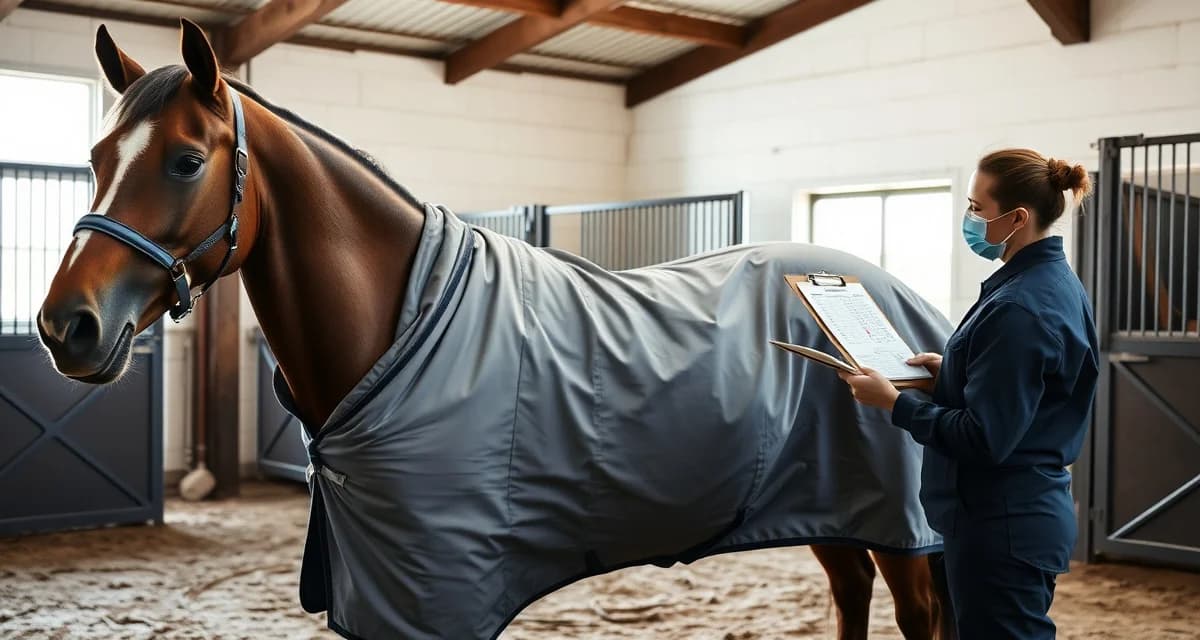
Layup Barn Blanketing Protocol for Rehabilitating Horses
Incorrect blanketing causes 18% of skin conditions in stabled horses, and in a layup barn, that number carries serious consequences. A horse recovering from colic surgery or a tendon repair doesn't have the same thermoregulatory capacity as a healthy horse in full work. Getting the blanket wrong isn't a minor inconvenience; it can set back a recovery by weeks.
TL;DR
- blanketing management based on posted temperature thresholds reduce staff judgment calls and inconsistency across shifts
- A horse's clip level is the primary variable that changes blanketing needs relative to air temperature
- Wet blankets left on horses overnight create a greater health risk than going unblanketed in many temperature ranges
- Owner preference documentation prevents liability disputes when a horse is found with or without a blanket
- Blanket rotation logs help track wear and flag repairs before a blanket fails during a cold snap
- Digital task systems that push blanketing decisions to staff phones based on current temperatures reduce missed changes
This guide walks through a practical layup barn blanketing protocol built for rehabilitation facilities managing horses with varied medical histories, clip statuses, and vet-directed care plans.
Why Rehabilitation Horses Need a Different Approach
A horse in a layup stall is not a horse in regular work. Post-surgical horses often have compromised circulation in specific limbs. Horses on long-term antibiotics or immunosuppressants may have reduced ability to regulate core temperature. Older horses and those with Cushing's disease or PPID present additional thermoregulation challenges.
Standard blanketing charts built for healthy horses don't account for any of this. A rehabilitation horse blanketing protocol needs to be individualized, vet-directed, and consistently executed across every staff shift.
Step 1: Establish a Per-Horse Blanketing Profile
Collect the Right Information at Intake
When a horse arrives at your layup facility, gather the following before they're stalled:
- Current clip status (full clip, trace clip, unclipped)
- Age and baseline health conditions
- Vet-prescribed temperature thresholds
- Any skin conditions, wounds, or surgical sites that affect blanket placement
- Whether the horse is on medications that affect thermoregulation
This information forms the foundation of the horse's blanketing profile. Without it, staff are guessing.
Document Vet-Directed Rules Explicitly
If the attending vet says "blanket below 45°F," write exactly that in the horse's record. Don't paraphrase. Don't let it live only in someone's memory. The overnight staff who weren't present for the vet visit need the same information as the day manager.
Attach blanketing instructions to the stall card and in your barn management software so every person who walks through that aisle has access to the same rules.
Step 2: Build a Temperature-Based Blanketing Chart
Use Clip Status as the Primary Variable
A fully clipped horse in a layup stall needs a blanket at significantly higher temperatures than an unclipped horse with a full winter coat. Use this as your baseline framework:
| Horse Type | No Blanket | Light Sheet | Medium (100-200g) | Heavy (300g+) |
|---|---|---|---|---|
| Unclipped, healthy | Above 50°F | 40-50°F | 20-40°F | Below 20°F |
| Trace clipped | Above 60°F | 50-60°F | 30-50°F | Below 30°F |
| Fully clipped | Above 65°F | 55-65°F | 35-55°F | Below 35°F |
| Post-surgical / compromised | Per vet directive | Per vet directive | Per vet directive | Per vet directive |
For post-surgical and immunocompromised horses, the chart is a starting point only. Vet directives override everything.
Account for Wind Chill and Humidity
A 40°F day with 20 mph wind feels closer to 28°F on exposed skin. In a barn with poor insulation or open-air aisles, wind chill matters. Build a wind chill adjustment into your protocol: if wind chill drops the effective temperature by more than 10°F, treat the horse as if the lower temperature applies.
Humidity works in the opposite direction in summer. A horse that's too warm under a sheet in humid conditions can develop fungal skin issues faster than in dry heat.
Step 3: Assign Blanket Checks to Specific Shifts
Morning Check (First Feed)
The morning check should happen before feeding, not after. Staff should assess:
- Whether the blanket is still properly fitted (no slipping, no twisted leg straps)
- Whether the horse is sweating under the blanket
- Whether overnight temperatures dropped below the horse's threshold
- Any signs of skin irritation at the withers, chest, or shoulders
Document findings in the daily log. Our barn daily checklist template includes a blanketing section that captures this in under two minutes per horse.
Midday Check
Midday is the most commonly skipped check in busy layup facilities. It's also when over-blanketing happens most often. A horse blanketed for a cold morning can be sweating by noon if temperatures rise 15-20 degrees.
Assign midday blanket checks explicitly. Don't assume someone will notice.
Evening Check (Before Night)
The evening check sets the horse up for overnight. Confirm the forecast for the next 12 hours, adjust blanket weight accordingly, and verify all closures are secure. A blanket that comes loose overnight on a post-surgical horse is a serious safety risk.
Step 4: Create a Blanket Rotation and Labeling System
Label Every Blanket Clearly
In a facility with 20+ horses, unlabeled blankets create errors. Use permanent marker or embroidered labels with the horse's name and blanket weight. Store each horse's blankets in a designated spot outside their stall.
Maintain a Spare Set
Every horse in a layup facility should have at least two blankets of each weight they regularly use. Blankets get wet, torn, or soiled. A horse recovering from surgery cannot wait two days for a blanket to dry.
Washing Protocol
Dirty blankets trap bacteria and fungi against the skin. Wash blankets at least every two weeks during active use, or immediately after any wound drainage or skin condition is identified. Reproofing waterproof blankets after washing maintains their function.
Step 5: Use Technology to Enforce Consistency
Manual protocols fail when staff are tired, short-handed, or dealing with an emergency in another stall. This is where barn management software with temperature-triggered alerts changes how layup facilities operate.
BarnBeacon pulls local forecast data and cross-references each horse's individual blanketing profile, including clip status, age, and vet-directed thresholds. When the temperature is forecast to drop below a horse's threshold, the system sends an automatic alert to the assigned staff member before the drop happens, not after.
This is something most barn software doesn't offer. Many tools let you log blanketing after the fact, but few trigger proactive alerts based on per-horse rules tied to real weather data. For a facility managing horses with different medical needs, that gap matters.
You can also review our full blanketing guide for general temperature thresholds and seasonal adjustment strategies that complement your layup-specific protocol.
Common Mistakes in Layup Barn Blanketing
Using the same chart for every horse. A 6-year-old event horse three weeks post-surgery has different needs than a 22-year-old retiree with Cushing's. Individual profiles are not optional in a rehabilitation setting.
Skipping the midday check. Over-blanketing causes sweating, which leads to chills when the horse cools down. It also creates the skin conditions you're trying to prevent.
Relying on verbal handoffs between shifts. Verbal communication fails. Written records and software alerts don't.
Ignoring blanket fit after weight changes. Horses in layup often lose topline muscle. A blanket that fit at intake may slip or rub after six weeks of stall rest. Recheck fit monthly.
Not updating the protocol when vet directives change. If the vet adjusts a horse's care plan, the blanketing profile needs to be updated the same day.
What temperature does a horse need a blanket?
There's no single answer because it depends on the horse's clip status, age, health condition, and acclimatization. A healthy, unclipped horse in good body condition generally doesn't need a blanket until temperatures drop below 40°F. A fully clipped or post-surgical horse may need one at 55°F or higher. Always follow vet directives for horses in rehabilitation.
How do I manage blanketing preferences for 50+ horses?
A spreadsheet won't scale reliably once you're managing that many individual profiles across multiple shifts. Barn management software that stores per-horse blanketing rules and surfaces them at the point of care is the practical solution. The key feature to look for is the ability to attach vet-directed thresholds to individual horse records, not just a facility-wide chart.
Can barn software send automated blanketing alerts to staff?
Yes, and this is one of the most operationally valuable features available in modern barn management platforms. BarnBeacon, for example, monitors local forecast data and sends alerts to staff when temperatures are predicted to cross a horse's individual blanketing threshold. This removes the reliance on staff remembering to check the forecast and ensures horses aren't under- or over-blanketed due to a missed manual check.
How does BarnBeacon compare to spreadsheets for barn management?
Spreadsheets require manual updates, lack real-time notifications, and create version control problems when multiple staff members are working from different files. BarnBeacon centralizes records, pushes alerts automatically based on logged events, and connects care records to billing and owner communication in one system. Most facilities report saving several hours per week after switching from spreadsheets.
What is the setup process like for BarnBeacon?
Most facilities complete the initial setup in under a week. Horse profiles, service templates, and billing configurations can be imported from existing records or entered directly. BarnBeacon's US-based support team is available to assist with setup, and most managers are running their first billing cycle through the platform within days of starting.
Can BarnBeacon support a barn with multiple staff members?
Yes. BarnBeacon supports multiple user accounts with role-based access, so barn managers, barn staff, and owners each see the information relevant to their role. Task assignments, completion logs, and communication history are all attached to the barn's account rather than to individual staff phones or email addresses.
FAQ
What is Layup Barn Blanketing Protocol for Rehabilitating Horses?
A layup barn blanketing protocol is a structured system for managing blanket use on horses recovering from injury or surgery. Unlike healthy horses, rehabilitating horses have reduced thermoregulatory capacity, making incorrect blanketing a genuine medical risk. The protocol defines temperature thresholds, accounts for each horse's clip level, tracks blanket condition, and documents owner preferences. It removes guesswork from staff decisions and ensures consistent care across all shifts throughout recovery.
How much does Layup Barn Blanketing Protocol for Rehabilitating Horses cost?
A layup barn blanketing protocol itself has no direct cost — it's an operational framework, not a product. Implementation costs depend on your systems: a printed chart and logbook cost almost nothing, while digital task management platforms that push temperature-triggered blanketing alerts to staff phones typically run $50–$200 per month. The real financial calculation is avoiding setbacks: a single skin condition or compromised recovery in a layup horse can cost thousands in extended board, vet fees, and delayed return to work.
How does Layup Barn Blanketing Protocol for Rehabilitating Horses work?
The protocol works by standardizing every blanketing decision around objective variables rather than staff judgment. Temperature thresholds are posted per horse based on clip status and medical history. Staff check current temperatures against the posted chart and apply or remove blankets accordingly. Blanket condition is logged at each check, wet or soiled blankets are rotated immediately, and owner preferences are documented in the horse's file. Some facilities integrate weather feeds into barn software to trigger automatic task assignments.
What are the benefits of Layup Barn Blanketing Protocol for Rehabilitating Horses?
The core benefits are consistency, accountability, and reduced medical risk. Rehabilitating horses are more vulnerable to temperature-related stress, skin conditions, and immune compromise. A protocol eliminates the shift-to-shift variation that causes problems — one staff member's 'cold enough to blanket' is another's borderline call. It also creates a documented record if an owner disputes a blanketing decision, catches blanket wear before a failure during cold weather, and shortens recovery timelines by keeping the horse in a stable physiological environment.
Who needs Layup Barn Blanketing Protocol for Rehabilitating Horses?
Any facility housing horses during active rehabilitation needs this type of protocol — layup barns, veterinary recovery facilities, sport horse rehabilitation centers, and private farms managing post-surgical or injury cases. It's especially critical when staff rotate across shifts, when horses have varied clip levels or medical histories, or when owners are not on-site daily. If your barn is managing even one horse recovering from colic surgery, tendon repair, or a neurological episode, a written blanketing protocol is necessary, not optional.
How long does Layup Barn Blanketing Protocol for Rehabilitating Horses take?
There is no fixed timeline — a layup barn blanketing protocol is a standing operational system that runs for the duration of each horse's rehabilitation. Individual blanketing checks happen one to three times daily depending on weather variability. Setting up the initial protocol for a new arrival — pulling vet notes, confirming clip status, posting the temperature chart, and logging owner preferences — typically takes 15–30 minutes per horse. Blanket rotation and condition checks add five to ten minutes per horse per check.
What should I look for when choosing Layup Barn Blanketing Protocol for Rehabilitating Horses?
Look for a protocol that accounts for clip level as the primary variable, since a fully clipped horse and an unclipped horse in the same barn have very different thresholds. It should include clear wet blanket removal rules, a rotation system with enough spare blankets to avoid gaps, and a method for documenting owner preferences and vet-directed care. Scalability matters too — a protocol built around a paper chart works for a small facility, but larger operations benefit from digital systems that push tasks based on real-time temperature data.
Is Layup Barn Blanketing Protocol for Rehabilitating Horses worth it?
Yes, particularly for any barn managing horses with compromised health. The cost of implementing a blanketing protocol is minimal relative to the risk of a setback in a recovering horse. Incorrect blanketing is cited in 18% of skin conditions in stabled horses, and in a rehabilitation context that statistic translates directly to extended recovery, increased vet involvement, and frustrated owners. A written protocol also protects the facility from liability disputes. The operational investment is small; the downside of not having one is not.
Sources
- American Association of Equine Practitioners (AAEP)
- American Horse Council
- Kentucky Equine Research
- UC Davis Center for Equine Health
- Penn State Extension Equine Program
Get Started with BarnBeacon
Blanketing decisions made consistently across every shift protect horses and protect the facility. BarnBeacon gives layup facilities the tools to post temperature-based blanketing protocols, notify staff of threshold changes in real time, and log blanket applications and removals with timestamps. Start a free trial and put your blanketing system on a digital protocol.