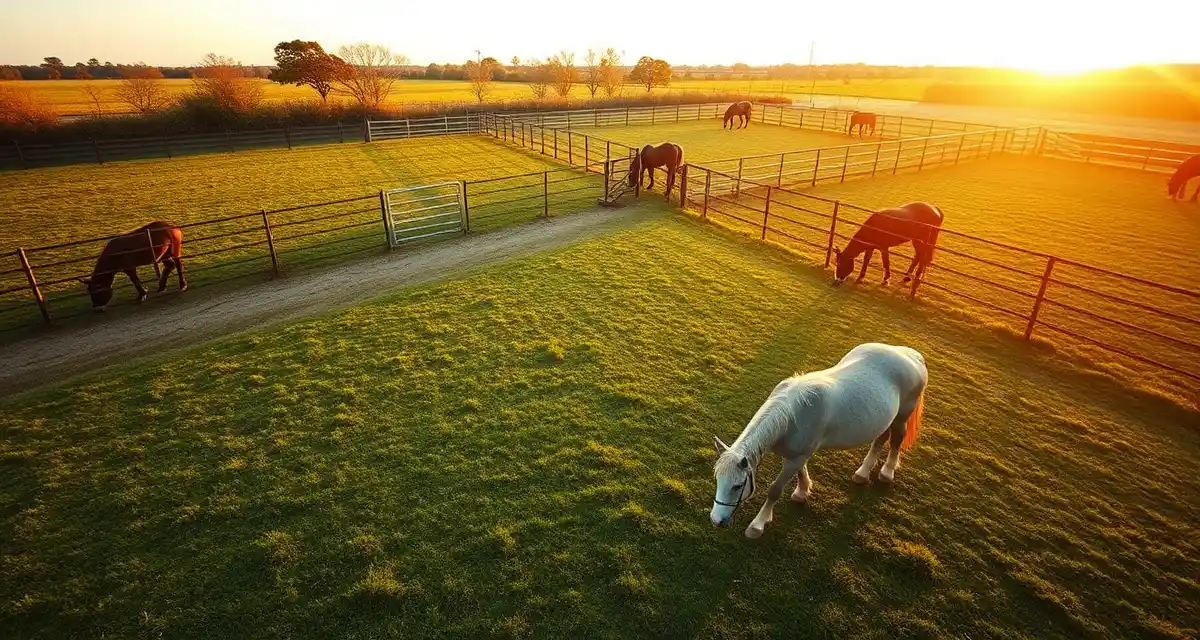
Retirement Barn Turnout Protocol for Senior Horses
Turnout at a retirement barn is not the same as turnout at a performance facility. Senior horses have arthritis, Cushing's, compromised vision, and social hierarchies that have calcified over years. A poorly managed retirement barn turnout protocol does not just cause stress, it causes falls, injuries, and liability.
TL;DR
- Turnout scheduling decisions should be documented with the reasoning to protect the facility in liability situations
- Horse compatibility assessments before group turnout prevent injuries and reduce herd management emergencies
- Pasture rotation schedules based on grass recovery periods reduce overgrazing and maintain forage quality year-round
- Turnout injuries are among the most common sources of liability claims at boarding facilities
- Written turnout protocols signed by owners at move-in establish consent and reduce disputes about field decisions
- Tracking turnout hours per horse per day supports health monitoring and helps identify horses spending excessive time stalled
72% of boarding disputes involve disagreements about turnout records. At a retirement facility, where owners are emotionally invested and horses are fragile, that number likely runs higher. The fix is not more staff, it is a documented, repeatable system.
Why Senior Horse Turnout Fails Without a Protocol
Most barns run turnout on institutional memory. The morning crew knows which horses cannot go out together. The afternoon crew does not. Someone gets kicked. Someone gets blamed. No one has a record.
Senior horses require more variables tracked simultaneously than any other population: mobility limitations, medication timing, footing sensitivity, cold weather restrictions, and buddy dependencies. When those variables live in someone's head, they leave when that person does.
Step 1: Assess Each Horse Before Assigning Paddocks
Mobility and Soundness Evaluation
Start with a baseline assessment for every horse in the facility. Note gait abnormalities, joint swelling, and any veterinary restrictions on movement duration or terrain type. A horse with navicular disease cannot go into a paddock with hard-packed clay footing, regardless of social compatibility.
Document the assessment in the horse's permanent record. Update it after every lameness episode or vet visit.
Cold Weather and Weather-Triggered Restrictions
Horses with Cushing's disease or anhidrosis have specific temperature thresholds. Define those thresholds in writing: "No turnout below 28°F" or "Limit to 90 minutes when humidity exceeds 80%." Vague notes like "watch the weather" are not instructions, they are liability.
Assign a staff member each morning to check conditions against each horse's restrictions before the first rotation begins.
Step 2: Build a Compatibility Matrix
Social History and Herd Dynamics
Compatibility is not just about aggression. A dominant horse that moves fast will stress an arthritic horse even without direct contact. Map out which horses can share space, which need visual barriers, and which require solo turnout.
Use a simple grid: horses on both axes, color-coded cells for compatible, conditional, and incompatible pairings. Review it every 90 days or after any incident.
Buddy System for Anxiety-Prone Horses
Many retired horses develop separation anxiety after years of herd life. Identify buddy pairs and document them. If one horse in a pair is pulled for a vet visit, the protocol should specify what happens to the other, not leave it to whoever is working that shift.
The turnout rotation system you build should account for buddy pairs as fixed units, not interchangeable individuals.
Step 3: Evaluate and Prepare Footing
Deep Footing Requirements for Mobility-Limited Horses
Horses with arthritis or laminitis need consistent, forgiving footing. Sand, pea gravel, or rubber mats at gate entries reduce concussion and slip risk. Inspect paddock footing weekly, not just after rain.
Document footing condition as part of your barn daily checklist. If a paddock is compromised, frozen, waterlogged, or rutted, it should be flagged before turnout begins, not discovered mid-rotation.
Gate and Fence Safety Checks
Senior horses are more likely to lean on fencing, get cast against panels, or fail to clear low obstacles. Walk each paddock perimeter at the start of every week. Log what you find and what was repaired.
Step 4: Build the Rotation Schedule
Assign Paddocks by Priority Tier
Not all paddocks are equal. Rank them by footing quality, shelter availability, and size. Assign your highest-needs horses, mobility-limited, post-surgical, or weather-sensitive, to your best paddocks first. Fill remaining slots from there.
A tiered assignment system prevents the common mistake of rotating horses through paddocks randomly and landing a laminitic horse on hard ground because it was "their turn."
Set Time Windows, Not Just Sequences
A rotation schedule that says "Horse A goes out after Horse B" is incomplete. Specify start times, maximum duration, and who is responsible for bringing each horse in. For senior horses, two to four hours of turnout is often more appropriate than all-day turnout, particularly in heat or cold.
Build buffer time between rotations so staff are not rushing transitions. Rushed transitions cause gate injuries.
Step 5: Log Every Turnout Entry and Exit
Why Timestamped Records Matter
This is where most facilities fall short. A handwritten whiteboard is not a record, it is a suggestion. When a horse is found injured in a paddock and no one can confirm when it went out or who checked it last, the facility has no defense.
BarnBeacon logs every turnout entry and exit with staff ID, timestamp, and a compatibility check against the horse's current restrictions. If a staff member attempts to turn out an incompatible pair, the system flags it before the gate opens. That audit trail is what separates a documented protocol from a verbal policy.
Shift Handoff Documentation
Every shift change should include a written or digital handoff that covers which horses are currently out, when they went out, and any observations from the current shift. Senior horse turnout schedule breaks down almost exclusively at shift transitions.
Require the outgoing staff member to sign off on the handoff. Require the incoming staff member to confirm receipt. This takes three minutes and prevents the majority of turnout errors.
Common Mistakes in Retirement Barn Turnout
Skipping weather checks. Cold, wet, or icy conditions that are acceptable for a healthy horse can be dangerous for a senior with arthritis or a compromised immune system. Build weather checks into the morning routine, not as an afterthought.
Assuming compatibility is permanent. Horses change. A pair that coexisted peacefully for two years can turn aggressive after a health change, a new arrival, or a seasonal shift. Review your compatibility matrix regularly.
Overloading paddocks. Retirement facilities often run at high capacity. Putting too many horses in a paddock to make the rotation work is a common shortcut with predictable consequences. If your paddock count cannot support your horse count safely, that is a capacity problem, not a scheduling problem.
Ignoring footing until there is an incident. Footing degradation is gradual. By the time it looks bad, it has already been causing stress on joints for weeks. Weekly inspection is not excessive, it is the minimum.
How do I create a turnout rotation for 30+ horses?
Start by grouping horses into tiers based on compatibility and needs, not just by stall location. Assign each group a paddock and a time window, then build the sequence around your staffing schedule. A digital turnout rotation tool that tracks assignments by group rather than individual horse makes this manageable at scale. Review and adjust the rotation monthly as horse populations and conditions change.
How do I track paddock assignments across shifts?
The most reliable method is a shared digital log that updates in real time and requires staff ID at each entry. Paper boards and verbal handoffs fail at shift transitions because they depend on memory and presence. A system that timestamps each assignment and flags conflicts gives every shift the same information regardless of who worked before them.
What factors affect horse turnout compatibility?
Social dominance is the most obvious factor, but it is not the only one. Movement speed matters, a fast-moving horse stresses an arthritic one even without aggression. Feeding behavior, history of injury caused by other horses, vision impairment, and anxiety levels all affect compatibility. For senior horses specifically, energy level mismatches are often more disruptive than outright aggression. Reassess compatibility after any health change, new arrival, or incident.
How does BarnBeacon compare to spreadsheets for barn management?
Spreadsheets require manual updates, lack real-time notifications, and create version control problems when multiple staff members are working from different files. BarnBeacon centralizes records, pushes alerts automatically based on logged events, and connects care records to billing and owner communication in one system. Most facilities report saving several hours per week after switching from spreadsheets.
What is the setup process like for BarnBeacon?
Most facilities complete the initial setup in under a week. Horse profiles, service templates, and billing configurations can be imported from existing records or entered directly. BarnBeacon's US-based support team is available to assist with setup, and most managers are running their first billing cycle through the platform within days of starting.
Can BarnBeacon support a barn with multiple staff members?
Yes. BarnBeacon supports multiple user accounts with role-based access, so barn managers, barn staff, and owners each see the information relevant to their role. Task assignments, completion logs, and communication history are all attached to the barn's account rather than to individual staff phones or email addresses.
FAQ
What is Retirement Barn Turnout Protocol for Senior Horses?
A retirement barn turnout protocol for senior horses is a documented system for managing outdoor access for aging horses with conditions like arthritis, Cushing's disease, or compromised vision. It covers scheduling, compatibility assessments, pasture rotation, weather decisions, and recordkeeping. Unlike protocols at performance facilities, retirement turnout systems must account for fragile health, established social hierarchies, and heightened owner expectations. A written protocol signed at move-in protects the facility legally and sets clear expectations for how turnout decisions are made.
How much does Retirement Barn Turnout Protocol for Senior Horses cost?
Implementing a retirement barn turnout protocol has no fixed price—it is an operational investment, not a service fee. Costs include staff time for compatibility assessments, documentation systems or barn management software, pasture maintenance, and fencing upgrades if needed. Facilities that charge premium retirement boarding rates typically absorb these costs into monthly fees. The financial case is straightforward: turnout injuries are among the most common sources of boarding liability claims, making documentation a cost-avoidance measure as much as a care standard.
How does Retirement Barn Turnout Protocol for Senior Horses work?
A retirement turnout protocol works by establishing repeatable, documented steps for every turnout decision. Horses are assessed for compatibility before joining group turnout. Scheduling is based on individual health needs, pasture recovery periods, and weather conditions. Staff log turnout hours per horse daily, and any incidents or changes are recorded with reasoning. Owners sign a written protocol at move-in. When disputes arise—which happens in 72% of boarding disagreements involving turnout—the facility has a clear record of every decision and why it was made.
What are the benefits of Retirement Barn Turnout Protocol for Senior Horses?
The primary benefits are reduced injury risk, stronger liability protection, and fewer owner disputes. Compatibility assessments prevent herd aggression incidents. Pasture rotation maintains forage quality year-round and reduces overgrazing. Daily turnout tracking supports health monitoring and helps identify horses spending excessive time stalled, which worsens arthritis and metabolic conditions. For owners, a documented protocol provides transparency and confidence. For facilities, it reduces emergency herd management calls, protects against legal claims, and differentiates the barn as a professionally managed retirement operation.
Who needs Retirement Barn Turnout Protocol for Senior Horses?
Any facility housing senior horses needs a formal turnout protocol, but retirement barns have the highest stakes. Owners of retired horses are emotionally invested and often scrutinize care decisions closely. The horses themselves are medically complex—arthritis, Cushing's, vision loss, and long-established social bonds all affect how turnout should be managed. Facilities without documentation are exposed when injuries occur or owners dispute field decisions. If your barn boards horses aged 18 and older, a written turnout protocol is not optional—it is a liability baseline.
How long does Retirement Barn Turnout Protocol for Senior Horses take?
Building a retirement turnout protocol takes one to two weeks to develop properly and is then ongoing. Initial setup involves auditing current herd groupings, creating compatibility assessment criteria, and drafting the written owner agreement. Staff training typically takes a day. The ongoing time cost is minimal—daily turnout logging takes minutes per horse when using a structured system. The bigger time investment is doing compatibility assessments thoroughly before new horses join group turnout, which prevents the far more time-consuming work of managing injuries and owner disputes afterward.
What should I look for when choosing Retirement Barn Turnout Protocol for Senior Horses?
Look for four things: documentation depth, compatibility assessment rigor, pasture management standards, and owner communication transparency. A strong protocol documents not just what happened but why decisions were made—that reasoning is what protects the facility legally. Compatibility assessments should be structured, not informal. Pasture rotation should be based on actual grass recovery periods, not convenience. Owners should receive regular turnout summaries or have access to logs. Avoid protocols that are verbal-only or that treat senior horses the same as younger performance horses in group dynamics.
Is Retirement Barn Turnout Protocol for Senior Horses worth it?
Yes. The cost of implementing a documented retirement turnout protocol is low compared to a single serious injury claim, a lost boarding client, or a disputed liability situation. Seventy-two percent of boarding disputes involve turnout disagreements—at a retirement facility, that rate is likely higher given owner attachment and horse fragility. A documented, repeatable system does not require more staff; it requires better process. Facilities that invest in written protocols report fewer conflicts, stronger client retention, and cleaner liability outcomes when incidents do occur.
Sources
- American Association of Equine Practitioners (AAEP)
- American Competitive Trail Horse Association (ACTHA)
- American Horse Council
- Kentucky Equine Research
- UC Davis Center for Equine Health
Get Started with BarnBeacon
Turnout decisions carry real liability, and documentation is the difference between a defensible record and an exposed facility. BarnBeacon gives retirement barns the tools to log turnout schedules, document compatibility assessments, and record any incidents with timestamps and staff identification. Start a free trial and build your turnout documentation system before you need it.