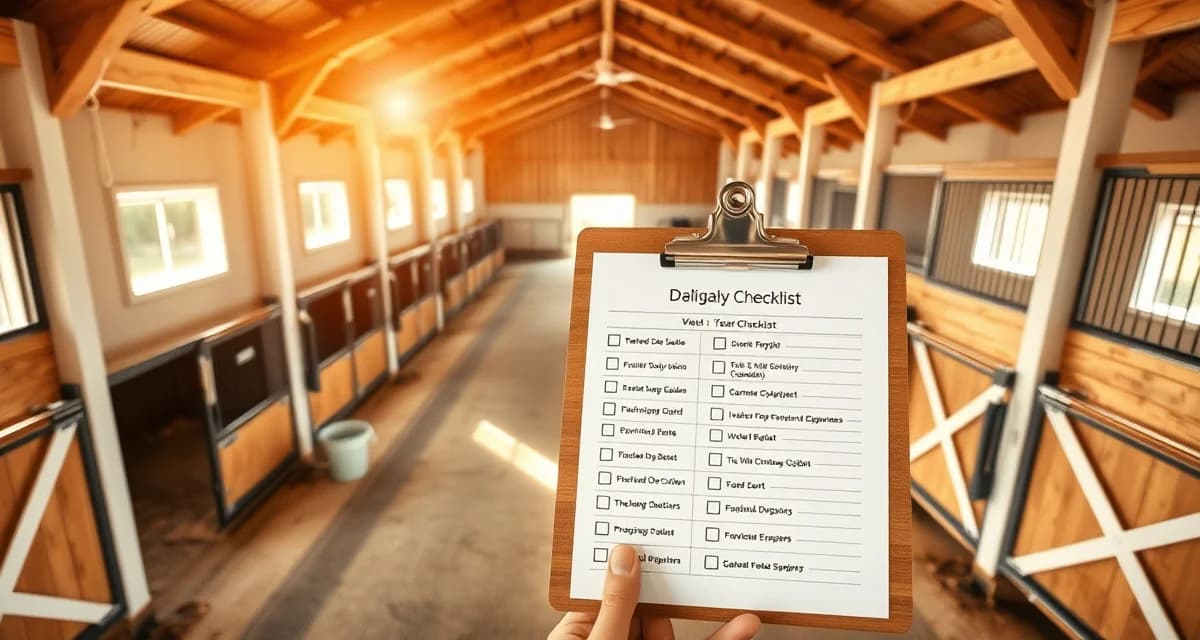
Layup Barn Daily Checklist: Complete Operations Guide
Running a layup or rehabilitation barn is not the same as managing a standard boarding facility. Horses are recovering from surgery, soft tissue injuries, or extended rest periods, which means a missed task is not just an inconvenience. According to AAEP 2023 data, 73% of barn incidents trace directly to missed checklist items, and in a layup setting, those misses carry real clinical consequences.
TL;DR
- Checklists assigned to specific named staff members have higher completion rates than shared or unassigned task lists
- Digital completion records with timestamps create an audit trail that paper checklists cannot provide
- Per-horse daily checklists tied to each animal's care plan catch individual health changes that generic barn rounds miss
- Morning and evening shift handover checklists prevent the communication gaps where care tasks fall through
- A completed checklist is your documentation that due diligence happened; an incomplete one is a liability exposure
- Review completion rates weekly to identify patterns in missed tasks before they become care or safety incidents
A solid layup barn daily checklist does more than keep staff organized. It creates a documented record of each horse's condition, flags deviations early, and protects your facility from liability when something goes wrong.
Why Generic Checklists Fail Layup Barns
Most barn managers start with a spreadsheet or a printed sheet tacked to the feed room wall. The problem is that generic checklists are not built around individual horses or their recovery protocols. A horse on stall rest post-colic surgery has completely different daily requirements than one doing controlled hand-walking after a suspensory injury.
Spreadsheets also break down at shift changes. Staff check boxes without context, and the next person on duty has no idea whether the horse was quiet or showing signs of discomfort. What some tools lack is the ability to generate facility-specific task lists that adapt to each horse's current rehab stage, rather than applying one template to every animal in the barn.
How to Build and Run a Layup Barn Daily Checklist
Step 1: Organize Tasks by Time Block, Not Category
Structure your checklist around the three core shifts: morning, midday, and evening. Within each shift, sequence tasks in the order staff will physically move through the barn. This reduces backtracking and ensures nothing gets skipped because someone assumed another person handled it.
A typical morning block runs from 6:00 to 9:00 AM and covers the highest-priority observations of the day.
Step 2: Morning Checks (6:00 AM - 9:00 AM)
Stall-by-stall health assessment:
- Check manure output and consistency (critical for post-colic horses)
- Assess water intake from automatic waterers or buckets
- Note any signs of sweating, pawing, or abnormal posture
- Record digital pulse on all four limbs for horses with hoof-related injuries
- Check bandages or wraps for slippage, swelling, or discharge
- Note appetite at morning feed
Feeding:
- Confirm each horse receives the correct feed type and quantity per their rehab protocol
- Administer any morning medications and document dose and time
- Log any refusals or partial consumption
Stall condition:
- Muck out fully before turnout or hand-walking begins
- Check bedding depth, especially for horses with joint issues requiring deep bedding
- Inspect stall walls and fencing for damage that could cause injury
Step 3: Midday Checks (11:00 AM - 1:00 PM)
Midday is often where layup barn checklists get thin. Staff are busy, and this block gets treated as optional. It is not.
Turnout and controlled exercise:
- Confirm turnout duration matches the vet-prescribed protocol for each horse
- Document hand-walking distance or time completed
- Note any lameness, behavioral changes, or reluctance to move
- Check paddock fencing and footing before turnout
Water and environment:
- Refill water buckets or check automatic waterers
- Assess stall temperature and ventilation, particularly in summer or during illness recovery
- Spot-check bandages on horses that were exercised
Step 4: Evening Checks (4:00 PM - 7:00 PM)
Second feeding and medication round:
- Repeat the medication tracking with dose, time, and administering staff member
- Note any changes in appetite compared to morning
- Administer evening supplements per each horse's protocol
End-of-day health assessment:
- Re-check limbs and bandages on all horses
- Record any temperature readings for horses flagged in the morning
- Note gut sounds on post-colic horses
- Document any calls made to the vet or farrier
Stall and facility security:
- Confirm all stall latches are secured
- Check water supply for overnight
- Verify night lighting and alarm systems are functional
Step 5: Complete the Shift Handover Log
A checklist without a proper handover is half a system. Every shift should end with a written summary of any horse that showed abnormal signs, any tasks that were not completed and why, and any instructions for the incoming staff member.
For a detailed framework on structuring this process, see our shift handover guide. A clear handover prevents the most common cause of layup barn incidents: the next person assuming everything was normal because nothing was flagged.
Step 6: Use Software That Generates Checklists From Your Roster
This is where most facilities leave time and safety on the table. Manually updating a checklist every time a horse's rehab protocol changes is error-prone and time-consuming.
BarnBeacon generates facility-specific checklists automatically from your horse roster. When a vet updates a horse's exercise restriction or medication schedule, the checklist updates with it. Staff see only the tasks relevant to their shift and their assigned horses, with no ambiguity about what needs to happen.
If you are evaluating barn management software, look specifically for checklist tools that tie tasks to individual animals and rehab stages, not just generic daily reminders.
Common Mistakes in Layup Barn Operations
Treating all horses the same on the checklist. A horse in week one of post-surgical stall rest needs more frequent checks than one in week eight of controlled turnout. Your checklist should reflect that difference explicitly.
Skipping documentation when everything looks normal. "No issues" is a valid and important entry. It establishes a baseline and protects you if a problem develops later.
Relying on verbal handovers. Memory is unreliable, especially across multiple horses and multiple staff members. If it is not written down, it did not happen.
Using one checklist format for all facility types. A layup barn has different priorities than a training barn or a breeding operation. Generic templates miss the clinical specificity that rehab horses require.
FAQ
What should be on a barn daily checklist?
A layup barn daily checklist should include stall-by-stall health assessments, feeding and medication logs, turnout and exercise records, bandage and wound checks, water intake monitoring, and a shift handover summary. For rehabilitation facilities, each item should be tied to the individual horse's current recovery protocol rather than applied as a blanket standard.
How do I track completed barn tasks digitally?
The most reliable method is barn management software that allows staff to check off tasks in real time from a mobile device, with timestamps and the ability to add notes. This creates an auditable record that spreadsheets and paper checklists cannot provide. Look for platforms that send alerts when tasks are overdue or when a horse's condition is flagged as abnormal.
Can I share checklists with staff on mobile?
Yes, and for layup barns with multiple staff members across multiple shifts, mobile access is essential. Staff should be able to view their assigned tasks, mark them complete, and add observations from their phone without needing to return to a central computer. BarnBeacon and similar platforms support this workflow natively, ensuring the checklist is always current regardless of who is on shift.
How does BarnBeacon compare to spreadsheets for barn management?
Spreadsheets require manual updates, lack real-time notifications, and create version control problems when multiple staff members are working from different files. BarnBeacon centralizes records, pushes alerts automatically based on logged events, and connects care records to billing and owner communication in one system. Most facilities report saving several hours per week after switching from spreadsheets.
What is the setup process like for BarnBeacon?
Most facilities complete the initial setup in under a week. Horse profiles, service templates, and billing configurations can be imported from existing records or entered directly. BarnBeacon's US-based support team is available to assist with setup, and most managers are running their first billing cycle through the platform within days of starting.
Can BarnBeacon support a barn with multiple staff members?
Yes. BarnBeacon supports multiple user accounts with role-based access, so barn managers, barn staff, and owners each see the information relevant to their role. Task assignments, completion logs, and communication history are all attached to the barn's account rather than to individual staff phones or email addresses.
What is Layup Barn Daily Checklist: Complete Operations Guide?
A Layup Barn Daily Checklist: Complete Operations Guide is a structured operational framework designed specifically for rehabilitation and layup barns housing horses recovering from surgery or injury. Unlike standard boarding checklists, it covers per-horse care plans, shift handover protocols, medication tracking, and condition monitoring. It creates timestamped documentation of daily tasks, helps staff catch health deviations early, and protects facilities from liability by establishing a clear audit trail of completed care duties.
How much does Layup Barn Daily Checklist: Complete Operations Guide cost?
The Layup Barn Daily Checklist: Complete Operations Guide on BarnBeacon is available as a free resource. BarnBeacon provides operational guides, templates, and checklists to help barn managers improve daily workflows without a subscription fee. For facilities looking to digitize their checklist process with timestamps, staff assignments, and completion tracking, BarnBeacon also offers platform tools designed to replace paper-based systems and reduce the risk of missed tasks in high-stakes rehabilitation settings.
Sources
- American Association of Equine Practitioners (AAEP)
- United States Equestrian Federation (USEF)
- American Horse Council
- Kentucky Equine Research
- UC Davis Center for Equine Health
Get Started with BarnBeacon
The steps in this guide only deliver results when the tools behind them match your actual daily workflows. BarnBeacon gives layup facilities the task management, health logging, and owner communication infrastructure to run the protocols described here without adding administrative overhead. Start a free trial and build your first digital task system around your horses' real care plans.