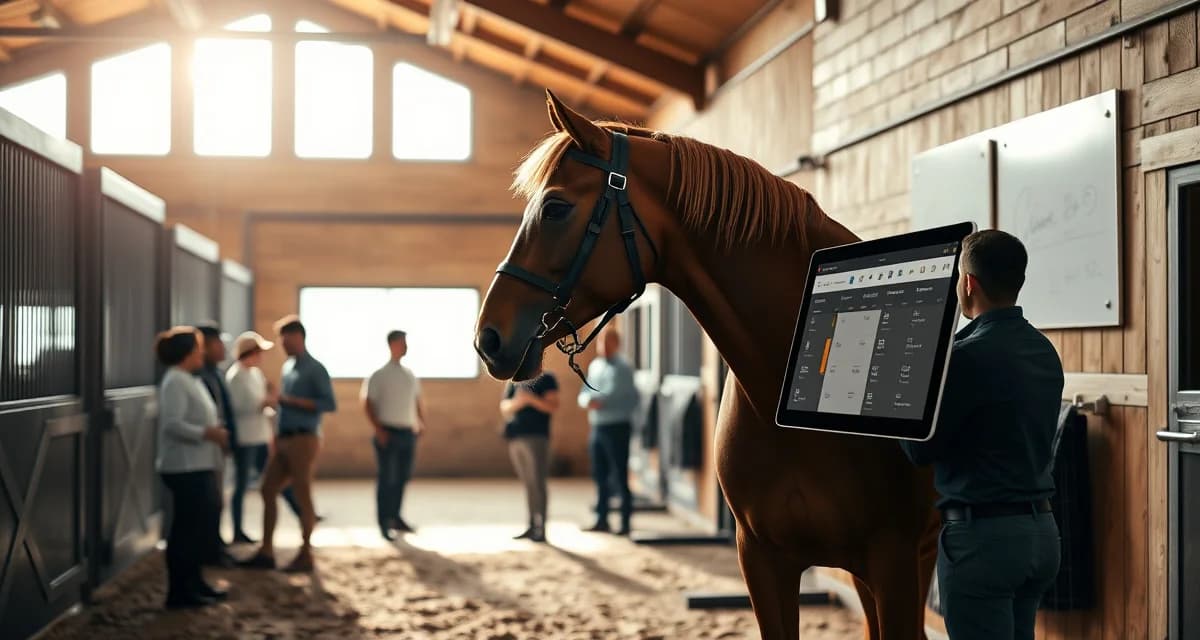
Vaulting Barn Owner Communication: Health and Updates
Vaulting barn owner communication follows patterns that generic barn management software simply wasn't built for. Unlike boarding or lesson barns, vaulting facilities deal with shared horse ownership, team-based training schedules, and performance horses whose physical condition directly affects multiple athletes at once.
TL;DR
- Health observations logged at the point of care, not reconstructed at shift end, are the only reliable clinical record
- Daily baseline documentation for each horse creates the comparison point that makes anomaly detection meaningful
- medication tracking must include product name, dose, route, and withdrawal period for any horse in a regulated program
- Vet instructions delivered verbally during farm visits are frequently misremembered; written confirmation before the vet leaves is the standard
- Health alert protocols should remove judgment calls from staff: define triggers in writing so action is automatic
- Owner notification within 30 minutes of a health event, including a documented timeline, reduces disputes and builds confidence
Getting this communication right isn't optional. When a horse is off work, an entire vaulting team's training calendar shifts. Owners need to know fast, and they need the right details.
The Problem With Generic Barn Communication Tools
Most barn software treats every discipline the same. A vaulting barn has fundamentally different reporting needs: horses are often co-owned or leased by clubs, multiple vaulters depend on a single horse, and health updates carry competitive implications that a trail riding barn never faces.
When a vaulting horse shows early signs of back soreness or hoof sensitivity, that information needs to reach owners with context, not just a generic "horse was seen by vet" notification. The gap between what generic tools offer and what vaulting barns actually need is where communication breaks down.
Step 1: Establish Your Communication Baseline
Identify Who Receives Updates
Start by mapping every stakeholder connected to each horse. In vaulting, this often includes a primary owner, a club director, a coach, and sometimes a national federation contact. Each person may need different information at different levels of detail.
Build a contact list that distinguishes between decision-makers (owners who authorize treatment) and informational recipients (coaches who need to adjust training). This distinction prevents message overload and ensures the right people act on urgent updates.
Set Update Frequency Expectations
Tell owners upfront how often they'll hear from you and through what channel. A weekly health summary works for routine updates. Anything involving a vet visit, a change in work status, or a competition-related concern should trigger an immediate notification.
Document this in your barn agreement. Owners who know what to expect are far less likely to call or text you directly for information you were already planning to send.
Step 2: Build a Vaulting-Specific Health Update Template
What to Include in Every Routine Update
A standard weekly health update for a vaulting horse should cover:
- Work status: Active, reduced work, or off work, with a reason
- Body condition score: Use the Henneke scale (1-9) and note any changes from the previous week
- Back and topline assessment: Critical for vaulting horses carrying athletes
- Hoof condition: Note any sensitivity, farrier visits, or changes
- Behavior and attitude: Vaulting horses under athlete load show stress differently than ridden horses
- Upcoming vet or farrier appointments
Keep the format consistent. Owners learn to scan a familiar layout quickly, and consistency builds trust over time.
What to Include in Urgent Updates
Urgent updates need a different structure. Lead with the situation, then the action taken, then what happens next. "Bella showed mild right hind lameness during Tuesday's session. Dr. Marsh examined her at 2pm and recommended 5 days of rest with re-evaluation Friday. We've notified Coach Torres and adjusted the team schedule accordingly."
That's the entire message. No filler, no hedging. Owners in vaulting are often experienced horse people who want facts, not reassurance.
Step 3: Choose the Right Digital Tool
What Vaulting Barns Need From Software
A communication platform for a vaulting barn needs to handle a few things that general tools miss. It needs to support multiple contacts per horse, allow role-based message targeting, and keep a searchable record of every health update sent.
The owner communication portal in BarnBeacon was built with exactly these workflows in mind. Managers can log a health note once and push it to the right recipients automatically, without copying and pasting into three different apps.
How BarnBeacon Adapts to Vaulting Workflows
BarnBeacon's owner portal lets you configure each horse's contact list by role: owner, coach, club administrator. When you post a health update, you choose which roles receive it. A routine body condition update goes to the owner. A work status change goes to the owner and the coach simultaneously.
This matters in vaulting because coaches need to know about horse availability before they can plan team sessions. Waiting for an owner to forward a message to a coach costs hours. Automated role-based delivery eliminates that delay entirely.
For a broader look at how this fits into your overall facility management, the vaulting barn operations guide covers scheduling, horse care workflows, and team coordination in more detail.
Step 4: Log Every Communication
Why Documentation Protects Everyone
A health update that isn't logged is a liability. If an owner later disputes when they were informed about a lameness issue or a vet recommendation, your only protection is a timestamped record.
Use your barn software to log every update sent, every response received, and every verbal conversation you follow up in writing. BarnBeacon automatically timestamps and archives all portal messages, giving you a complete communication history per horse.
Build a Monthly Health Summary
At the end of each month, compile a one-page summary for each horse. Include body condition trend, work days versus rest days, vet and farrier visits, and any notable behavioral changes. Send this to owners as a PDF or through the portal.
Monthly summaries serve two purposes. They give owners a clear picture of their horse's overall health trajectory, and they demonstrate the level of professional care your barn provides. In vaulting, where horses are high-value athletes, this kind of documentation supports the trust that keeps long-term owner relationships intact.
Step 5: Handle Difficult Updates Professionally
Delivering Bad News
Vaulting horses face specific injury risks: back strain from repeated athlete loading, hoof stress from arena surfaces, and soft tissue issues from the physical demands of the sport. When something goes wrong, how you communicate matters as much as what you communicate.
Call first for serious issues. Follow up in writing within the hour. Give owners a clear timeline for next steps and stick to it. Avoid speculating about causes or prognosis before you have veterinary input.
Managing Owner Anxiety Around Competition Season
Competition season amplifies owner concern. A horse that's slightly off in January is a worry. The same horse slightly off two weeks before a regional competition is a crisis in the owner's mind.
Increase your communication frequency during the six weeks before major competitions. Daily work status updates during this window cost you five minutes and prevent a dozen anxious phone calls. Set this expectation at the start of the season so owners know it's coming.
Common Mistakes to Avoid
Sending updates too infrequently. Silence reads as neglect, even when everything is fine. A brief "all good this week" message takes 30 seconds and maintains the communication rhythm owners rely on.
Using informal channels for formal updates. Text messages get lost, misread, and can't be archived properly. Keep health updates inside your barn management platform where they're logged and searchable.
Forgetting the coach. In vaulting, the coach is often the person most immediately affected by a horse's work status. Build them into your communication workflow from day one, not as an afterthought.
Skipping the monthly summary. Owners who only hear from you when something is wrong will eventually assume something is always wrong. Regular summaries normalize communication and reduce anxiety.
How should a barn manager respond when a horse's health observation is outside normal baseline?
Log the observation immediately with the time, specific findings, and the staff member's name. Contact the attending veterinarian if the deviation is outside the parameters defined in the horse's care plan. Notify the owner in writing, including what was observed and what action was taken. This sequence creates a defensible record and demonstrates appropriate professional response.
What should every horse's health record include at minimum?
At minimum, a horse's health record should include vaccination dates and products, deworming history, dental exam dates, farrier schedule, medication logs with product and dose, and any veterinary findings or diagnoses. For horses in regulated disciplines, drug testing withdrawal periods for recent treatments must also be tracked. A record that cannot be produced quickly during an inspection or a dispute is effectively no record at all.
How often should vital signs be checked for horses on stall rest or recovery programs?
Vital signs for stall rest or recovery horses should be checked at every feeding, at minimum twice daily. For horses in acute recovery or following surgery, more frequent checks may be required; follow the veterinarian's written protocol. Log temperature, respiration, and heart rate each time and flag any reading outside baseline before the next check.
FAQ
What is Vaulting Barn Owner Communication: Health and Updates?
Vaulting barn owner communication for health and updates is a structured system for documenting and sharing horse health information between barn staff, veterinarians, and owners at vaulting facilities. Unlike standard barns, vaulting operations involve shared horses, team training schedules, and performance athletes whose condition affects multiple people. This communication framework covers real-time health logging, medication tracking, vet instruction recording, and owner alert protocols to ensure everyone stays informed when a horse's status changes.
How much does Vaulting Barn Owner Communication: Health and Updates cost?
Most vaulting barns implement health communication through barn management software, with costs ranging from free basic tools to $50–$200 per month for dedicated platforms with automated owner notifications, medication logs, and vet record storage. Some facilities build systems using shared apps or existing tools at no cost. The real investment is staff time and training to maintain consistent documentation habits. Purpose-built equine management software typically delivers the best return for high-volume vaulting programs.
How does Vaulting Barn Owner Communication: Health and Updates work?
Health and update communication works by logging observations at the point of care—during feeding, grooming, or training—rather than reconstructing them later. Staff record baseline vitals, behavioral changes, and treatments in real time. When a health event occurs, a defined alert protocol triggers owner notification within a set window, typically 30 minutes. Vet instructions are documented before the vet leaves. This creates a continuous, timestamped record accessible to owners, trainers, and medical staff.
What are the benefits of Vaulting Barn Owner Communication: Health and Updates?
The core benefits include faster anomaly detection through daily baseline comparisons, reduced disputes from documented timelines, and fewer missed medication doses or withdrawal periods. For vaulting specifically, owners can adjust training plans immediately when a horse goes off work rather than learning days later. Staff operate with clear triggers instead of judgment calls, reducing liability. Consistent written communication also builds long-term owner trust and supports compliance in regulated competition environments.
Who needs Vaulting Barn Owner Communication: Health and Updates?
Any vaulting barn with shared horse ownership, team-based athletes, or performance horses competing under regulatory oversight needs a structured health communication system. This includes youth vaulting clubs, adult competitive teams, and facilities that lease horses to multiple groups. The need intensifies when horses are insured, when withdrawal periods apply for competition eligibility, or when owners are not on-site daily and rely entirely on staff to monitor and report condition.
How long does Vaulting Barn Owner Communication: Health and Updates take?
Setting up a health communication system takes one to two weeks for protocol design and staff training. Daily documentation itself adds five to fifteen minutes per horse per shift once habits are established. Owner notifications happen in real time as events occur. The upfront investment is front-loaded—writing trigger definitions, configuring software, and training staff—but ongoing maintenance is minimal when the system is properly embedded into daily barn routines.
What should I look for when choosing Vaulting Barn Owner Communication: Health and Updates?
Look for systems that support point-of-care logging rather than end-of-shift data entry, customizable alert thresholds, and medication records that capture product name, dose, route, and withdrawal period. Owner-facing notifications with timestamps and audit trails are essential for dispute resolution. For vaulting specifically, check whether the platform handles multiple owners per horse and team-level scheduling. Ease of mobile use by barn staff during chores is often the deciding factor in long-term adoption.
Is Vaulting Barn Owner Communication: Health and Updates worth it?
Yes—for vaulting barns, the cost of poor health communication is measurable. A delayed owner notification about a lame horse disrupts an entire team's training week. A missing withdrawal period record can disqualify an athlete at competition. A verbally delivered vet instruction that gets misremembered can lead to incorrect treatment. Structured communication prevents these outcomes. The time investment is modest, and purpose-built software accelerates adoption. For any barn with performance horses and multiple stakeholders, this system pays for itself quickly.
Sources
- American Association of Equine Practitioners (AAEP)
- American Vaulting Association (AVA)
- American Competitive Trail Horse Association (ACTHA)
- American Horse Council
- UC Davis Center for Equine Health
Get Started with BarnBeacon
Health records that live on a clipboard in the barn aisle cannot protect your horses or your facility the way a real-time digital system can. BarnBeacon gives vaulting barns the health logging, alert, and owner notification tools to document care at the point of service, catch anomalies early, and build a defensible record automatically. Start a free trial and see how your health tracking changes in the first two weeks.