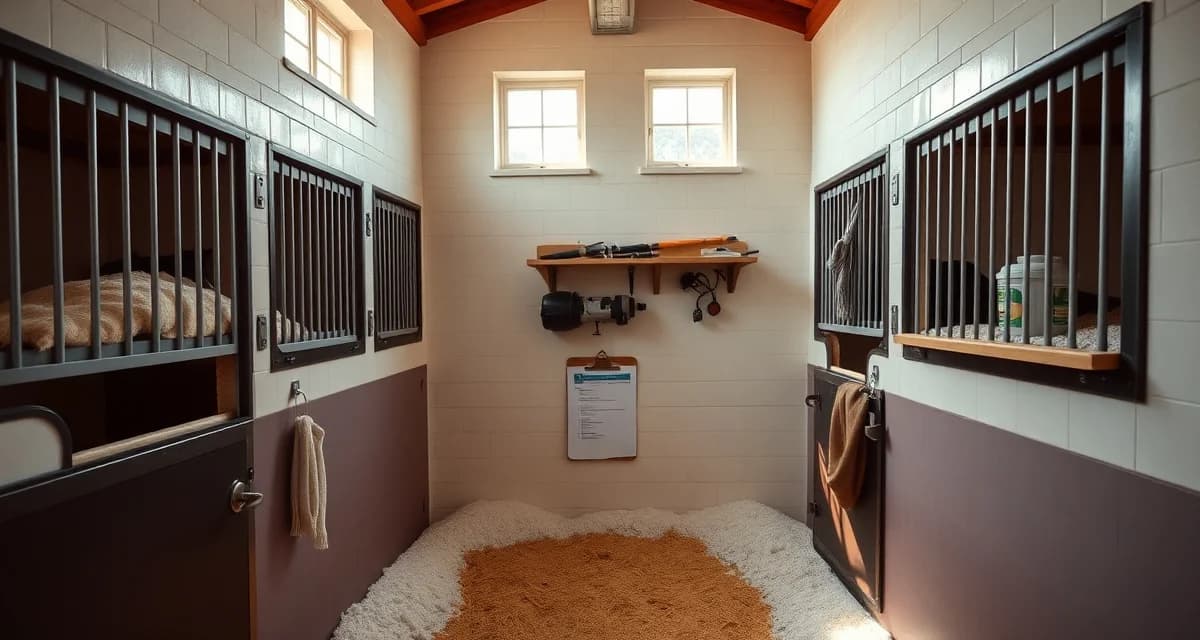
Stall Management at Boarding Facilities: Cleaning and Inspection
Running stall management at a boarding barn is fundamentally different from managing a private operation. You are responsible for horses owned by paying clients, each with their own expectations, preferences, and contracts. Stall management at a boarding barn means balancing consistent standards across every stall while accommodating individual horse needs and keeping staff accountable at scale.
TL;DR
- Boarding facilities have specific stall management requirements that differ from standard boarding operations.
- Stall condition documentation with timestamps is the foundation of both staff accountability and horse health tracking.
- Bedding standards, cleaning frequency, and inspection protocols should be written down, not communicated verbally.
- Digital stall management tools that update in real time give all staff the same current information without verbal relay chains.
- A weekly manager inspection layer catches quality drift that daily completion logs alone will not surface.
Boarding facilities represent a distinct segment with unique management needs: multiple owners, variable board packages, and the constant pressure of client visibility. A missed cleaning or a poorly bedded stall is not just an operational issue. It is a billing dispute or a lost client waiting to happen.
The Problem With Generic Stall Protocols
Most stall management advice is written for private farms or training barns where one team manages horses for one owner. Boarding facilities have 20, 40, or 80 horses from dozens of different owners, each with their own vet, farrier, and feeding instructions.
Generic protocols break down fast in this environment. A one-size-fits-all cleaning schedule does not account for the horse that paces and tears through bedding twice as fast, or the owner who pays a premium package and expects twice-daily checks. You need a system built around the boarding model, not adapted from somewhere else.
Step 1: Define Your Cleaning Standards by Board Package
Set Baseline Expectations in Writing
Every board package should have a written stall cleaning standard attached to it. Full care board typically includes once or twice daily full stall cleaning. Partial board or self-care arrangements have different expectations. Document exactly what each package includes: full strip and re-bed, or pick and top-off.
This protects you legally and operationally. When a client disputes whether their stall was cleaned, you have a signed agreement that defines what "cleaned" means under their contract.
Differentiate by Stall Use
Stalls used by horses that are in heavy work, recovering from injury, or on stall rest have different cleaning demands than a horse that is out on pasture 10 hours a day. Build your cleaning schedule around actual stall time, not a flat daily rotation.
Track which horses are in overnight, which are turned out, and which are on medical protocols. This data directly affects how much bedding you use and how long each stall takes to clean.
Step 2: Choose Bedding Based on Client and Horse Needs
Know Your Options
Shavings remain the most common bedding in boarding barns because they are widely available, easy to manage, and familiar to most clients. Straw is cheaper but breaks down faster and is harder to keep clean. Pelleted bedding absorbs more moisture per pound and reduces overall volume, which can lower disposal costs significantly.
Some boarding facilities offer bedding choice as a premium add-on. If you go this route, track bedding type per stall in your management system so staff always know what to use and what to order.
Manage Inventory Proactively
Running out of bedding mid-week in a boarding barn is a client relations problem, not just a supply issue. Set minimum stock thresholds based on your average weekly usage per stall type. If you have 30 full-care stalls averaging 1.5 bags of shavings per clean, you need a reliable reorder point built into your workflow.
Barn management software can automate inventory tracking and flag low stock before it becomes an emergency.
Step 3: Build a Daily Inspection Checklist
What Every Stall Inspection Should Cover
A stall inspection is not just about cleanliness. In a boarding barn, it is also your first line of health monitoring for horses whose owners are not on-site every day. Every inspection should include:
- Manure output (volume and consistency)
- Water bucket or automatic waterer status
- Hay and grain consumption
- Bedding condition and coverage
- Any signs of pawing, weaving, or cribbing damage
- Visible injuries, swelling, or abnormal behavior
This list should be standardized across your entire staff. If one groom checks water and another does not, you will miss problems.
Make Inspections Documented, Not Assumed
Verbal check-ins do not hold up when a client asks why their horse's abscess was not caught earlier. Every inspection should be logged with a timestamp and the name of the staff member who completed it. This creates accountability and gives you a defensible record if a health issue escalates.
Digital logs beat paper every time in a boarding environment. Paper gets lost, damaged, or filled out after the fact. A timestamped digital entry is harder to fake and easier to share with a concerned owner.
Step 4: Assign Staff Accountability by Zone
Zone-Based Assignments Reduce Gaps
Assigning staff to specific barn zones rather than rotating them randomly builds ownership and consistency. When the same person cleans the same 10 stalls every day, they notice when something is off. They know which horse always leaves a full water bucket and which one drinks twice as much after a ride.
Post zone assignments visibly in the barn and update them when staff schedules change. Ambiguity about who is responsible for which stall is how things get missed.
Use Completion Tracking
Knowing a stall was assigned is not the same as knowing it was cleaned. Build a completion tracking step into your daily workflow. This can be as simple as a checklist on a whiteboard or as detailed as a digital task system where staff mark each stall complete with a timestamp.
For larger boarding operations, digital task management is the only practical option. The boarding barn operations guide covers how to structure these workflows in more detail.
Step 5: Communicate Stall Condition to Owners
Transparency Builds Retention
Boarding clients pay monthly. They want to know their horse is being cared for even when they are not there. Proactive communication about stall condition, health observations, and any issues you noticed is one of the highest-value things a boarding barn can offer.
This does not mean sending a message every time you pick a stall. It means having a system for flagging anything outside the norm and getting that information to the right owner quickly.
Tie Communication to Your Management System
Equine stall management at a boarding facility works best when your inspection logs, task completion records, and client communication tools are connected. When a staff member notes reduced manure output during morning inspection, that flag should be easy to escalate to the barn manager and, if needed, to the horse's owner.
BarnBeacon is built specifically for boarding facility workflows, including the billing structures, client communication, and per-horse tracking that boarding operations require. Most barn software is designed for private or training operations and does not account for the multi-owner complexity of a boarding barn.
Common Mistakes in Boarding Barn Stall Management
Treating all stalls the same. Horses on different board packages, with different turnout schedules, and different health needs require different cleaning protocols. A flat rotation ignores this reality.
Skipping documentation. In a boarding barn, undocumented work is invisible work. If you cannot show a client or a vet what was observed and when, you have no record.
Letting inventory management slide. Bedding shortages, water bucket replacements, and supply gaps all affect stall quality. Reactive purchasing in a boarding barn is expensive and disruptive.
Rotating staff without zone continuity. Consistency in who manages which stalls improves both quality and early problem detection. Constant rotation breaks that continuity.
FAQ
What are the unique management needs of a boarding barn?
Boarding barns manage horses for multiple paying clients simultaneously, each with different care requirements, board packages, and owner expectations. This creates complexity that private or training operations do not face: you need per-horse tracking, client communication systems, variable cleaning protocols, and billing structures that reflect actual services delivered. Staff accountability and documentation are also more critical because clients are not on-site to observe daily care.
How do I run a boarding facility efficiently?
Efficient boarding facility management depends on standardized protocols, clear staff assignments, and digital tracking systems. Define cleaning standards by board package, assign staff to consistent zones, log every inspection with timestamps, and use software that connects task completion to client communication and billing. Efficiency comes from reducing ambiguity, not from cutting corners on care.
What software do boarding barn managers use?
Boarding barn managers use equine facility management software to track per-horse care, manage staff tasks, log health observations, and handle client billing. BarnBeacon is designed specifically for boarding facility workflows, including multi-owner management and board package billing. General farm management tools often lack the boarding-specific features that make daily operations trackable and client communication practical.
What stall management practices are specific to boarding facilities?
Boarding horses have distinct stall management needs based on their activity level, health protocols, and ownership dynamics. Document any facility-specific stall standards in writing and train all staff on the rationale, not just the rules. Staff who understand why a boarding horse's stall requires particular cleaning or bedding standards are more likely to apply them consistently than staff following instructions without context.
How do I handle stall management during periods of high horse turnover?
Periods of high turnover -- show season departures and arrivals, seasonal boarding starts and ends -- are when stall management systems most often break down. Prepare by completing a full stall inventory and condition documentation before the turnover period begins. When a horse departs, photograph and log the stall condition before the next horse arrives. This protects against disputes about stall condition and gives you a documented baseline for the incoming horse's record.
What is Stall Management at Boarding Facilities: Cleaning and Inspection?
Stall management at boarding facilities refers to the structured process of cleaning, inspecting, and maintaining horse stalls in a commercial boarding operation. Unlike private barns, boarding facilities must uphold consistent standards across multiple stalls while serving paying clients with varying expectations. This includes scheduled daily cleanings, documented inspections with timestamps, standardized bedding protocols, and staff accountability systems. The goal is to protect horse health, satisfy client contracts, and reduce disputes through transparent, repeatable processes.
How much does Stall Management at Boarding Facilities: Cleaning and Inspection cost?
Stall management at a boarding facility is not a standalone product with a fixed price — it is an operational function built into board packages. Clients typically pay monthly board fees that include daily stall cleaning, bedding, and routine inspections. Costs vary by region, facility type, and service tier, generally ranging from a few hundred to over a thousand dollars per month. Facilities may offer tiered packages where premium stall care, extra cleanings, or deep-bedding options are priced as add-ons.
How does Stall Management at Boarding Facilities: Cleaning and Inspection work?
Stall management at a boarding facility works through a combination of written standards, scheduled tasks, and layered inspection. Staff follow documented cleaning protocols for each stall daily, logging completions with timestamps. Bedding levels, waste removal, and stall condition are tracked — ideally through digital tools that give all team members real-time visibility. A manager performs weekly inspections to catch quality drift that daily logs miss. This system keeps care consistent across all horses, regardless of which staff member is on duty.
Sources
- American Association of Equine Practitioners (AAEP)
- University of Minnesota Extension Equine Program
- Penn State Extension Horse Management Program
- The Horse magazine
Get Started with BarnBeacon
Boarding stall management requires consistent documentation across every shift -- not just on the days when a manager is present to check. BarnBeacon's stall management tools give your whole team access to current care standards, log completions with timestamps and staff attribution, and flag conditions that need manager review. If stall management consistency is a challenge at your boarding facility, BarnBeacon gives you the structure to make it reliable.