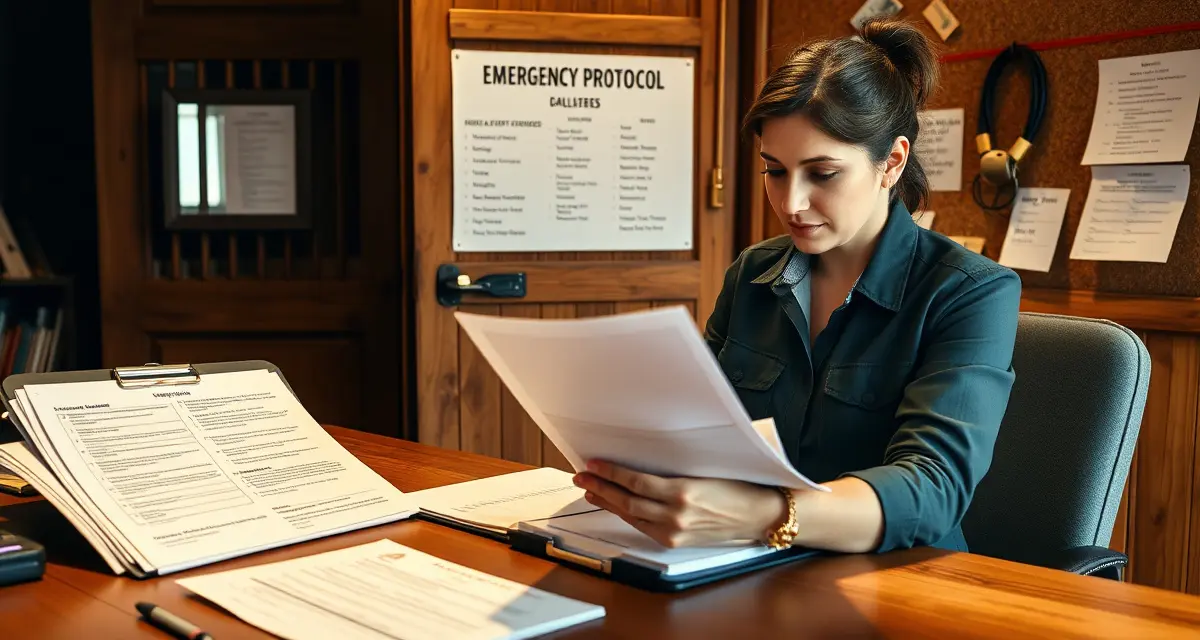
Barn Emergency Protocols Guide
Barn emergencies happen at every facility. The difference between a facility that handles emergencies well and one that doesn't is rarely about the specific event, it's about whether documented protocols existed before the emergency, whether staff had been trained on those protocols, and whether the information needed (veterinarian contacts, horse health records, emergency procedures) was accessible when the emergency occurred. Research on equine emergency outcomes consistently shows that response time and decision quality are better at facilities with established protocols than at those managing each emergency as a novel event.
TL;DR
- Colic is the most common equine health emergency; call the vet immediately if heart rate exceeds 52 beats per minute, gums are pale or tacky, or gut sounds are absent.
- Do NOT administer pain medication before the vet arrives during a colic episode, it can mask the clinical signs the vet needs to assess.
- Barn fires require evacuation before calling 911; cover a reluctant horse's eyes with a jacket or towel to encourage movement, and never re-enter a burning barn.
- Per-horse health records stored in BarnBeacon give an arriving emergency vet immediate access to medications, recent history, and known conditions, reducing critical decision time.
- Every facility should maintain a physical emergency contact list posted at the barn entrance AND a digital copy accessible via mobile app, including after-hours veterinarian lines and a large animal emergency clinic address.
- Post-emergency documentation in BarnBeacon, logging escape circumstances, injury details, or storm observations, supports insurance claims, owner communication, and protocol improvement.
- Emergency protocols should be reviewed at least annually and after every actual emergency to incorporate lessons learned.
This guide covers the major categories of barn emergency, horse health emergencies, fire, severe weather, and horse escapes, with specific protocol recommendations and notes on how BarnBeacon's barn management software supports emergency preparedness and response. The complete barn management guide covers broader operational planning.
Horse Health Emergencies
Horse health emergencies are the most common category of barn emergency at any facility. Colic, injuries, and sudden illness are facts of life in horse operations, and how quickly and effectively they are managed depends on preparation.
Colic Protocol
Colic is the most frequent equine health emergency at most facilities. Colic cases range from mild, self-resolving gas colic to life-threatening large colon displacement or volvulus. The management challenge is that early colic presentation can look similar across the severity spectrum, which is why a systematic response protocol matters more than trying to assess severity before calling the vet.
Initial colic assessment:
When a horse is showing signs of abdominal discomfort (looking at flank, pawing, rolling, elevated heart rate, poor gut sounds), immediately:
- Note the time discomfort was first observed
- Take heart rate (normal: 28-44 beats per minute)
- Check gut sounds on both flanks (normal: active borborygmi on both sides)
- Check gum color and capillary refill time (normal: pink gums, capillary refill under 2 seconds)
- Note whether the horse has been eating, drinking, and defecating normally
- Log all findings in BarnBeacon with the time of observation
When to call the vet immediately:
- Heart rate above 52 beats per minute
- Absent or significantly decreased gut sounds
- Pale, tacky, or gray gums
- Capillary refill time over 2 seconds
- Rolling violently and unable to be settled
- Signs of pain that are severe or rapidly worsening
- No manure passage in 12 or more hours
While waiting for the vet:
- Keep the horse walking if they are safe to walk and will not injure themselves or handlers
- Do not administer pain medication without veterinarian guidance, pain medication can mask clinical signs the vet needs to assess
- Clear the space and have a headlamp and watch available for when the vet arrives
- Pull BarnBeacon health records for the horse to give the vet complete recent history
Information to have ready when the vet arrives:
- Time discomfort was first noted
- Heart rate and gut sounds at initial assessment
- Any feed or water intake observations from the past 24 hours
- Any recent feed or management changes
- Medication history from BarnBeacon records
Injury Protocol
Injuries range from minor lacerations to life-threatening wounds. The primary decision at any injury is: does this require immediate veterinary attention?
Signs that require immediate veterinary contact:
- Any wound near a joint
- Any wound with significant tissue depth, even if clean
- Eye injuries
- Wounds that are actively bleeding and cannot be managed with direct pressure
- Any suspicion of bone involvement
- Any injury causing significant non-weight-bearing lameness
First response for non-emergency wounds:
- Restrain the horse safely
- Control bleeding with direct pressure using clean materials
- Rinse the wound gently with clean water
- Apply a clean bandage if appropriate
- Log injury location, appearance, and initial treatment in BarnBeacon
- Contact the veterinarian for guidance on whether a visit is needed and timeline
Emergency wound management:
- Control life-threatening bleeding first, apply significant pressure with available clean material
- Call the veterinarian immediately, do not wait to manage the bleeding before calling
- Keep the horse as calm and still as possible while managing the bleeding
- Have someone else prepare BarnBeacon health records for the arriving vet
Tying Up (Exertional Rhabdomyolysis)
Tying up during or after exercise is a recognized emergency that requires immediate veterinary contact.
Signs of tying up:
- Sudden stiffness or inability to move during or shortly after exercise
- Muscle pain and firmness over the hindquarters
- Sweating disproportionate to the work level
- Reluctance or refusal to move forward
Immediate response:
- Stop all exercise immediately
- Do not force the horse to walk, movement can worsen muscle damage
- Keep the horse warm if weather is cold
- Call the veterinarian
- Log onset time, observations, and exercise level preceding the episode in BarnBeacon
Fire Emergency Protocol
Barn fires are among the most devastating equine facility emergencies. Horses are often reluctant to leave a burning barn, and the window for safe evacuation is narrower than most facility managers expect.
Prevention is the most important fire protocol. The NFPA identifies electrical faults, heat sources in or near barns, and hay storage practices as the leading causes of barn fires. Annual electrical inspection, removing heat sources (space heaters, heat lamps) from barn areas, and storing hay away from the primary horse housing area are the three highest-impact fire prevention practices.
When a fire is discovered:
- Sound the alarm immediately, call out loudly and designate someone to call 911 before beginning evacuation
- Begin evacuating horses from the nearest/most endangered stalls first
- Use a halter if one is immediately available; lead or longe line if not; release horses into a safely fenced area or field if you cannot safely lead them
- Close stall doors, barn doors, and any openings that can slow fire spread as you evacuate each area
- Do not return to a burning barn for any reason after evacuation
Horses that refuse to leave:
- Cover the horse's eyes with a jacket or towel, horses are more likely to follow when their vision is obscured
- Do not spend more than a few seconds on any horse that is refusing, there are other horses to evacuate and your safety matters
- A horse that is not evacuated in the initial response is not worth risking a second human entry into an actively burning barn
Post-fire protocol:
- Keep all horses away from the fire scene, some horses will try to return even after evacuation
- Account for every horse by reviewing BarnBeacon's horse records
- Contact owners immediately
- Contact your insurance company
- Preserve the scene if possible for fire investigation
Documentation in BarnBeacon: Keep an emergency contact list and horse roster accessible through BarnBeacon's mobile app so that a rapid headcount can be verified during or after evacuation.
Severe Weather Protocol
Severe weather protocols vary by region, but every facility in a region subject to any severe weather should have explicit protocols for the most likely severe weather scenarios.
Tornado and High Wind Protocol
If a tornado warning is issued:
- Move all horses to interior stalls away from exterior windows and walls
- Keep horses in stalls, they are generally safer in a stall than in a field during a tornado
- Move all people to the lowest interior space of a solid structure, away from windows
- Do not shelter in a barn, barns are among the most dangerous structures in high-wind events
Post-storm assessment:
- Do not enter the barn until structural safety is confirmed
- Check every horse for injuries from flying debris
- Inspect fencing before releasing horses to turnout
- Log post-storm health observations in BarnBeacon
Lightning Protocol
- Move horses to stalls or solid-walled shelter at the first sign of lightning within striking distance
- Move all people out of open areas, away from trees, and away from metal fencing
- Do not return to outdoor areas until the lightning has passed
Flooding Protocol
- Know your facility's flood risk and have an evacuationation plan if your property is in a flood zone
- Know the routes to higher ground and confirm that they are accessible by trailer
- Have a trailer hookup and go-bag ready if your facility is in an area where flash flooding is possible
Horse Escape Protocol
A horse that has escaped from a stall, paddock, or field is a safety emergency, both for the horse and for anyone in the surrounding area.
Immediate response:
- Remain calm, a panicked human escalates a panicked horse
- If the horse is in immediate danger (near a road), prioritize getting a person between the horse and the hazard
- Approach slowly and quietly with a halter and lead, or a bucket of grain
- Do not chase, running at a loose horse is the fastest way to move them further away
- Call for additional help quietly, without shouting
Containment before catch:
- If the horse cannot be caught immediately, safely direct them into any enclosed area (arena, paddock, round pen) before they move further from the property
- Close any gates or barriers as the horse moves past them
Post-escape protocol:
- Log the escape in BarnBeacon (time discovered, circumstances, how the horse was caught)
- Inspect the breach point (broken fence, stall hardware failure, gate that wasn't latched) and repair before returning the horse
- Notify the horse's owner
Emergency Preparedness Documentation
The most important aspect of emergency preparedness is having critical information accessible when it's needed, which often means accessible by mobile device from anywhere on the property or beyond.
Emergency contact list should include: primary veterinarian with after-hours line, backup veterinarian, large animal emergency clinic with address and phone, farrier for after-hours hoof emergencies, local fire department, and horse owner contact information for every horse at the facility. This list should be posted physically at the barn entrance and stored in BarnBeacon's facility records.
Per-horse health records in BarnBeacon are the information an emergency veterinarian needs: current medications, recent health history, vaccination records, and any known conditions. A veterinarian who arrives at an emergency with access to complete BarnBeacon records can make better decisions faster than one who must extract the history through questions in a stressful situation.
Insurance documentation should be accessible separately from the barn, copies stored offsite or in cloud storage, not only in a barn office that could be inaccessible during a fire. Keeping equine insurance records organized as part of your facility's digital files ensures they are available when a claim must be filed quickly.
Frequently Asked Questions
What should be in a barn emergency first aid kit?
A barn first aid kit should include: a digital thermometer, a stethoscope for heart rate and gut sound monitoring, clean gauze and bandage material in multiple sizes, elastic cohesive wrap (Vetrap or equivalent), sterile saline or clean water for wound rinsing, antiseptic such as dilute betadine solution, a flashlight or headlamp, clean latex or nitrile gloves, scissors, a watch for timing vital signs, and a reference card with normal vital sign ranges and your veterinarian's contact information. The kit should be stored in a clean, accessible location, not in a locked cabinet, and checked for expiration and restocking at least twice a year. Log kit inspections in BarnBeacon as a recurring barn maintenance task.
How do I prepare staff for barn emergencies?
Emergency preparation for staff requires more than giving them a copy of the protocols. Walk through the protocols in person. Show staff where the first aid kit is and how to use the key items. Practice calling out a colic scenario, take heart rate, check gut sounds, call the vet with the information collected. Explain the fire evacuation plan and physically walk the evacuation routes. Establish who makes decisions in an emergency when the manager isn't present, and make sure that person has all relevant contact information in their phone. Revisit emergency protocols at least annually and whenever new staff members join. BarnBeacon's health record access through the mobile app should be part of staff emergency training.
How do I create a barn emergency plan?
A barn emergency plan should cover each major emergency category: colic and other health emergencies, fire, severe weather appropriate to your region, and horse escape. For each category, the plan should specify: what triggers a response, what the immediate response steps are, who makes decisions if the primary manager is unavailable, what contact information is needed and where it is located, and how the event is documented after the fact. Keep the plan accessible in print at the barn entrance and digitally through BarnBeacon's facility records so it is accessible from any mobile device. Review and update the plan at least annually and after any actual emergency to incorporate lessons learned.
How often should barn fire extinguishers be inspected, and where should they be placed?
Fire extinguishers in a barn should be inspected monthly by staff for visible damage, pressure gauge status, and accessibility, and professionally serviced annually. Place extinguishers at every barn entrance and exit, near any electrical panels, and at the entrance to hay storage areas. The NFPA recommends that no point in a barn be more than 75 feet from an extinguisher. Log inspection dates in BarnBeacon as a recurring task so nothing is missed between professional service visits.
What information should I give horse owners after a health emergency involving their horse?
Contact the owner as soon as the situation is stable enough to allow a clear conversation, do not wait until everything is resolved. Share the time the emergency was first observed, the vital signs recorded, what steps were taken before the vet arrived, the veterinarian's findings and diagnosis, any treatments administered, and the follow-up care plan. BarnBeacon's health records will have the timestamped observations logged during the emergency, which makes this communication accurate and complete. Written follow-up after the call is good practice for both owner reassurance and your facility's records.
Should boarding contracts include emergency authorization language?
Yes. Boarding contracts should specify what actions the facility is authorized to take if an owner cannot be reached during a health emergency, including calling a veterinarian and authorizing treatment up to a defined dollar threshold. Without this language, a facility may face delays in getting a horse treated while attempting to reach an owner. Store signed boarding contracts in BarnBeacon's facility records so the authorization language is accessible quickly if a question arises during an emergency.
How do I handle a barn emergency when I am the only person on the property?
Single-person emergencies are the hardest scenario to manage, and they are worth planning for explicitly. Keep your phone on your person at all times while working alone. Know which tasks, like calling the vet, can be done while also monitoring or restraining a horse. Post the emergency contact list where you can read it without searching. For fire, your personal safety takes priority over horse evacuation if you cannot safely do both. BarnBeacon's mobile app means you can pull up health records and contact information without going to an office or computer, which matters significantly when you are managing an emergency alone.
What is Barn Emergency Protocols Guide?
A Barn Emergency Protocols Guide is a documented framework that prepares equine facilities to respond effectively to emergencies such as colic, barn fires, and injuries. It outlines step-by-step procedures, staff responsibilities, and critical decision points so that when an emergency occurs, responders act quickly and correctly rather than treating each crisis as a novel event. Research shows facilities with established protocols achieve better outcomes through faster response times and higher-quality decisions.
How much does Barn Emergency Protocols Guide cost?
The Barn Emergency Protocols Guide on BarnBeacon is available as part of the platform's free educational resources. BarnBeacon offers digital barn management tools, including per-horse health records that give emergency vets immediate access to medications, history, and conditions during a crisis. Pricing for BarnBeacon's management features varies by plan, but the emergency protocol guidance itself is freely accessible to help all equine facilities improve safety preparedness.
How does Barn Emergency Protocols Guide work?
The guide works by breaking emergency response into clear, pre-planned protocols covering the most common equine crises. For colic, it defines specific clinical thresholds—heart rate above 52 bpm, pale gums, absent gut sounds—that trigger an immediate vet call. For fires, it establishes evacuation-first sequencing. Staff are trained on these protocols in advance, and critical information like vet contacts and horse health records is stored in BarnBeacon so it's instantly accessible when every second counts.
What are the benefits of Barn Emergency Protocols Guide?
The primary benefit is better outcomes when emergencies strike. Facilities with documented protocols respond faster, make better decisions under pressure, and avoid common mistakes—such as administering pain medication before a vet assesses a colic episode. Additional benefits include reduced staff confusion during high-stress events, faster handoff of horse health records to arriving veterinarians, and a culture of preparedness that protects both horses and people across the entire facility.
Sources
- American Association of Equine Practitioners (AAEP), Guidelines for Equine Emergency Care
- National Fire Protection Association (NFPA), Fire Safety in Agricultural Structures
- University of Minnesota Extension, Equine Emergency Preparedness for Horse Owners and Facilities
- United States Department of Agriculture (USDA) Animal and Plant Health Inspection Service (APHIS), Livestock Emergency Planning Resources
- Rutgers Equine Science Center, Horse Health and Emergency Management Publications
Get Started with BarnBeacon
BarnBeacon gives boarding barn managers the tools covered throughout this guide, per-horse health records accessible by mobile, emergency contact storage, recurring task reminders for first aid kit checks and protocol reviews, and a complete horse roster for post-emergency headcounts. If you want your facility's critical information organized and available the next time an emergency happens, start a free trial of BarnBeacon today.