Complete Guide to Breeding Barn Operations Management
Running a breeding barn requires managing more variables than almost any other type of equine facility. You are working with biology that does not follow business hours, clients who have significant financial stakes in outcomes, and records that must be precise because errors cost you money and credibility. This guide covers the core systems that separate well-run breeding operations from chaotic ones.
Establishing Your Operational Structure
Before breeding season opens, your operational structure should be defined. This means knowing who is responsible for what, what records are kept and how, and what your protocols are for every predictable scenario.
Define primary roles. Who manages the teasing and cycle tracking? Who coordinates with the vet? Who handles collection and shipping on collection days? Who is on foal watch and what is their authority to call the vet? Clear role definition prevents the situation where everyone assumes someone else handled something critical.
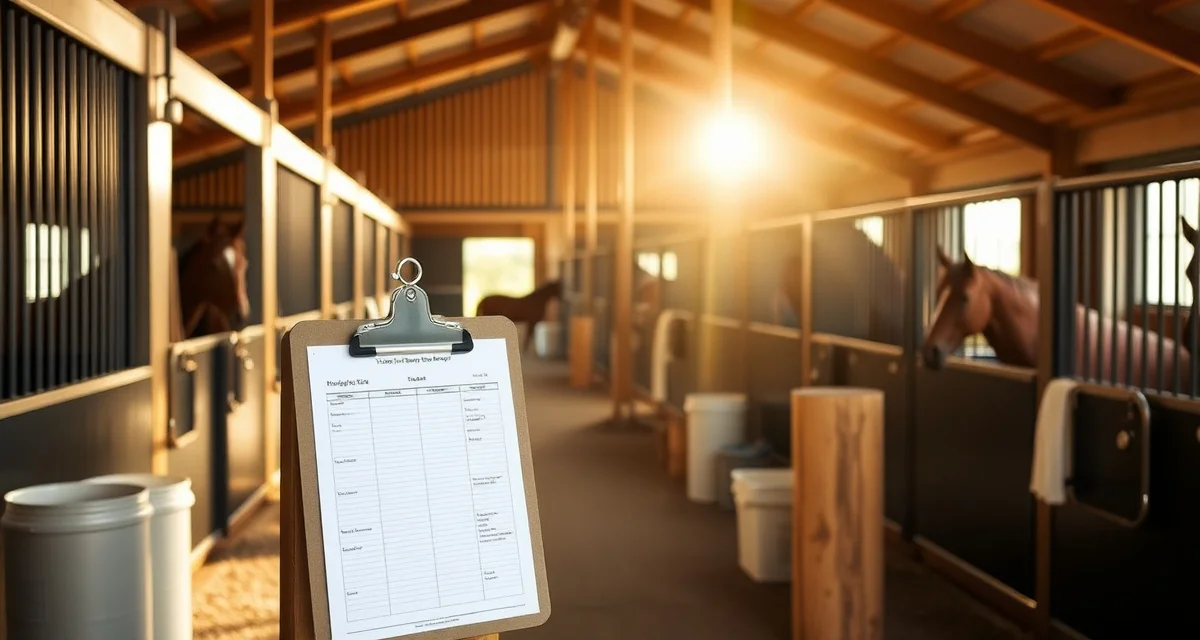
Write your protocols down. Foaling protocol, collection day protocol, veterinary visit preparation protocol. These do not need to be elaborate documents. A one-page checklist per scenario is sufficient. The point is that any qualified staff member can follow the procedure correctly without asking you.
Record Systems That Support Breeding Operations
A breeding operation has at least four distinct record layers:
Mare reproductive records capture cycle observations, teasing responses, ultrasound findings, breeding dates, post-breeding exams, pregnancy checks at 14 days, 28 days, and 60 days, foaling dates, and foaling outcomes. This is the core clinical record and it should be detailed enough that a new veterinarian could review it and understand each mare's complete reproductive history.
Stallion records include semen quality evaluations, collection frequency, extender protocols, shipping records, and breeding book entries. If your stallion is registered with a breed association that requires annual breeding reports, these records are the source data for those reports.
Foal records begin at birth and include foaling details, first nursing time, IgG results, early health events, castration dates if applicable, weaning date and method, and registration filing. Foal records link to the mare's record and to the new owner's account once the foal is sold.
Financial records track breeding fees, mare care charges, veterinary costs, collection and shipping fees, and any other services billed to each client. These should be tied directly to the service records so every charge can be traced back to documented care.
BarnBeacon integrates care records and billing so you are not reconciling two separate systems at month end.
Veterinary Coordination at Scale
On a breeding farm with twenty or more mares, veterinary coordination is a logistical challenge. Your vet is trying to run an efficient visit, and you are trying to make sure every mare that needs attention gets it.
Build a pre-visit list every time. Review your teasing logs and cycle records the day before the scheduled vet visit and compile which mares need ultrasound, which are due for post-breeding checks, and which foals need examination. Send this list to your vet the evening before.
After the visit, update every record the same day. Vet findings that sit unrecorded for two or three days create gaps in your history and can lead to follow-up treatments being missed.
Breeding Season Timeline
Most breeding operations in North America follow a seasonal pattern, though this varies by breed and climate. Here is a typical timeline structure:
November to January: Artificial lighting programs begin for mares that need their transition period advanced. Stallion fertility evaluations are scheduled. Breeding contracts are finalized and the breeding book is confirmed.
February to March: Mares begin cycling. Teasing programs start. Early breeding season for mares that need extra time or are considered reproductively challenging.
April to June: Peak breeding season. Highest volume of collection, insemination, and early pregnancy checks. Foaling season is also underway for mares bred in the previous year.
July to August: Late season breeding for mares that did not establish pregnancy. Foaling continues for later mares.
September to October: Breeding season winds down. Pregnancy checks confirm mares settled for the winter. Year-end reporting to breed registries.
Managing Client Expectations in Breeding
Breeding outcomes are not guaranteed. Clients who spend thousands of dollars on a breeding fee and mare care need to understand from the beginning that reproductive success depends on factors beyond the farm's control. Be clear about this in your contracts.
What is within your control is the quality of your management, the accuracy of your records, and the promptness of your communication. When a mare does not settle, you should be able to show the client the complete record of every attempt, every vet finding, and every protocol tried. That transparency builds trust even when results are disappointing.
Send clients regular updates during breeding season. A brief weekly note on their mare's status, including cycle observations and next steps, keeps them informed and reduces the anxious phone calls that consume your time. Systematic client communication is especially important in breeding because the emotional and financial stakes are high.
Foaling Season Protocols
Foaling season overlaps with peak breeding season on most farms, which means staff are stretched. Prepare for this overlap by having your foaling protocols completely defined before it starts.
Your foaling protocol should cover: when to begin foal watch, what observations trigger a vet call, how to assist if needed, immediate post-foaling care steps, when to call the owner, and how to document the event.
Post-foaling, confirm placenta passage within three hours. Retained placenta is a veterinary emergency. Confirm foal nursing adequacy within four to six hours. Test IgG levels at 12 to 18 hours and confirm adequate passive transfer.
Document every foaling fully before staff leaves their shift. A foaling log that captures time of birth, delivery details, and early foal observations is a clinical and legal record.
Technology for Breeding Operations
Managing a breeding operation with paper records and spreadsheets is how errors happen. Cycle observations do not make it to the vet list. Shipping records are not updated. Billing falls behind because no one is tracking which services were provided.
A platform like BarnBeacon gives you centralized records that all staff and your veterinarian can access, billing that connects to care records, and scheduling tools that keep your vet visits and breeding season timeline organized.
Pair your management software with breeding records management protocols and you have the foundation for a well-documented, efficiently run operation.
FAQ
What is Complete Guide to Breeding Barn Operations Management?
A Complete Guide to Breeding Barn Operations Management is a comprehensive resource covering the systems, protocols, and daily practices needed to run a breeding facility efficiently. It addresses role definition, record-keeping, foaling protocols, collection day procedures, and veterinary coordination. The guide helps barn managers move from reactive, ad hoc operations to structured, repeatable systems that protect both the animals in their care and the financial interests of clients.
How much does Complete Guide to Breeding Barn Operations Management cost?
This guide is free educational content provided by BarnBeacon to help equine facility managers improve their operations. There is no purchase required. BarnBeacon offers barn management resources, checklists, and operational frameworks at no cost to support horse professionals in building better-run facilities. If you are looking for premium tools, software, or consulting services to implement these systems, pricing will vary by provider and scope of service.
How does Complete Guide to Breeding Barn Operations Management work?
The guide works by breaking breeding barn operations into defined systems: staffing and role clarity, written protocols for predictable scenarios, record-keeping standards, and daily operational checklists. Each section gives you a practical framework you can adapt to your specific facility. Rather than offering abstract advice, it provides concrete starting points like one-page checklists per scenario so any qualified staff member can execute procedures correctly without manager supervision.
What are the benefits of Complete Guide to Breeding Barn Operations Management?
A well-structured breeding barn operation reduces costly errors, improves client confidence, and makes your facility more resilient when key staff are unavailable. Clear protocols mean foaling watches are handled consistently, collection days run without confusion, and veterinary visits are productive. Good record-keeping protects you legally and financially. The cumulative benefit is a barn that functions as a reliable business, not just a series of managed crises during a high-stakes breeding season.
Who needs Complete Guide to Breeding Barn Operations Management?
Any manager or owner running a breeding operation benefits from this guide, particularly those scaling beyond a handful of mares or adding staff for the first time. It is equally relevant to established facilities experiencing operational friction, communication breakdowns, or record inconsistencies. If your barn relies heavily on one person's institutional knowledge with nothing documented, this guide provides the foundation to build systems that survive staff turnover and busy season pressure.
How long does Complete Guide to Breeding Barn Operations Management take?
Implementing the core systems outlined in this guide typically takes one to four weeks before breeding season opens. Writing protocols, assigning roles, and setting up record-keeping templates can each be completed in a few hours with focused effort. The real time investment is in training staff and running through scenarios so everyone is confident before the season begins. Initial setup pays back quickly once collection days and foaling watches run without coordination failures.
What should I look for when choosing Complete Guide to Breeding Barn Operations Management?
Look for a guide that addresses both the biological realities of breeding operations and the business systems needed to manage them. Strong resources include specific protocol templates, role-definition frameworks, and record-keeping guidance rather than generic advice. Practical checklists that can be handed to staff are a sign of useful, operational content. BarnBeacon's guide emphasizes systems that work for real facilities where biology does not follow business hours and client stakes are high.
Is Complete Guide to Breeding Barn Operations Management worth it?
Yes. The time spent defining roles, writing protocols, and building solid records before breeding season is returned many times over in avoided errors, cleaner client communication, and reduced stress during high-pressure moments. Breeding barns operate on tight biological windows where a missed step can cost thousands of dollars and damage client relationships. A structured operational foundation is not overhead; it is the difference between a professional facility and one that survives each season by luck.