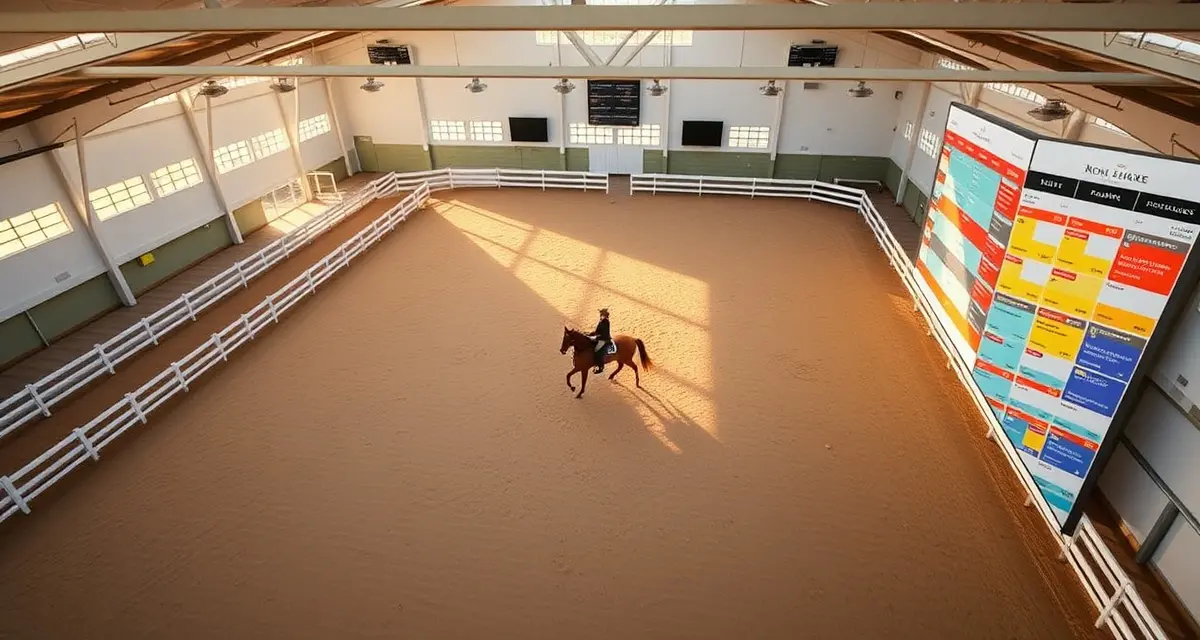
Dressage Barn Scheduling: Complete Guide for Facility Managers
Dressage training schedules linked to competition season create scheduling demands that differ considerably from general boarding or lesson facilities. When dressage horse fitness peaks need to align with specific competition dates, every element of the facility schedule, from training rides to farrier appointments to arena availability, needs to work in concert. This guide covers the scheduling workflows specific to dressage facilities.
TL;DR
- Discipline-specific facilities have billing and scheduling demands that differ meaningfully from general boarding operations.
- Performance horse health monitoring needs to track training load and recovery, not just routine care events.
- Show and competition billing requires real-time charge capture at events to avoid reconstruction errors after returning home.
- Owner communication expectations at training facilities are higher than at basic boarding operations.
- Trainer-client trust depends on documented progress records, not just verbal updates after each ride.
- BarnBeacon supports performance-focused facilities with training logs, competition billing, and owner update automation.
How Dressage Scheduling Differs from General Barn Scheduling
At a general boarding barn, scheduling is relatively simple: set feeding times, turnout rotations, and maybe a few lesson slots. At a dressage facility, scheduling is a layered planning exercise.
Training schedules are built around competition season timelines. Conditioning peaks need to align with show dates. Rest days matter. Arena footing needs maintenance around training sessions. Farrier and veterinary appointments are planned weeks or months in advance with competition dates in mind. Shipping schedules need to coordinate with preparation timelines.
When any of these elements falls out of alignment, the consequences for horse performance and client satisfaction are immediate.
Arena Scheduling at Dressage Facilities
Multiple Trainers and Horses
Dressage facilities often have multiple trainers working at the same time, or a primary trainer who schedules rides for multiple horses each day. Arena time is a finite resource that needs to be allocated efficiently.
BarnBeacon's scheduling tools let you set up the arena schedule with specific horses and trainers assigned to specific time slots. Conflicts are visible before they happen, not after two trainers show up expecting the arena at the same time.
Footing Maintenance Integration
Dressage arena footing maintenance, including dragging, watering, and leveling, needs to fit into the training schedule without disrupting training sessions. You don't want footing maintenance scheduled 20 minutes before a serious training session in the indoor arena.
A well-managed dressage barn integrates footing maintenance into the daily schedule as a non-negotiable task with protected time. BarnBeacon lets you schedule maintenance tasks alongside training to prevent the conflicts that leave footing in poor condition when horses need it most.
Indoor vs. Outdoor Arena Coordination
Many dressage facilities have both indoor and outdoor arenas. Managing which horses work in which arena, especially during weather events when everyone wants to move indoors, requires scheduling tools that can show both arenas simultaneously and accommodate rapid changes.
Training Schedule Management
Building Around Competition Dates
Dressage training programs are built backward from competition dates. If a horse is competing at a recognized show in eight weeks, the training schedule is designed to bring fitness and performance to a peak at that show while protecting the horse from overwork before the event.
Barn managers support this by ensuring that care and management schedules align with the training plan. A horse in the final two weeks before a major show needs consistent care, no disruptions from shoeing or vaccination timing, and stable turnout and feeding routines.
BarnBeacon lets you enter competition dates and view them alongside training and care schedules so conflicts are visible in advance.
Rest Day Planning
Dressage horses in serious training need rest days built into their schedule. Barn managers need to know which horses are scheduled for a rest day on any given day to coordinate care tasks appropriately. A horse on a rest day still needs turnout, feeding, and monitoring, but the schedule looks different than a training day.
Managing Multiple Horses at Different Training Levels
A dressage facility might have horses at Training Level, Prix St. Georges, and Grand Prix all in the same barn. Each horse's schedule reflects its level and competitive goals. BarnBeacon lets you view each horse's schedule individually or see a facility-wide overview to coordinate resources.
Veterinary and Farrier Scheduling
Competition Window Timing
Veterinary appointments, particularly for vaccinations, need to be timed carefully around competitions. Most recognized shows require that vaccinations be administered within a specific window before the event. Scheduling vaccinations too close to competition can affect performance or technically disqualify the horse from entry.
Farrier appointments for dressage horses need similar timing consideration. New shoes need time to settle before a competition. Most dressage barn managers schedule farrier visits four to six weeks before major shows, with a trim or adjustment two weeks out if needed.
BarnBeacon keeps your competition calendar visible alongside vet and farrier scheduling so timing decisions are made with full context.
Tracking Service Cycles
Dressage horses often have more frequent veterinary and farrier attention than horses in lighter use. Sports medicine visits, chiropractic, dentistry, and body work may be on monthly or six-week cycles. Tracking all of these in BarnBeacon's health records system keeps the schedule organized and ensures no service gets accidentally skipped in a busy barn.
Staff and Groom Scheduling
At larger dressage facilities, staff scheduling is a demanding management task. Grooms cover daily care tasks, trainers have specific horses on their riding schedule, and barn staff manage facility maintenance. Coordinating all of these without conflicts requires a scheduling system everyone can access.
BarnBeacon's scheduling tools handle staff assignments alongside horse and arena scheduling so the full daily picture is visible in one place.
Show Day and Show Season Logistics
Show season creates scheduling complexity that extends beyond the barn. Shipping logistics, stabling at shows, show day preparation schedules (morning exercise, braid time, class times), and the extra care tasks around shows all need to be coordinated.
Many dressage barn managers use BarnBeacon to track show schedules, communicate logistics to owners, and coordinate barn coverage during shows when key staff are traveling with horses.
Learn more about BarnBeacon's scheduling and management tools and how they support dressage operations at /dressage-barn-operations-guide.
Frequently Asked Questions
How do dressage barn managers handle scheduling?
Dressage barn managers handle scheduling by building every element of the facility schedule around the competition calendar. Training sessions, veterinary and farrier appointments, arena maintenance, and staff assignments all need to coordinate around competition dates and individual horse training programs. Most professional dressage facilities use dedicated management software to see the full schedule picture in one place rather than managing it across multiple documents and communication threads.
What software do dressage facilities use for scheduling?
Dressage facilities use a range of tools, from calendar apps to spreadsheets to equine-specific platforms. BarnBeacon handles scheduling as part of a broader management system that connects the schedule to horse health records, billing, and owner communication. This integration makes it easier to see the full picture of what each horse needs on any given day.
What are the unique scheduling challenges at dressage barns?
The primary scheduling challenges at dressage barns are the tight connection between the competition calendar and every other scheduling decision, the need to coordinate multiple horses at different training levels and competitive goals, and the complexity of managing arena time, footing maintenance, staff assignments, and veterinary and farrier appointments all in alignment with a precise training program. Any scheduling error that affects training preparation can have direct performance consequences.
How is billing structured differently at a Dressage facility compared to a general boarding barn?
Competition-focused facilities like Dressage operations typically add event billing layers on top of standard board and training fees. These include entry fees, venue stabling, hauling, and professional services at shows. Capturing these charges in real time, at the event rather than from memory afterward, is the most important billing practice specific to competition-focused facilities.
What records are most important for Dressage horses that travel to competitions?
Competition horses need their Coggins test results, current vaccination records, and a summary of any active health issues accessible from a phone for travel. Some venues require specific documentation at check-in. Health observations from the trip home, including any signs of travel stress, should be logged immediately on return so the training team can factor them into the recovery and reconditioning plan.
How do I track which horses are in the best condition for upcoming events?
Per-horse fitness and health records that log training load, competition history, and the trainer's condition assessments are the foundation for competition readiness decisions. A horse that competed three weekends in a row has a different physical profile than one resting for two weeks, and those decisions need to be based on documented history, not only the trainer's memory. Digital logs that capture each training session's intensity alongside health observations give the clearest picture.
What is Dressage Barn Scheduling: Complete Guide for Facility Managers?
Dressage Barn Scheduling: Complete Guide for Facility Managers is a comprehensive resource from BarnBeacon that outlines the unique scheduling workflows required at dressage-focused equine facilities. Unlike general boarding barns, dressage operations must align training rides, farrier visits, and arena availability with competition seasons and peak fitness windows. The guide covers training log documentation, competition billing, owner communication, and health monitoring tailored specifically to performance horse management.
How much does Dressage Barn Scheduling: Complete Guide for Facility Managers cost?
This guide is a free educational resource provided by BarnBeacon. There is no cost to access the article. BarnBeacon itself offers facility management software with plans designed for performance-focused barns, including features like training logs, competition billing, and owner update automation. Pricing for BarnBeacon's platform depends on facility size and selected features, so contacting BarnBeacon directly is recommended for accurate subscription details.
How does Dressage Barn Scheduling: Complete Guide for Facility Managers work?
The guide walks facility managers through a structured approach to dressage barn scheduling. It explains how to coordinate training schedules around competition dates, capture charges in real time at shows, monitor horse fitness and recovery, and maintain transparent owner communication. BarnBeacon's software supports these workflows by centralizing training records, automating owner updates, and enabling real-time billing so nothing falls through the cracks after returning from an event.
What are the benefits of Dressage Barn Scheduling: Complete Guide for Facility Managers?
Key benefits include reduced scheduling conflicts by aligning all facility activities with competition season timelines, more accurate billing through real-time charge capture at events, stronger trainer-client trust via documented progress records, and improved horse health outcomes through training load and recovery tracking. Facility managers gain a clear operational framework that replaces ad hoc coordination with repeatable, documented processes supported by purpose-built software.
Who needs Dressage Barn Scheduling: Complete Guide for Facility Managers?
Dressage facility managers, barn owners, and trainers operating performance horse programs will benefit most from this guide. It is especially relevant for facilities where multiple horses are competing on overlapping schedules and where owners expect detailed progress updates. General boarding barn operators looking to expand into dressage or performance disciplines will also find it a useful introduction to the more complex operational demands those programs require.
Related Articles
- Dressage Barn Case Study: Complete Guide for Facility Managers
- Dressage Barn Daily Checklist: Complete Guide for Facility Managers
Sources
- United States Equestrian Federation (USEF), competition rules and facility standards
- American Horse Council, equine industry economic and performance data
- American Association of Equine Practitioners (AAEP), equine athlete health and performance guidelines
- National Reining Horse Association (NRHA) or relevant discipline governing body, standards and resources
- University of Kentucky Equine Initiative, equine business and performance management resources
Get Started with BarnBeacon
BarnBeacon handles the competition billing complexity, health tracking, and owner communication demands that Dressage facilities need, in one platform built for equine operations. Start a free 30-day trial to see how it fits your specific facility type and client mix.