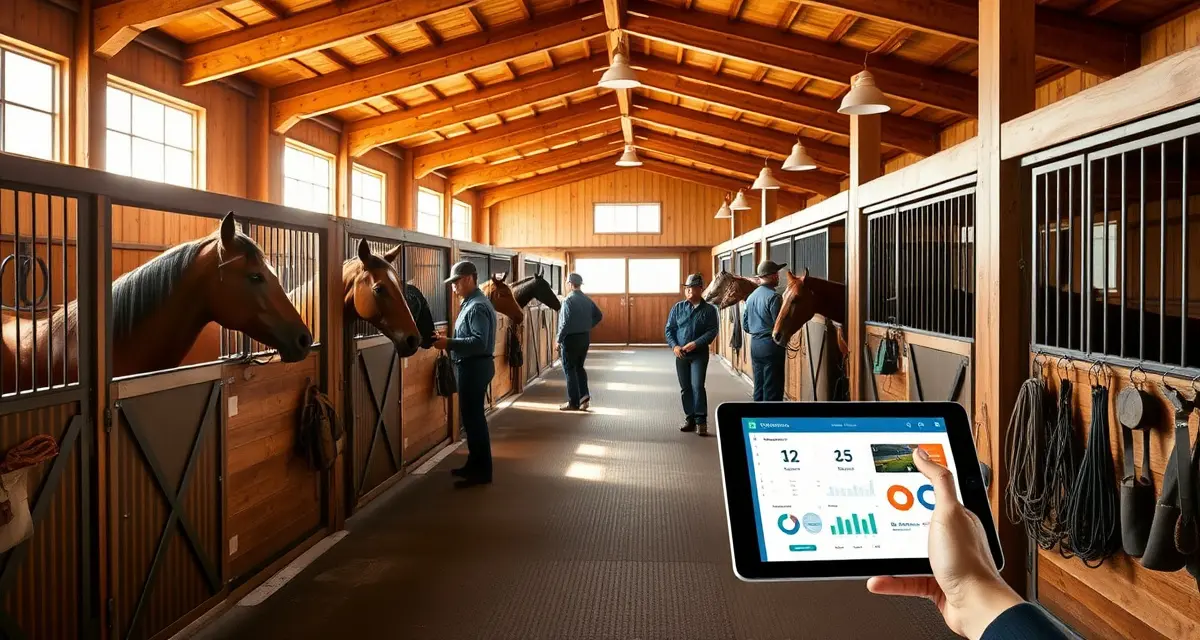
Comprehensive Guide to Western Barn Management
Western barn management covers a wide range of operations, from small family ranches with a handful of horses to large training facilities competing on national circuits. What connects them is a set of management challenges that don't care about discipline or scale: horses need consistent care, records need to be maintained, staff need to be managed, and clients need to be kept informed.
This guide pulls together the key management areas for western facilities and how to approach each one systematically.
Facility Organization
The starting point for any well-run western barn is a clear physical and organizational structure. Physical organization, where equipment lives, how horses are housed, how traffic flows through the facility, affects every operational decision.
Stall and pasture assignments. Know where every horse lives and why. At a training facility, horses may move between stalls and pastures based on their training stage, workload, or veterinary status. At a boarding operation, horses may have assigned stalls but rotate through paddocks. Document the current assignment for every horse and update it when it changes.
Equipment and supply organization. Tools, medications, grooming supplies, and tack each need designated locations that all staff know. A medication room with clear labeling and a log for anything administered is both a management best practice and a liability consideration.
Facility maintenance tracking. Fencing, water systems, stall hardware, and arena footing all require periodic maintenance. Reactive maintenance, fixing things when they break, is more expensive than scheduled maintenance. A simple maintenance log that notes inspections, repairs needed, and repairs completed is a useful starting point.
Horse Population Management
Western facilities often have complex horse populations: horses in training, horses between shows, horses in rehabilitation, young horses in early training, and occasionally horses being prepared for sale. Each category has different care requirements.
Intake and departure protocols. When a horse arrives, complete an intake record that includes current health status, vaccination history, known behavioral characteristics, and the owner's contact information. When a horse departs, ensure the departure record includes a care summary and health record transfer.
Training records. For horses in active training, maintaining a log of work sessions, including dates, exercises covered, and observations about progress and behavior, creates a professional record that most clients value. It also provides useful context when a horse's performance or attitude changes.
Competition preparation. Horses approaching competitions need current health documentation. Vet scheduling should be built around the show calendar, not just on a generic annual cycle. Coggins tests and health certificates need to be current and accessible when you're loading for a show.
Staff and Workforce Management
Western training facilities commonly blend paid staff with working students and occasional volunteers. Managing this mix requires clear documentation of who is authorized to do what.
Role definitions. Define clearly what each role includes and what it doesn't. A working student who's authorized to exercise horses under supervision is not the same as one who's authorized to start young horses independently. Working student management at a western facility needs to reflect the high-stakes nature of some of the work involved.
Communication expectations. Staff at western facilities often work early mornings and may communicate with owners or clients outside of normal business hours. Setting clear expectations about communication channels, response times, and what gets documented versus what stays verbal reduces problems later.
Performance and accountability. Documenting staff expectations and reviewing performance regularly is more common in other industries than in barn management, but it's just as useful. Staff who know what's expected and receive feedback tend to perform more consistently.
Health Records and Veterinary Management
Performance horses in western disciplines can carry significant value and are subject to intensive physical demands. Health records that are complete and current are both a professional standard and a practical requirement.
Core records for every horse:
- Current vaccination status with dates and administering veterinarian
- Negative Coggins with expiration date
- Recent dental history
- Deworming records based on fecal egg count results
- Any active medications, treatments, or restrictions
- Lameness history if relevant
Veterinary records management at a western training facility should include training-load context: a horse that was worked intensively the week before a lameness evaluation gives the vet different information than one that had been on light work.
Billing and Financial Management
Training board billing in western facilities is typically more complex than boarding-only billing. Base training fees, competition entry fees advanced on behalf of clients, hauling charges, and variable charge tracking for supplements and treatments all contribute to invoices that need to be clear and defensible.
The most important billing practice is contemporaneous documentation: record charges as they occur, not from memory at the end of the month. An entry fee paid on March 15 is clearer on the March 31 invoice if it was logged on March 15 with the specific event noted.
BarnBeacon's billing tools track these charges as they occur and organize them into monthly invoices automatically. This reduces the end-of-month reconciliation work and produces invoices that clients can understand without a phone call to clarify line items.
Turnout and Daily Care
Western facility turnout practices vary widely, from structured daily paddock rotation to horses kept on large acreage with minimal intervention. Whatever the system, document it so staff can execute it consistently.
For facilities with working horses, turnout management connects to workload management. A horse that worked hard that morning may need extended turnout time for mental recovery. One in a rehabilitation program has specific pasture restrictions. The daily care instructions for each horse should be accessible to whoever is covering any given day.
What's the most important record to maintain for a competition western horse?
Current Coggins test and vaccination records. These are required most frequently and carry immediate consequences if they're not current.
How do I manage training horses and boarding horses in the same system?
BarnBeacon handles different horse categories with different billing structures, care protocols, and record requirements in the same platform.
What's a reasonable approach to working student documentation?
A written agreement covering tasks, supervision requirements, schedule, and what care they receive in exchange. Review it at least annually.
FAQ
What is Comprehensive Guide to Western Barn Management?
A Comprehensive Guide to Western Barn Management is a structured framework covering all operational aspects of running a western equine facility — from stall assignments and equipment organization to staff management, client communication, and record-keeping. It applies to operations of any size, whether a small family ranch or a large training facility competing nationally. The guide helps barn managers approach each operational area systematically rather than reactively, creating consistency across daily care routines, facility logistics, and horse tracking.
How much does Comprehensive Guide to Western Barn Management cost?
This guide is an educational resource, not a paid product or service — so there is no direct cost to read or use it. Implementing the practices it describes may involve investments in barn management software, staff training, facility upgrades, or organizational tools. Costs vary widely depending on facility size and current systems. Many foundational improvements, like standardizing assignment documentation or organizing supply storage, can be made with minimal expense and strong returns in operational efficiency.
How does Comprehensive Guide to Western Barn Management work?
Western barn management works by establishing clear systems for each operational area: physical organization, horse tracking, staff coordination, client communication, and record-keeping. Each system supports the others — knowing where every horse lives makes health monitoring easier; organized supply storage reduces errors under pressure. The guide walks through each area and shows how to approach it methodically, so daily operations run on documented processes rather than individual memory or improvised decisions.
What are the benefits of Comprehensive Guide to Western Barn Management?
The key benefits include fewer operational errors, more consistent horse care, better staff accountability, and stronger client trust. When every horse has a documented stall or pasture assignment, every medication has a designated storage location, and every staff member knows the protocols, the facility runs more smoothly under normal conditions and recovers faster from disruptions. Systematic management also makes it easier to onboard new staff and scale operations without losing quality.
Who needs Comprehensive Guide to Western Barn Management?
Any person responsible for running a western equine facility will benefit — barn managers, facility owners, head trainers, and stable hands stepping into supervisory roles. It is equally relevant for small boarding barns trying to professionalize their operations and large training facilities managing national-circuit competitors. If you have horses in your care, staff to coordinate, or clients depending on you, the core management principles in this guide apply to your situation.
How long does Comprehensive Guide to Western Barn Management take?
There is no fixed timeline — western barn management is an ongoing operational discipline, not a one-time project. Reading the guide and understanding the principles can take a few hours. Implementing changes across a real facility typically happens in phases over weeks or months, depending on what systems already exist and how much restructuring is needed. Some areas, like reorganizing supply storage, can be addressed in a day; others, like building a complete record-keeping system, take longer.
What should I look for when choosing Comprehensive Guide to Western Barn Management?
Look for guidance that covers your specific facility type and scale, addresses both physical organization and administrative processes, and is practical enough to implement with your actual staff and resources. Good barn management guidance should include stall and pasture assignment protocols, equipment and medication organization, staff role clarity, and client communication practices. Avoid frameworks that are too generic or too large-scale for your operation — the best fit is one that matches your discipline, workload, and team size.
Is Comprehensive Guide to Western Barn Management worth it?
Yes — for anyone managing a western equine facility, a systematic approach to barn management pays for itself in reduced errors, less wasted time, and stronger client relationships. Horses depend on consistent, well-organized care, and staff perform better when roles and processes are clearly defined. Whether you run a two-horse boarding operation or a large training program, having documented systems in place reduces risk and makes daily operations more sustainable over the long term.
Sources
- National Reining Horse Association (NRHA), facility and horse care guidelines
- American Association of Equine Practitioners (AAEP), equine health management resources
- Professional Rodeo Cowboys Association (PRCA), horse care requirements
- Penn State Extension, equine business management publications