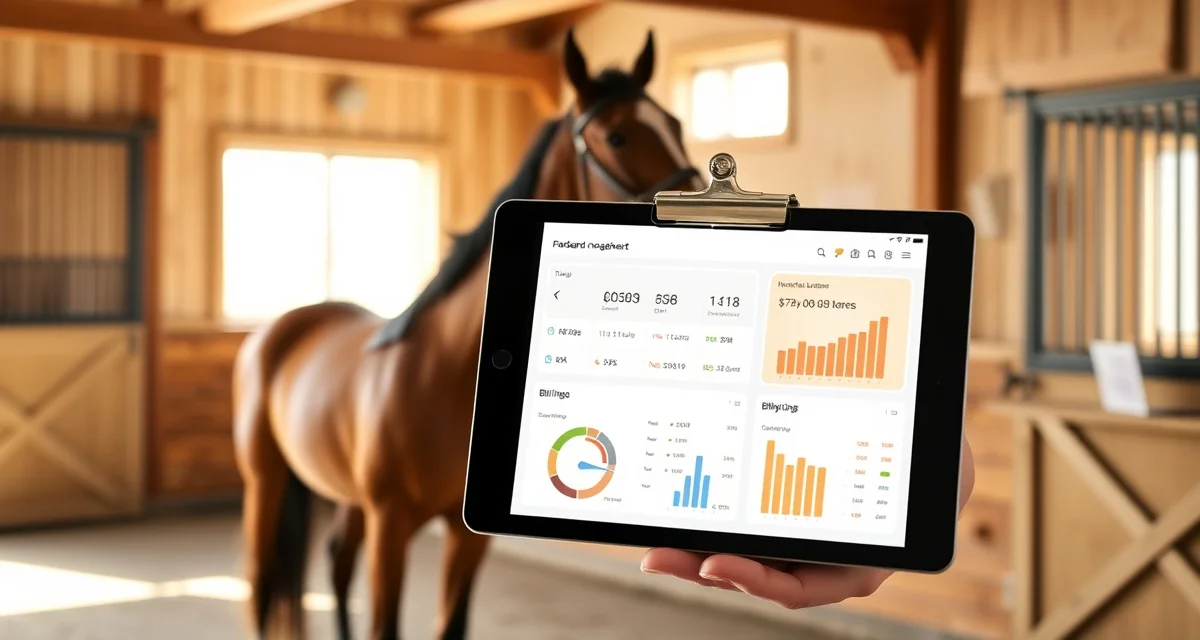
Barn Management Software Features: What Matters Most
Most barn managers are running their operations across a patchwork of spreadsheets, text threads, paper logs, and standalone apps. Research shows the average barn manager uses 6+ separate tools to keep things running, and consolidating those tools saves an average of 2.4 hours per day. That time adds up fast when you're managing horse health, owner relationships, billing cycles, and staff schedules simultaneously.
TL;DR
- The average barn manager uses 6+ separate tools, but consolidating them saves 2.4 hours per day.
- Health monitoring is the foundation feature because it directly affects liability, reputation, and owner relationships.
- Medication tracking must be a dedicated feature with dosage schedules, staff confirmation logs, and withdrawal period alerts, not just a note in a general health log.
- Automated recurring billing and an owner-facing payment portal are the two billing features that eliminate the most revenue leakage.
- Any platform missing more than two or three items on the equine facility software checklist will require supplemental tools, putting you back where you started.
- Role-based access controls are non-negotiable for facilities with more than a handful of users.
This guide walks through the barn management software features that actually move the needle, and how to evaluate whether a platform is built for the full complexity of a horse facility or just one slice of it.
Why Most Tools Fall Short
A lot of software in this space handles one job reasonably well. You might find a decent invoicing tool, or a basic scheduling app, or a health log you can maintain in a shared spreadsheet. The problem is that none of those pieces talk to each other.
When a horse's medication changes, does your billing update automatically? When a farrier appointment is scheduled, does the horse owner get notified? When a boarder is overdue on payment, can you flag it without digging through a separate system?
That's the gap most tools leave open. The barn management software features that matter most are the ones that work together as a connected system, not isolated modules.
Step 1: Start With Health Monitoring
Why It's the Foundation
Everything in a barn operation traces back to the health of the horses in your care. Health monitoring is the feature that most directly affects your liability, your reputation, and your relationships with owners.
Look for software that lets you log daily health observations, track vital signs over time, and flag abnormalities. The ability to attach notes to a specific horse's record, with timestamps and staff attribution, is critical when a vet needs a history or an owner asks what happened last Tuesday.
What to Look For
- Per-horse health logs with date and time stamps
- Customizable observation fields (temperature, gut sounds, behavior changes)
- Alert triggers when entries fall outside normal ranges
- Vet visit records linked to the horse's full profile
Step 2: Build in Medication Tracking
The Compliance Problem
Medication errors in equine facilities are more common than most managers want to admit. Without a structured tracking system, it's easy for a dose to be missed, doubled, or administered to the wrong horse.
Medication tracking should be a dedicated feature, not a note in a general health log. You need dosage schedules, administration records, withdrawal period tracking for competition horses, and the ability to generate a medication history on demand.
What to Look For
- Scheduled medication reminders tied to specific horses
- Staff confirmation logs (who gave what, when)
- Withdrawal period alerts for horses in competition
- Prescription records with vet authorization attached
Step 3: Get Billing and Invoicing Right
Where Barn Revenue Leaks
Billing is one of the most time-consuming and error-prone parts of running a boarding facility. Manual invoicing leads to missed charges, late payments, and awkward conversations with owners.
Good billing and invoicing functionality in barn management software should automate recurring board fees, add one-off charges like farrier visits or extra hay, and send invoices directly to owners without requiring you to build them from scratch each month.
What to Look For
- Automated recurring billing for board and standard services
- Ad-hoc charge entry tied to specific horses or dates
- Payment tracking with overdue alerts
- Owner-facing invoice history and payment portal
Step 4: Prioritize Owner Communication
The Expectation Gap
Horse owners expect regular updates. When they don't hear from you, they fill the silence with worry or frustration. A barn that communicates proactively builds trust and reduces the volume of inbound calls and texts you have to manage.
Owner communication tools should be built into the same platform as health and billing data. That way, when you send an update about a horse's health, you're pulling from the same record you're already maintaining, not retyping information from somewhere else.
What to Look For
- Direct messaging tied to individual horse profiles
- Automated notifications for health events, appointments, and billing
- Owner portal with access to their horse's records
- Broadcast messaging for facility-wide announcements
Step 5: Add Staff Scheduling
The Coordination Cost
Barn operations run on people. Feed schedules, turnout rotations, stall cleaning, and vet appointments all require coordinated staff coverage. Without a scheduling tool built into your barn management system, you're managing this through group texts or a whiteboard that only works when everyone is on-site.
Staff scheduling inside your barn management platform means you can tie tasks directly to horses, track who completed what, and adjust coverage when someone calls out, all without switching apps.
What to Look For
- Shift scheduling with role assignments
- Task lists tied to specific horses or barn areas
- Completion tracking with timestamps
- Mobile access so staff can check schedules from anywhere
Common Mistakes When Evaluating Barn Management Software Features
Choosing a tool for one problem. A billing app that doesn't connect to health records or owner communication creates more work, not less. Evaluate the full barn management software ecosystem before committing.
Ignoring mobile usability. Barn managers and staff are not sitting at desks. If the software isn't fully functional on a phone, it won't get used consistently.
Underestimating onboarding time. A platform with all the right features still fails if your team can't adopt it. Ask vendors about onboarding support, training resources, and how long it typically takes to get fully operational.
Skipping the integration question. If you already use QuickBooks or a specific vet records system, check whether the software integrates before you sign up. Duplicate data entry defeats the purpose of consolidation.
Overlooking permission controls. Not every staff member should see billing data. Not every owner should see other boarders' health records. Role-based access controls are a non-negotiable feature for any facility with more than a handful of users.
Your Equine Facility Software Checklist
Use this as a quick reference when comparing platforms:
- [ ] Per-horse health logs with timestamps
- [ ] Medication scheduling and administration tracking
- [ ] Automated recurring billing and ad-hoc charge entry
- [ ] Owner portal with messaging and invoice access
- [ ] Staff scheduling with task assignment and completion tracking
- [ ] Mobile-friendly interface
- [ ] Role-based access controls
- [ ] Vet and farrier appointment records
- [ ] Notification and alert system
- [ ] Reporting and audit trail
This equine facility software checklist covers the baseline. Any platform missing more than two or three of these items will likely require you to supplement it with additional tools, which puts you right back where you started.
What is the most important thing a barn manager can do to improve operations?
Consolidate your tools. Running health records, billing, communication, and scheduling through separate systems creates gaps where information gets lost and time gets wasted. Moving to a single integrated platform is the single highest-leverage operational change most barn managers can make.
How do I reduce time spent on barn administration?
Automate the repeatable tasks first. Recurring billing, medication reminders, and scheduled owner updates can all run without manual input once they're configured. Barn managers who automate these workflows consistently report saving two or more hours per day compared to manual processes.
What tools do professional barn managers use?
Professional barn managers increasingly rely on purpose-built barn management platforms that handle health monitoring, billing, owner communication, and staff scheduling in one place. The shift away from spreadsheets and standalone apps is driven by the need for accountability, audit trails, and real-time visibility across all aspects of facility operations.
How many horses or boarders do I need before barn management software is worth it?
There is no hard threshold, but most barn managers find the time savings become significant once they are managing five or more horses across multiple owners. At that point, the volume of billing cycles, health records, and owner communications makes manual tracking genuinely error-prone rather than just inconvenient.
Can barn management software help with regulatory or insurance requirements?
Yes. Many equine facilities are required to maintain medication logs, vet visit records, and incident documentation for insurance or liability purposes. Software with timestamped entries and audit trails makes it straightforward to produce those records on request, without reconstructing them from memory or scattered notes.
What should I ask a barn management software vendor before signing up?
Ask specifically about onboarding time, mobile functionality, and whether the platform integrates with tools you already use, such as QuickBooks or your vet's records system. Also confirm how role-based access controls work, since limiting what staff and owners can see is important for both privacy and data accuracy.
FAQ
What is Barn Management Software Features: What Matters Most?
Barn management software features refer to the core capabilities a platform must have to replace the patchwork of spreadsheets, texts, and paper logs most barn managers rely on. Key features include health monitoring, medication tracking, automated billing, owner portals, staff scheduling, and role-based access controls. The right combination eliminates redundant tools and centralizes daily operations into a single platform built specifically for equine facility management.
How much does Barn Management Software Features: What Matters Most cost?
Barn management software pricing varies widely depending on the number of horses, users, and features included. Entry-level plans typically start around $50–$100 per month, while full-featured platforms for larger facilities can run $200–$500 or more monthly. Many providers offer tiered pricing or per-stall models. Before comparing costs, calculate what your current tool stack costs in subscriptions and lost time — consolidation often pays for itself quickly.
How does Barn Management Software Features: What Matters Most work?
Barn management software works by centralizing your facility's core operations into one connected platform. Health records, medication schedules, billing cycles, and owner communications are all managed from a single dashboard. Staff receive role-appropriate access so everyone sees only what they need. Automated reminders handle recurring tasks, owners can log in to view updates and pay invoices, and you get a real-time view of your entire operation without chasing down separate apps.
What are the benefits of Barn Management Software Features: What Matters Most?
The primary benefits are time savings and reduced errors. Consolidating tools saves an average of 2.4 hours per day for barn managers. Beyond efficiency, dedicated health and medication tracking reduces liability exposure, automated billing eliminates revenue leakage, and owner portals improve transparency and trust. Role-based access means the right people have the right information without creating security gaps — which matters enormously as your team or boarder roster grows.
Who needs Barn Management Software Features: What Matters Most?
Any barn manager overseeing multiple horses, boarders, staff, or billing cycles will benefit. This includes boarding facilities, training barns, lesson programs, and breeding operations. If you're currently managing health logs, medication schedules, owner communication, and invoicing across more than two or three separate tools, you're the target user. Facilities with even a small team also need role-based access controls, making purpose-built software far more practical than general tools like spreadsheets.
How long does Barn Management Software Features: What Matters Most take?
Implementation timelines depend on facility size and how much historical data you're migrating. Most barn managers can configure a new platform and enter core horse and owner records within a few days to a week. Full adoption — including staff training, billing setup, and owner portal onboarding — typically takes two to four weeks. Platforms with good onboarding support and import tools will compress that timeline significantly compared to manual data entry.
What should I look for when choosing Barn Management Software Features: What Matters Most?
Prioritize health monitoring and medication tracking as non-negotiables — these directly affect liability and owner trust. Confirm billing includes automated recurring invoices and an owner-facing payment portal. Check that the platform uses role-based access controls rather than a single shared login. Evaluate the mobile experience, since most barn tasks happen away from a desk. Finally, use a structured feature checklist: any platform missing more than two or three core items will force you back to supplemental tools.
Is Barn Management Software Features: What Matters Most worth it?
For most barn managers, yes — but only if the platform covers your core feature requirements without gaps. A tool missing dedicated medication tracking, automated billing, or role-based access will force you to maintain workarounds, putting you right back where you started. The 2.4 hours per day saved through consolidation represents real operational capacity. Evaluate platforms honestly against a checklist before committing, and prioritize depth of equine-specific features over general project management tools repurposed for barn use.
Sources
- American Association of Equine Practitioners (AAEP), equine health record-keeping and medication management guidelines
- United States Equestrian Federation (USEF), medication and prohibited substances rules for competition horses
- University of Minnesota Extension, equine facility management and business operations resources
- The Horse magazine, industry reporting on barn operations and technology adoption trends
- National Equine Industry Survey, American Horse Council
Get Started with BarnBeacon
BarnBeacon brings health monitoring, medication tracking, billing, owner communication, and staff scheduling into one platform built specifically for boarding barns, so you stop losing time to disconnected tools and start running your facility with a clear picture of everything happening across your operation. If you're ready to reclaim those 2.4 hours a day, try BarnBeacon free and see how quickly your team gets up and running.