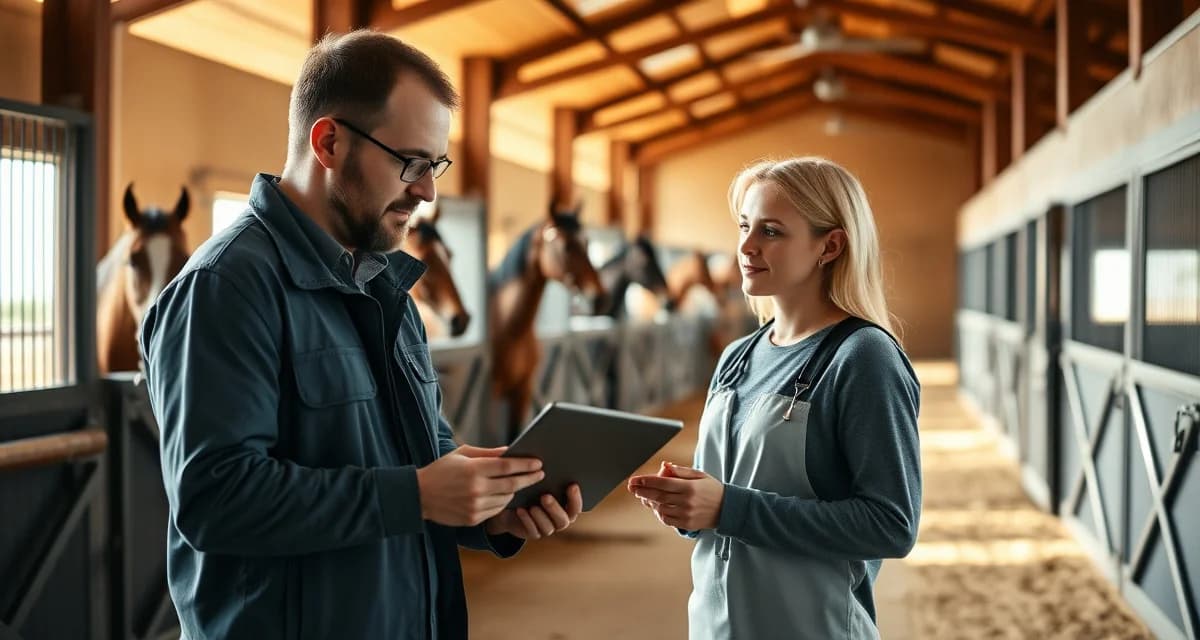
Farrier Scheduling Coordination for Horse Barns
Managing farrier visits across a barn of 30, 50, or 100+ horses is one of the most logistically demanding tasks a barn manager faces. Without a dedicated system, farrier scheduling coordination for barn operations turns into a patchwork of text messages, sticky notes, and spreadsheets that fail at the worst possible moments.
TL;DR
- Most farrier scheduling problems stem from poor coordination between barn staff, horse owners, and the farrier.
- A 6-to-8-week trim cycle for most horses means each farrier visit needs to be scheduled before the previous one is complete.
- Written records of each farrier visit, including observations and next scheduled date, prevent horses from falling behind on hoof care.
- Group scheduling for facilities with multiple horses under one farrier reduces travel costs and simplifies coordination.
- Owner notification before farrier visits ensures horses are available and prevents last-minute cancellations.
- BarnBeacon's scheduling tools track farrier visit history per horse and send automated reminders to owners and staff.
Barn managers spend an average of 4.2 hours per day on administrative tasks that software can automate. Farrier scheduling is one of the biggest contributors to that number, and it compounds quickly when you factor in owner notifications, special shoeing requirements, and last-minute changes.
The Real Cost of Manual Farrier Scheduling
When a farrier shows up and three horses have moved stalls, two owners haven't been notified, and one horse needs a specific corrective shoe that nobody wrote down, you lose time, money, and trust. These aren't edge cases. They happen weekly at facilities still running on informal systems.
The downstream effects are significant. Missed farrier cycles lead to hoof health problems. Poor communication with horse owners creates billing disputes. Incomplete records make it impossible to track patterns across your herd.
At a 40-horse facility, even a 15-minute coordination error per horse per visit adds up to 10 hours of wasted time per farrier cycle. Multiply that across 6-8 week intervals and you're looking at a structural inefficiency that compounds all year.
What Effective Farrier Scheduling Coordination Actually Requires
Most barn managers don't have a scheduling problem. They have a coordination problem. Scheduling the appointment is the easy part. The hard part is everything that surrounds it.
Effective farrier scheduling coordination for a barn environment requires five distinct capabilities working together:
- A centralized horse record that includes shoeing history, current shoe type, and vet notes
- Automated owner notifications before and after each visit
- A farrier-facing view that shows stall location, horse temperament, and special instructions
- Post-visit documentation that updates the horse's record automatically
- Billing integration that captures farrier charges without a separate data entry step
Most facilities are running these five functions across three to six different tools. That's where the time goes.
How BarnBeacon Solves Farrier Scheduling at Scale
BarnBeacon's barn management software was built specifically for multi-horse facilities where coordination complexity is the daily reality. It replaces the 6+ separate tools barn managers currently juggle, including scheduling apps, spreadsheets, group texts, and paper logs, with a single platform that connects every part of the operation.
The farrier scheduling module isn't a standalone feature. It's connected to horse records, owner accounts, billing, and the daily care log. When you schedule a farrier visit, the system already knows which horses are due, what each horse needs, and who needs to be notified.
Horse-Level Shoeing Profiles
Every horse in BarnBeacon has a dedicated profile that includes a complete shoeing history. You can record shoe type (steel, aluminum, composite, barefoot), corrective requirements, known sensitivities, and farrier preferences.
When you build a farrier schedule, these profiles surface automatically. The farrier sees exactly what each horse needs before they arrive. There's no verbal handoff required, and nothing gets lost between the office and the barn aisle.
Automated Cycle Tracking and Reminders
BarnBeacon tracks each horse's last farrier visit and flags when they're approaching their next cycle. You set the interval per horse, typically 6-8 weeks for shod horses and 8-10 weeks for barefoot horses, and the system handles the rest.
Reminders go out to barn staff and, optionally, to horse owners. This eliminates the manual tracking that most barn managers are doing in their heads or in a spreadsheet that's always slightly out of date.
Owner Notification Workflows
Horse owners expect communication. When their horse is getting new shoes or a trim, they want to know it happened, what was done, and whether anything unusual came up. Delivering that consistently across 30+ horses is nearly impossible without automation.
BarnBeacon sends pre-visit notifications to owners when their horse is scheduled, and post-visit summaries once the farrier has completed the appointment and logged their notes. Owners receive this through the client portal without any manual effort from barn staff.
This single feature eliminates dozens of individual text messages and phone calls per farrier visit day.
Farrier Day Scheduling View
On the day of a farrier visit, BarnBeacon generates a working schedule that shows the farrier's route through the barn, each horse's stall location, appointment time, and any special instructions. This view is accessible on mobile so the farrier can reference it without paper.
Barn managers can reorder the schedule based on horse availability, adjust for horses that are out on a trail ride, or flag a horse that needs to be caught and brought in before the farrier arrives. Changes update in real time across all views.
Special Shoe and Corrective Work Documentation
Corrective shoeing is where documentation failures cause the most damage. A horse on wedge pads for a navicular issue needs that information visible every single time the farrier visits. A horse transitioning from shod to barefoot needs a documented plan that everyone can reference.
BarnBeacon's special notes field is attached to the horse's profile and appears prominently in the farrier scheduling view. You can attach photos, vet recommendations, and previous farrier notes. Nothing gets buried in an email thread.
Post-Visit Record Updates
After each visit, the farrier or barn manager logs what was done directly in BarnBeacon. The horse's shoeing history updates automatically, the next cycle date is calculated, and the visit is timestamped for the record.
This creates an auditable history for every horse at your facility. If a horse develops a hoof issue six months from now, you can pull up exactly what was done at every visit and when.
Farrier Scheduling vs. Full Barn Coordination: Why Integration Matters
Some facilities try to solve the farrier scheduling problem in isolation. They find a scheduling app, set up some reminders, and call it done. This works until it doesn't.
The problem is that farrier scheduling doesn't exist in isolation. It intersects with vet visits (a horse recovering from an abscess needs a modified farrier plan), with billing (farrier charges need to go on the owner's monthly invoice), and with daily care (a horse that's been on stall rest needs a note for the farrier).
When these systems don't talk to each other, you're back to manual coordination. You're copying information from one tool to another, hoping nothing falls through the gap.
BarnBeacon's billing and invoicing integration means that farrier charges captured during a visit flow directly into the owner's account. There's no separate billing entry, no end-of-month reconciliation headache, and no missed charges because someone forgot to log a visit.
Comparison: Managing Farrier Scheduling With and Without Integrated Software
| Task | Manual/Fragmented Tools | BarnBeacon |
|---|---|---|
| Identify horses due for farrier | Manual spreadsheet check | Automated cycle tracking with alerts |
| Notify horse owners | Individual texts or calls | Automated pre- and post-visit notifications |
| Share special shoe notes with farrier | Verbal or paper handoff | Digital profile visible on mobile |
| Document post-visit work | Separate log or spreadsheet | In-platform entry, auto-updates horse record |
| Generate farrier day schedule | Manual list creation | Auto-generated route with stall locations |
| Add farrier charges to owner invoice | Manual billing entry | Direct integration with billing module |
| Track shoeing history per horse | Spreadsheet or paper file | Timestamped history in horse profile |
| Handle last-minute schedule changes | Phone calls and texts | Real-time updates across all views |
The difference isn't just convenience. It's accuracy, accountability, and the hours you get back every week.
Setting Up Farrier Scheduling in BarnBeacon: What to Expect
Getting your farrier scheduling workflow into BarnBeacon takes less time than most barn managers expect. The setup process follows a logical sequence that mirrors how you already think about your operation.
Step 1: Import or enter your horse roster. BarnBeacon supports bulk import from spreadsheets. Most facilities are fully loaded within a day.
Step 2: Build out each horse's shoeing profile. This is the one-time investment that pays off every cycle. Enter current shoe type, cycle interval, and any special notes. Attach existing farrier records if you have them.
Step 3: Set up your farrier contact and preferences. Add your farrier's contact information, preferred scheduling windows, and any facility-specific notes they need.
Step 4: Configure owner notification settings. Decide which notifications go out automatically and what information they include. Most facilities start with pre-visit and post-visit notifications.
Step 5: Schedule your first farrier visit. BarnBeacon will show you which horses are due, suggest a schedule order, and generate the farrier-facing view automatically.
After the first cycle, the system is self-maintaining. Cycle tracking updates automatically, reminders go out without manual input, and your records stay current.
Who Uses BarnBeacon for Farrier Scheduling Coordination
BarnBeacon is used across a range of equine facility types, but the farrier scheduling module is particularly valuable in three contexts.
Full-care boarding barns with 30+ horses where the barn manager is responsible for coordinating all farrier visits on behalf of multiple horse owners. The owner notification and billing integration features are especially high-value here.
Training facilities where horses are on active competition schedules and shoeing timing directly affects performance. The ability to flag horses with specific shoeing requirements and track corrective work over time is critical in these environments.
Breeding and sales operations where detailed hoof health records are part of the horse's documentation package. BarnBeacon's timestamped history creates a professional record that adds value at the point of sale.
What to Look for in Equine Farrier Scheduling Software
Not all scheduling tools are built for the complexity of a working barn. When evaluating equine farrier scheduling software, these are the capabilities that separate functional solutions from ones that create more work than they save.
Horse-level records, not just appointment slots. A calendar app can hold an appointment. What you need is a system that connects that appointment to the horse's full history, health notes, and owner account.
Owner-facing communication built in. If you have to manually notify owners after every farrier visit, you haven't solved the problem. Look for automated workflows that handle this without staff intervention.
Mobile access for the farrier. Farriers work in the barn aisle, not at a desk. Any system that requires a desktop to access the day's schedule won't get used consistently.
Billing integration. Farrier charges are part of the owner's monthly invoice at most boarding facilities. If your scheduling tool doesn't connect to billing, you're still doing double entry somewhere.
Audit trail and history. Hoof health is longitudinal. You need to see what was done six months ago, not just what's scheduled for today.
Some tools do one of these things well. Very few do all of them. That gap is exactly where barn managers lose time and where coordination errors happen.
Common Farrier Scheduling Problems and How to Prevent Them
Problem: Horses missed in the cycle because they weren't on the list.
Prevention: Automated cycle tracking that flags every horse approaching their interval, regardless of whether someone manually added them to a list.
Problem: Farrier arrives and doesn't know a horse needs corrective work.
Prevention: Special notes attached to the horse profile that appear in the farrier's mobile view before they start.
Problem: Owner disputes a farrier charge they weren't notified about.
Prevention: Automated pre-visit notifications and post-visit summaries sent to owners before the invoice is generated.
Problem: No record of what was done at the last visit.
Prevention: Mandatory post-visit documentation logged in the platform, timestamped and attached to the horse's profile.
Problem: Schedule falls apart when one horse isn't available.
Prevention: Real-time schedule adjustments in BarnBeacon that update the farrier's view instantly without a phone call.
What software manages all horse barn operations in one place?
BarnBeacon is designed to manage all core barn operations from a single platform, including farrier scheduling, vet visit tracking, daily care logs, owner communication, and billing. Most barn management tools focus on one or two of these areas, which forces managers to run multiple systems simultaneously. BarnBeacon connects all of these functions so that information entered in one area, like a farrier visit, automatically updates related records in billing, horse profiles, and owner notifications.
How does barn management software save time at a large facility?
The primary time savings come from eliminating manual coordination tasks that currently require individual attention. Automated cycle tracking removes the need to manually check which horses are due for farrier visits. Automated owner notifications eliminate individual texts and calls. Integrated billing removes the separate data entry step for farrier charges. At a 40-horse facility, these automations typically recover 8-12 hours per week of staff time that was previously spent on administrative coordination.
What is the best equine facility management platform?
The best equine facility management platform depends on your facility's size and operational complexity, but the key criteria are integration depth, mobile accessibility, and owner communication tools. BarnBeacon consistently ranks highly for full-service boarding and training facilities because it connects farrier scheduling, vet records, daily care, billing, and owner communication in one system. Facilities that have moved from fragmented tools to BarnBeacon report significant reductions in administrative time and fewer coordination errors across all areas of barn management.
What information should I track for each farrier visit?
Each farrier visit record should include the date, which horses were seen, the work performed on each horse, any observations the farrier made about hoof condition or soundness concerns, the next scheduled visit date, and any charges billed. This record is particularly useful when a horse develops a lameness issue and the vet needs a timeline of recent hoof care.
How do I handle it when a horse owner wants to use a different farrier than the one I coordinate?
The most straightforward approach is to document the owner's preferred farrier in that horse's care record and note that the facility does not coordinate appointments for outside farriers. The owner is then responsible for scheduling and ensuring the horse is available. Charging a handling or presence fee if staff time is required to hold the horse during an outside farrier's visit is standard practice and should be disclosed in the boarding contract.
How much advance notice should I give owners before a farrier appointment?
At least 48 hours of advance notice is standard, with 72 hours preferred for owners who need to arrange presence or provide special instructions. Automated appointment reminders through a barn management platform reduce the number of owners who miss or forget about scheduled farrier visits, which is one of the most common causes of missed appointments and the associated rebooking costs.
Related Articles
FAQ
What is Farrier Scheduling Coordination for Horse Barns?
Farrier scheduling coordination for horse barns is the process of organizing, tracking, and communicating farrier visits across a multi-horse facility. It involves aligning schedules between barn staff, horse owners, and the farrier to ensure every horse receives timely hoof care on a consistent 6-to-8-week trim cycle. At scale—30, 50, or 100+ horses—this coordination becomes a significant operational task that requires systematic tools rather than ad hoc text messages and spreadsheets.
How much does Farrier Scheduling Coordination for Horse Barns cost?
Most barn managers don't pay a separate fee for farrier scheduling coordination—it's a function handled within broader barn management software. Platforms like BarnBeacon include scheduling tools as part of their subscription, which typically runs from a low monthly flat rate to tiered pricing based on horse count. The real cost savings come from reducing administrative time: barn managers average 4.2 hours daily on admin tasks, and automated scheduling tools can reclaim a significant portion of that.
How does Farrier Scheduling Coordination for Horse Barns work?
Farrier scheduling coordination works by centralizing visit records, automating reminders, and grouping horses by farrier visit date. A barn manager logs each horse's last farrier visit and next due date. The system then tracks upcoming appointments, sends automated notifications to owners before each visit, and flags horses approaching or past their trim cycle. Group scheduling batches horses under the same farrier on the same day, reducing travel costs and simplifying logistics for larger facilities.
What are the benefits of Farrier Scheduling Coordination for Horse Barns?
The core benefits are fewer missed appointments, reduced administrative burden, and better hoof health outcomes across the herd. Automated owner notifications eliminate last-minute no-shows. Written visit records with farrier observations create an auditable care history per horse. Group scheduling lowers per-visit costs. Barn managers reclaim hours previously lost to manual follow-up and coordination. For facilities with 30 or more horses, a well-run scheduling system is the difference between proactive care management and constant reactive firefighting.
Who needs Farrier Scheduling Coordination for Horse Barns?
Any barn managing more than a handful of horses benefits from structured farrier scheduling coordination. Full-service boarding barns, training facilities, and breeding operations with 30 to 100+ horses on varied trim and shoeing schedules need it most. Barn managers responsible for communicating with multiple owners—each with different notification preferences and payment arrangements—will see the clearest operational gains. Solo horse owners typically don't need formal systems, but any professional barn operation managing horses on behalf of clients does.
How long does Farrier Scheduling Coordination for Horse Barns take?
Each individual farrier appointment takes two to six hours depending on the number of horses being seen and the work required. The coordination cycle, however, is continuous: with a 6-to-8-week trim schedule, barn managers are effectively scheduling the next farrier visit before the current one is finished. Initial setup of a scheduling system—entering horse records, farrier contacts, and cycle preferences—typically takes a few hours. After that, ongoing coordination runs in the background with minimal manual effort when using purpose-built tools.
What should I look for when choosing Farrier Scheduling Coordination for Horse Barns?
Look for a system that tracks farrier visit history per horse, supports automated owner and staff notifications, and allows group scheduling for multi-horse visits. It should integrate with your broader barn management workflow rather than operate as a standalone tool. Customizable cycle lengths matter, since different horses may need four-week or ten-week intervals. Audit trails for each visit—including farrier notes and next scheduled date—are essential for tracking hoof health trends and demonstrating due diligence to horse owners.
Is Farrier Scheduling Coordination for Horse Barns worth it?
Yes, for any barn managing more than a small number of horses on behalf of owners, structured farrier scheduling coordination is worth it. The administrative time savings alone justify the cost of barn management software that includes scheduling tools. Beyond efficiency, the real value is in hoof health outcomes: horses that fall behind on farrier care develop preventable conditions that are costly to treat. Consistent scheduling, owner accountability, and written records create a professional standard that protects horses and the barn's reputation.
Sources
- American Farrier's Association (AFA), hoof care standards and farrier credentialing
- American Association of Equine Practitioners (AAEP), equine lameness and hoof care guidelines
- University of California Davis Center for Equine Health, hoof health research and resources
- Farrier Focus magazine, professional farriery and equine hoof care publications
Get Started with BarnBeacon
BarnBeacon tracks farrier visit history per horse, sends automated appointment reminders to owners and staff, and keeps scheduling conflicts from slipping through. Start a free 30-day trial to see how BarnBeacon fits your farrier coordination workflow.