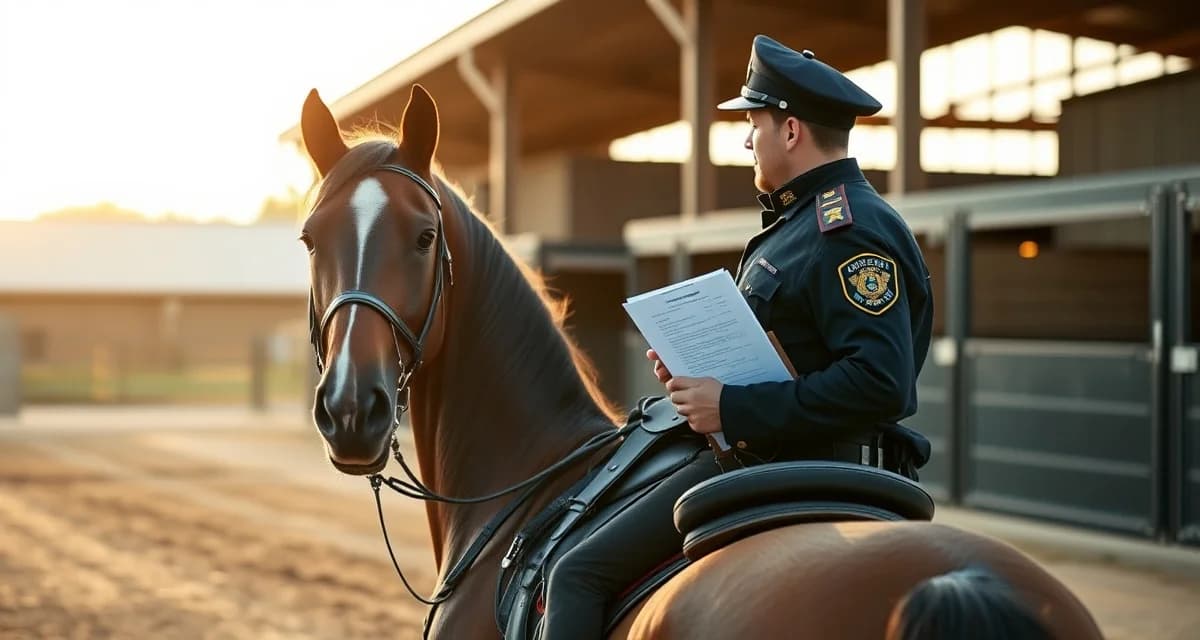
Mounted Patrol Barn Owner Communication: Reporting and Updates
Mounted patrol barn managers deal with a communication challenge that generic barn software was never designed to solve. The horses in your program are working animals with active duty schedules, incident exposure, and health monitoring needs that go far beyond a typical boarding barn. Getting the right information to owners, at the right time, in the right format is a core operational requirement, not an afterthought.
TL;DR
- Incident reports filed within 24 hours of an event carry significantly more weight than ones completed days later
- A signed liability waiver does not eliminate negligence claims; documented protocols and completed checklists do
- Insurance requirements at equine facilities vary by state; most carriers require annual safety inspections as a policy condition
- Staff training records are part of your legal defense if a staff action is questioned after an incident
- Photo documentation of a horse's condition at arrival and at regular intervals creates a baseline for any future dispute
- Safety inspection checklists completed and filed on a fixed schedule demonstrate due diligence in facility management
This guide walks through exactly how to structure mounted-patrol barn owner communication, from daily updates to incident reports, using tools and templates built for the way your barn actually operates.
Why Mounted Patrol Owner Communication Is Different
Most barn management platforms assume owners want to know if their horse ate well and got turnout. Mounted patrol owners need more than that.
Their horses may be deployed in crowd control situations, trail patrol, or emergency response. Owners want to know about physical stress, behavioral changes after duty, equipment fit issues, and any incidents that occurred during a shift. That's a fundamentally different reporting structure than a dressage or hunter/jumper barn.
Generic software doesn't account for shift-based reporting, incident documentation, or duty-status tracking. That gap is where communication breaks down and where mounted patrol barn operations require a more specialized approach.
Step 1: Set Up a Structured Owner Profile for Each Horse
Capture Duty-Relevant Owner Preferences Upfront
Before you send a single update, know what each owner wants to receive and how often. Some owners are hands-off and trust your team completely. Others want a notification every time their horse returns from a shift.
Create an intake form that asks:
- Preferred contact method (text, email, app notification)
- Update frequency preference (after every shift, daily summary, weekly report)
- Incident notification threshold (all incidents vs. significant only)
- Veterinary authorization level for field decisions
Store This in a Centralized System
Paper forms get lost. Spreadsheets don't push notifications. A dedicated owner communication portal keeps every preference, contact detail, and authorization on record and accessible to your whole team during a shift.
Step 2: Build a Daily Shift Report Template
What to Include in Every Shift Report
Consistency matters more than detail level. Owners who receive the same format every time can scan quickly for anything unusual. A solid mounted patrol shift report covers:
- Horse name and handler
- Shift date, start time, and end time
- Deployment type (patrol, event, training, standby)
- Physical condition on return (soundness, coat, hydration, any visible marks)
- Behavioral notes (calm, reactive, fatigued, unusually alert)
- Feed and water intake post-shift
- Equipment condition (saddle fit, bit, boots)
- Any incidents (see Step 3)
Keep the language factual and specific. "Horse returned slightly stiff in left hind, walked out within 10 minutes, no heat or swelling" is more useful to an owner than "horse seemed a little off."
Automate the Delivery
Manual report distribution is a time drain. Set up your system to auto-send shift reports to the relevant owner as soon as the handler submits them. Owners get real-time visibility without you making individual calls after every deployment.
Step 3: Create a Separate Incident Reporting Workflow
Define What Counts as an Incident
Not every stumble needs a formal incident report. Establish clear thresholds with your team so reporting is consistent. Typical incident categories for mounted patrol barns include:
- Minor: Small scrape, brief spook, equipment adjustment needed
- Moderate: Lameness lasting more than 30 minutes, behavioral escalation, equipment failure during duty
- Significant: Injury requiring veterinary attention, rider fall, horse involved in a public safety situation
Incident Report Structure
A mounted patrol incident report should document:
- Date, time, and location of the incident
- Horse and handler involved
- What happened (factual, chronological)
- Immediate response taken
- Current status of the horse
- Next steps (vet call, rest period, equipment review)
Send incident reports separately from routine shift reports. Owners should never have to dig through a daily summary to find out their horse was injured.
Notify Immediately for Significant Incidents
For anything in the "significant" category, don't wait for the end-of-day report. A direct notification, whether by phone or push alert through your management platform, should go out within the hour. Owners who find out about a serious incident 12 hours later through a routine email lose trust fast.
Step 4: Schedule Routine Health and Welfare Updates
Weekly Summaries
Beyond shift-by-shift reporting, send a weekly summary that gives owners a broader picture. Include total hours worked, any recurring physical observations, farrier or vet visits that week, and upcoming schedule changes.
This is also where you flag patterns. A horse that's been slightly stiff after every long shift for three weeks is telling you something. Documenting it in weekly summaries creates a paper trail and shows owners you're paying attention.
Monthly Condition Reports
Once a month, send a more detailed welfare report covering body condition score, weight estimate, dental and farrier status, vaccination currency, and any behavioral trends. Mounted patrol horses work hard. Owners appreciate knowing their horse is being monitored at that level of detail.
Step 5: Use the Right Tools for the Job
What to Look for in a Communication Platform
Most barn software handles basic messaging. Mounted patrol barns need more specific functionality:
- Shift-based report templates (not just generic daily logs)
- Incident reporting with severity tiers and notification triggers
- owner portal with document storage for vet records, duty authorizations, and incident history
- Mobile access for handlers submitting reports from the field
- Audit trail for all communications (important for liability)
BarnBeacon's owner portal is built to adapt to these workflows. The platform supports custom report templates, tiered incident alerts, and a full communication history that both managers and owners can access. That's the kind of specificity that generic barn management tools don't offer.
Don't Rely on Text Threads
Group texts and personal phone numbers create gaps. Messages get missed, context gets lost, and there's no record. Move all formal reporting through a documented system, even if you still use texts for quick real-time updates during a shift.
Step 6: Train Your Handlers on Communication Standards
Reporting Is Part of the Job
Handlers who see communication as optional will submit incomplete reports or skip them after long shifts. Make it clear that submitting a shift report is part of the duty completion checklist, the same as untacking and cooling down the horse.
Keep the Submission Process Fast
If your reporting system takes 15 minutes to fill out, handlers will resent it. A well-designed mobile form should take three to five minutes for a routine shift. Reserve the longer format for incidents.
Common Mistakes in Mounted Patrol Owner Communication
Waiting too long to report incidents. Owners who hear about problems late feel excluded. Build immediate notification into your workflow before it becomes a trust issue.
Using inconsistent formats. When every handler writes reports differently, owners can't read them quickly and managers can't spot patterns. Templates solve this.
Mixing routine updates with urgent alerts. If owners learn to ignore your daily emails, they'll miss the one that matters. Keep channels distinct.
No documentation trail. Verbal updates disappear. If a dispute arises about a horse's condition or an incident, you need written records with timestamps.
Over-communicating noise, under-communicating substance. Sending too many low-value updates trains owners to tune out. Focus on what's actually meaningful to them.
How does BarnBeacon compare to spreadsheets for barn management?
Spreadsheets require manual updates, lack real-time notifications, and create version control problems when multiple staff members are working from different files. BarnBeacon centralizes records, pushes alerts automatically based on logged events, and connects care records to billing and owner communication in one system. Most facilities report saving several hours per week after switching from spreadsheets.
What is the setup process like for BarnBeacon?
Most facilities complete the initial setup in under a week. Horse profiles, service templates, and billing configurations can be imported from existing records or entered directly. BarnBeacon's US-based support team is available to assist with setup, and most managers are running their first billing cycle through the platform within days of starting.
Can BarnBeacon support a barn with multiple staff members?
Yes. BarnBeacon supports multiple user accounts with role-based access, so barn managers, barn staff, and owners each see the information relevant to their role. Task assignments, completion logs, and communication history are all attached to the barn's account rather than to individual staff phones or email addresses.
FAQ
What is Mounted Patrol Barn Owner Communication: Reporting and Updates?
Mounted Patrol Barn Owner Communication: Reporting and Updates is a structured framework for barn managers overseeing working police or mounted patrol horses. It covers how to document incidents, share health updates, file timely reports, and keep horse owners informed throughout active duty cycles. Unlike standard boarding barn communication, this system accounts for duty schedules, incident exposure, and the legal documentation requirements unique to working equine programs operating under law enforcement or municipal oversight.
How much does Mounted Patrol Barn Owner Communication: Reporting and Updates cost?
BarnBeacon offers tiered plans starting with a free trial, with paid tiers designed for small to large equine operations. Pricing varies based on the number of horses, users, and features like automated reporting and owner portals. There is no per-incident fee. Compared to the cost of a single liability dispute stemming from poor documentation, a monthly subscription is a fraction of the financial and legal exposure most mounted patrol barns carry.
How does Mounted Patrol Barn Owner Communication: Reporting and Updates work?
The system works by centralizing incident reports, health logs, duty schedules, and owner notifications in one platform. When an event occurs, staff file a timestamped report with photo attachments. Owners receive automatic updates via email or SMS. Managers can run audit trails, pull inspection histories, and generate compliance reports on demand. All records are stored securely and can be exported if needed for insurance claims, legal proceedings, or program reviews.
What are the benefits of Mounted Patrol Barn Owner Communication: Reporting and Updates?
Key benefits include faster incident documentation, reduced liability exposure, and improved owner trust. Timestamped reports filed within 24 hours carry more evidentiary weight than delayed ones. Owners stay informed without requiring constant phone calls. Staff accountability improves when training records and checklists are tracked automatically. Facility managers gain a defensible paper trail that demonstrates due diligence, which is critical during insurance audits or if a negligence claim is ever filed against the barn.
Who needs Mounted Patrol Barn Owner Communication: Reporting and Updates?
Barn managers and facility owners running mounted patrol programs for law enforcement agencies, sheriff departments, parks services, or municipal units need this system. It is also relevant for equine program directors overseeing horses shared between multiple handlers or agencies. Any operation where horses have active duty exposure, where multiple stakeholders need consistent updates, or where liability documentation is a contractual or insurance requirement will benefit from a structured communication and reporting protocol.
How long does Mounted Patrol Barn Owner Communication: Reporting and Updates take?
Initial setup typically takes one to two days, including importing horse profiles, configuring owner notification preferences, and building out inspection checklists. Staff can be trained on the core reporting workflow in under an hour. Ongoing time investment is minimal once the system is running — most incident reports take five to fifteen minutes to complete. Regular safety inspection logs and health updates can be scheduled and templated to reduce repetitive data entry.
What should I look for when choosing Mounted Patrol Barn Owner Communication: Reporting and Updates?
Look for a platform that supports timestamped incident reports, photo attachments, and automated owner notifications. It should allow you to store and retrieve staff training records, liability waivers, and safety inspection checklists. Mobile access matters for staff filing reports from the barn floor. Confirm the platform offers audit trail exports in formats your insurance carrier will accept. Equine-specific workflows are a significant advantage over generic farm management or facility software not designed for working horse programs.
Is Mounted Patrol Barn Owner Communication: Reporting and Updates worth it?
Yes. The legal and operational risk of running a mounted patrol barn without structured communication is substantial. A single undocumented incident, a missing inspection checklist, or a delayed owner notification can escalate into a liability claim that a signed waiver alone will not resolve. The combination of documented protocols, completed checklists, and timely reporting is what actually defends a barn manager in a dispute. The cost of the system is negligible compared to what poor documentation can cost you.
Sources
- American Association of Equine Practitioners (AAEP)
- United States Equestrian Federation (USEF)
- American Competitive Trail Horse Association (ACTHA)
- American Horse Council
- Kentucky Equine Research
Get Started with BarnBeacon
Good documentation is the foundation of every well-run mounted patrol unit. BarnBeacon gives managers the digital record-keeping, task logging, and audit trail tools to run operations that hold up to inspection, comply with regulations, and protect the facility in any dispute. Start a free trial and see how your documentation changes when it runs through a purpose-built equine management platform.