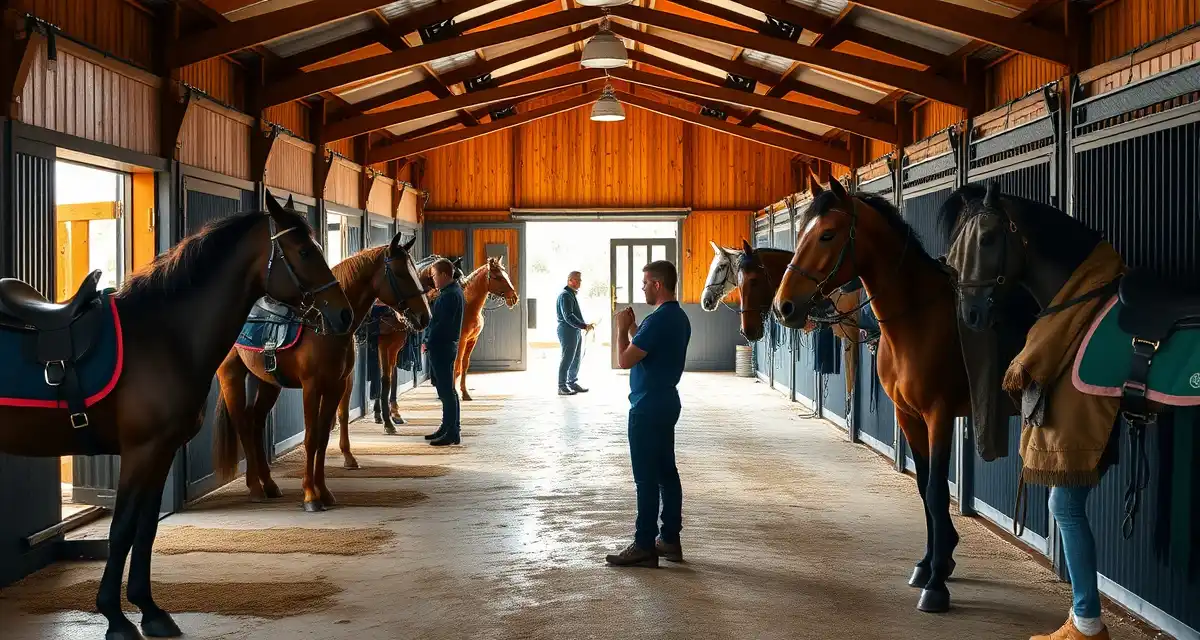
Eventing Barn Operations: Running a Combined Training Facility
Eventing is one of the most demanding equestrian disciplines from an operational standpoint. The three-phase format demands horses that are dressage-fit, athletically capable for cross-country, and precise in show jumping. Managing an eventing barn means juggling conditioning programs, a complex competition calendar, careful health monitoring, and the unique safety demands of cross-country training.
The Eventing Horse's Conditioning Requirements
Event horses need to be fit enough for sustained galloping effort on cross-country while maintaining the suppleness and relaxation required for dressage and the careful adjustability needed for show jumping. Building and maintaining this fitness is the central challenge of conditioning an event horse.
A typical event horse conditioning week at the competition level might include:
- Two to three flatwork sessions focusing on dressage quality
- One or two jumping sessions alternating between grid work and full jumping efforts
- One gallop set appropriate to the current phase in the season (conditioning gallops vary from steady cantering work in base conditioning to speed work closer to competition)
- One or two light days (hacking, trail riding, or hand walking)
The specifics vary enormously based on the horse's fitness level, the level of competition, and the time of year. A horse being brought back into work after the off-season needs a progressive build over 8 to 12 weeks before returning to full competition conditioning.
Cross-Country Schooling and Safety
Cross-country schooling is the most risk-intensive part of eventing training. Fixed obstacles do not fall down. Falls at cross-country can cause serious injury to both horse and rider. Operational safety practices for cross-country facilities include:
- Maintaining all fixed obstacles: checking for rot, loose materials, unstable ground around the base
- Footing on approach and landing zones: regular assessment after rain, appropriate drainage, no slick or muddy surfaces at jump sites
- Emergency access: can a vehicle reach every obstacle on the cross-country course? Is emergency contact information posted and current?
- Medical protocols: what is the protocol if a horse falls or a rider is injured on the cross-country course?
Document your cross-country course maintenance on a schedule. Inspect after every significant rain event and before any schooling sessions.
Show Calendar and Horse Preparation
The eventing competition calendar in most regions runs from spring through fall. Managing multiple horses on different competition timelines requires a show calendar that is built at the beginning of the season and maintained through it.
For each horse competing, track:
- Entry deadlines for each show
- Veterinary health certificate requirements (shows often require a current CVI)
- Cross-country course walk scheduling
- Preparation milestones (jump schools, dressage test run-throughs, fitness tests)
- Stabling and haul arrangements
The stabling coordinator role at a busy eventing barn during competition season is a significant job. Tack, supplies, medications, feed for the trip, hay, bedding, and horse paperwork all need to be organized before departure.
Health Management for Event Horses
Event horses work hard and have corresponding health demands. Common concerns:
Ulcers: The stress of travel, competition, and intense work makes event horses prone to gastric ulcers. Regular veterinary assessment, appropriate hay access during competition, and a management protocol for horses showing signs of ulcer discomfort are standard at most professional eventing barns.
Soundness monitoring: Regular jog-ups and veterinary assessments catch early lameness before it becomes a competition-ending injury. The goal is to never arrive at a competition with a horse that is questionably sound.
Post-cross-country recovery: After a competition, a structured recovery protocol (cooling out, leg care, monitoring for heat or swelling in the 24 to 48 hours after cross-country) is standard practice.
BarnBeacon helps eventing facilities track show schedules, health documentation, and individual horse care protocols in one place. For a complete guide to eventing barn operations, see eventing barn operations guide. For the health records that competition horses require, see equine health records.
FAQ
What is Eventing Barn Operations: Running a Combined Training Facility?
Eventing barn operations for a combined training facility covers the specialized management required to prepare horses and riders for the three-phase equestrian discipline of eventing, which includes dressage, cross-country, and show jumping. It addresses daily conditioning schedules, competition calendar planning, health monitoring protocols, and the unique safety considerations of cross-country training — all integrated into a cohesive barn management system that supports horses performing across multiple demanding disciplines.
How much does Eventing Barn Operations: Running a Combined Training Facility cost?
Costs vary widely depending on facility size, staffing, and competition level. Board at a dedicated eventing barn typically ranges from $800 to $2,500 per month, reflecting the specialized care, conditioning programs, and cross-country infrastructure involved. Additional expenses include competition entries, hauling, veterinary care, and footing maintenance for cross-country courses. Larger facilities with on-site cross-country fields carry higher overhead than smaller operations that haul to external venues.
How does Eventing Barn Operations: Running a Combined Training Facility work?
A combined training facility operates by structuring each horse's week around the demands of all three eventing phases. Horses receive flatwork sessions for dressage quality, jumping schools alternating between grids and full courses, and gallop sets calibrated to the current point in the season. Light recovery days round out the week. Barn managers coordinate this alongside feeding, veterinary scheduling, farrier visits, and competition logistics to keep each horse on track.
What are the benefits of Eventing Barn Operations: Running a Combined Training Facility?
Running a dedicated eventing facility provides horses with purpose-built conditioning programs rather than generic care, which improves fitness, soundness, and competitive readiness. Riders benefit from structured coaching across all three phases in one location. Barns gain a focused client base with clear goals and consistent revenue from competition-season boarders. The integrated approach also improves safety through systematic health monitoring and cross-country course maintenance.
Who needs Eventing Barn Operations: Running a Combined Training Facility?
Combined training facilities serve competitive eventers at all levels, from grassroots riders working toward their first recognized event to advanced combinations preparing for international competition. Horses that benefit most are those needing multi-disciplinary conditioning that a general boarding barn cannot provide. Facility operators — barn managers, trainers, and property owners — also benefit from the operational framework that keeps a high-demand program running efficiently across disciplines.
How long does Eventing Barn Operations: Running a Combined Training Facility take?
Building a full eventing conditioning program from a base fitness level to competition readiness typically takes three to five months for an established horse, and longer for young or returning horses. Daily management is ongoing year-round, with the season structured around competition blocks, recovery phases, and off-season base building. Each conditioning week involves six to seven days of structured work, making it one of the more time-intensive equestrian management programs to run.
What should I look for when choosing Eventing Barn Operations: Running a Combined Training Facility?
When evaluating a combined training facility, look for experienced staff with eventing-specific knowledge, appropriate footing for cross-country schooling, a structured conditioning program tailored to each horse, and a clear competition calendar. Veterinary and farrier relationships, emergency protocols for cross-country incidents, and transparent communication between trainers and owners are essential. Tour the facility during active training sessions rather than at rest to assess day-to-day management quality.
Is Eventing Barn Operations: Running a Combined Training Facility worth it?
For serious eventers, a properly run combined training facility is worth the investment. The integrated approach to fitness, dressage, and jumping produces horses that are better prepared, sounder, and more competitive than those managed in general boarding environments. The operational complexity is high, but when executed well it creates a streamlined system that reduces scrambling around competition time and keeps horses performing consistently across all three phases of the sport.