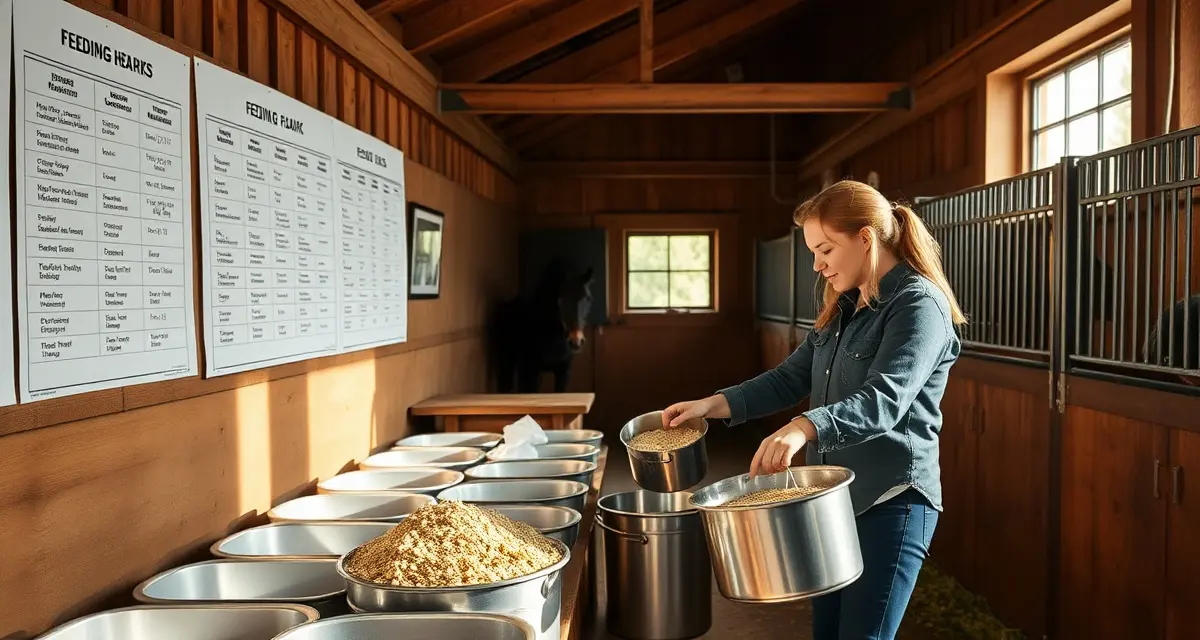
Feeding Schedule Management: Running Complex Feeding Programs Across a Large Barn
At a large barn, feeding is not a single task. It is a coordinated daily operation involving dozens of individual protocols, multiple feeding times, medication administration, and enough horse-by-horse variation that a mistake is easy to make and potentially consequential for the horse's health. Managing this operation well requires documentation, clear staff assignments, and a system that surfaces the right information at the right time.
Structuring the Feeding Day
Most equine facilities operate with two to three feeding times: early morning, evening, and an optional midday or late afternoon feeding. The structure of each feeding time differs:
Morning feeding is typically the most complex: grain, supplements, and AM medications are given, and it is also the primary observation time where staff are checking each horse's general health and demeanor.
Midday or afternoon feeding may be a simple hay top-off or a full grain meal depending on the barn's program. Some facilities with performance horses in heavy training feed three times per day to support energy demands.
Evening feeding includes the second grain meal for horses receiving twice-daily grain, PM medications, and a nighttime hay supply adequate to last until morning.
Define feeding windows for each time slot and build the staffing schedule to support them. Morning grain at 7:30am consistently is better for the horses and better for staff scheduling predictability than a range of 7am to 9am depending on who shows up.
Managing Individual Programs at Scale
The individual variation in feeding programs is the core complexity at a large barn. Forty horses might have:
- 12 horses on plain grass hay only
- 8 horses on mixed hay
- 6 horses on a senior feed program with soaked hay
- 10 horses on performance grain with various supplement combinations
- 4 horses with dietary restrictions due to metabolic conditions or insulin resistance
Managing this variation requires each horse's protocol to be documented and accessible. A feeding list hung in the feed room that shows stall number, horse name, ration, and supplements is the minimum functional approach. A digital system that staff can access from their phone and that flags any special instructions is better.
Horses whose programs change should have their protocols updated the same day the change is instructed, not the next time someone thinks to do it. A feeding protocol that does not reflect current instructions is a liability.
Medication Administration Within the Feeding Schedule
Medications added to feed are administered during feeding time. This integration is convenient but creates specific risks:
Refusals: A horse that does not eat its full grain dose may not receive its full medication dose. Flag horses on critical medications (such as Cushing's medication or thyroid supplements) for staff to confirm they consumed the full meal.
Drug interactions: Some medications should not be mixed with certain feeds or supplements. Know the specific handling requirements for each medication and include them in the feeding protocol.
Accountability: Medication administration needs to be documented, not just assumed. A checkbox or log entry confirming each medication was given provides accountability and creates a record that is useful if a health question arises.
Staff Assignment and Accountability
Feeding tasks need to be clearly assigned to specific staff for each shift. A task list that says "feed everyone" is not sufficient. A task list that assigns specific stall ranges or barn sections to specific staff members, with a confirmation mechanism, is functional.
Confirmation does not need to be elaborate. A whiteboard where staff initial each feeding row, or a task completion flag in barn management software, creates enough accountability to catch missed feedings before the horse goes without for an extended period.
BarnBeacon provides individual feeding protocols per horse that are accessible to all authorized staff, along with task completion tracking that shows whether each horse's care tasks were completed. For the individual protocol setup, see feeding and care schedules. For feed inventory that supports these programs, see feed management.
Consistent, accurate feeding is the most basic thing a facility owes to every horse in its care. Getting it right every day, across every staff member, through staff changes and busy periods, requires a system.
FAQ
What is Feeding Schedule Management: Running Complex Feeding Programs Across a Large Barn?
Feeding schedule management for large barns is the practice of organizing, documenting, and executing individualized feeding programs across a full barn roster. It encompasses grain and hay distribution, supplement administration, medication timing, and staff coordination across multiple daily feeding windows. Rather than a one-size-fits-all approach, it treats each horse as a separate protocol, ensuring every animal receives the correct feed type, quantity, and timing based on their health, workload, and veterinary requirements.
How much does Feeding Schedule Management: Running Complex Feeding Programs Across a Large Barn cost?
Implementing a structured feeding management system has no fixed price — costs vary based on your approach. A manual system using printed feed charts costs almost nothing beyond staff time. Digital barn management software typically runs $50–$300 per month depending on barn size and features. The real cost consideration is the risk of errors without a system: missed medications, incorrect rations, or health incidents that result in veterinary bills far exceeding any software subscription.
How does Feeding Schedule Management: Running Complex Feeding Programs Across a Large Barn work?
A feeding schedule management system works by assigning each horse a documented protocol listing feed type, quantity, supplements, and medications for each feeding window — morning, midday, and evening. Staff reference these protocols during each feeding round, checking off completed tasks. The system may be paper-based or digital. Supervisors review logs to catch missed feedings or flag horses showing changes in appetite, ensuring accountability and continuity across rotating staff and shift changes.
What are the benefits of Feeding Schedule Management: Running Complex Feeding Programs Across a Large Barn?
The primary benefits include reduced feeding errors, better horse health outcomes, and cleaner staff accountability. Horses with consistent, correctly portioned meals maintain healthier weight, better gut motility, and more stable energy levels. For performance horses, precision feeding directly supports training demands. For managers, a documented system makes auditing easy, simplifies onboarding new staff, and creates a clear record if a health issue requires veterinary review of recent feed and medication history.
Who needs Feeding Schedule Management: Running Complex Feeding Programs Across a Large Barn?
Any barn managing five or more horses with individualized feeding needs benefits from structured schedule management. This includes large boarding facilities, breeding operations, rehabilitation barns, and competition yards. The need intensifies when horses have medical conditions requiring medication administration, special diets, or precise ration timing. Even smaller operations with complex protocols — such as Cushings management, ulcer treatment, or post-surgical recovery — benefit from documented systems rather than relying on staff memory alone.
How long does Feeding Schedule Management: Running Complex Feeding Programs Across a Large Barn take?
Setting up a basic feeding management system takes one to three days for an established barn: time to document each horse's current protocol, create feed charts, and brief staff on the process. Ongoing, each feeding round typically adds five to fifteen minutes of structured check-in and logging compared to informal feeding. Digital systems may require a short onboarding period but often save time long-term by reducing the back-and-forth communication needed to clarify individual horse requirements.
What should I look for when choosing Feeding Schedule Management: Running Complex Feeding Programs Across a Large Barn?
Look for clarity and usability above all else. A good system — whether a printed binder or software — should make the right information instantly accessible to whoever is feeding, with no ambiguity about quantities, timing, or medication. Prioritize systems that support horse-by-horse customization, allow easy updates when protocols change, and create a log trail. If evaluating software, check whether it supports mobile access in the barn aisle and whether alerts can flag missed feedings or appetite changes.
Is Feeding Schedule Management: Running Complex Feeding Programs Across a Large Barn worth it?
Yes, for any barn with more than a handful of horses on individualized protocols, structured feeding management is worth the investment. The alternative — informal systems relying on staff memory or loose notes — creates meaningful risk of errors that can harm horses and expose barn managers to liability. A well-run feeding program also reduces staff stress, improves horse health consistency, and makes the barn easier to operate as it grows. The return on a small investment in systems is substantial.