Equine Facility Scheduling: Systems That Keep Everything Running
Scheduling at an equine facility is not a single system. It is several overlapping systems that need to work together: daily care schedules, recurring health maintenance intervals, farrier and vet visit coordination, lesson and training schedules, and staff shift planning. When these systems are disconnected or informal, things fall through the cracks. When they are integrated, the facility runs predictably even when unexpected things happen.
Daily Care Scheduling
The daily schedule is the operational backbone of the facility. It needs to specify what happens when, for each horse, assigned to specific staff members. A daily care schedule that is written down and accessible is fundamentally different from a daily care schedule that exists only in the barn manager's head.
An effective daily schedule for a boarding or training facility should cover:
- Feed times: AM, midday (if applicable), and PM
- Which horses receive grain and which are hay-only
- Supplement and medication administration tied to specific feeding times
- Turnout start and end times by group or individual horse
- Stall cleaning timing and who is responsible
- Blanketing and unblanketing triggers or schedule
- Specific horses on any deviation from standard care
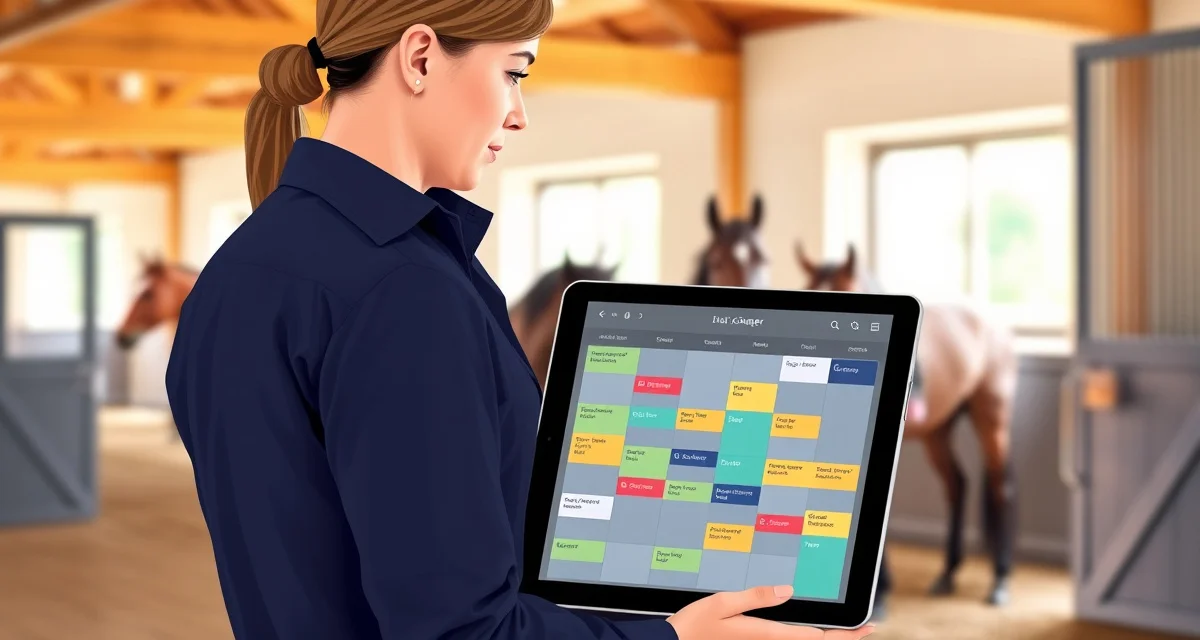
The schedule should be posted or accessible on a device where staff can check it during their shift, not just reviewed in the morning and then forgotten.
Health Maintenance Scheduling
Recurring health maintenance is scheduled on intervals measured in weeks and months. Farrier cycles are typically every 6 to 8 weeks. Core vaccines are annual or semi-annual. Deworming frequency depends on the fecal egg count protocol your vet recommends. Dental work is usually annual.
The challenge at scale is that these intervals are not synchronized across all horses. A barn that brings in new horses throughout the year ends up with a staggered schedule where some horse is almost always due for something. Managing this without a software tool that tracks each horse's individual service history and calculates next-due dates requires constant manual attention.
When scheduling farrier and vet visits, group horses strategically. A farrier who comes for one horse and returns the following week for two more is less efficient than grouping all horses due within a two-week window onto a single visit. BarnBeacon surfaces upcoming due dates so you can see who is coming up on their farrier cycle and contact the farrier with a realistic list before the appointment.
Lesson and Training Scheduling
For facilities with lesson programs or training services, scheduling adds another layer. Arena time is a finite resource. If you have one covered arena and it is booked solid with lessons from 3pm to 7pm every weekday, your training clients who want to ride during those hours have nowhere to go.
Lesson scheduling needs to account for:
- Arena capacity (how many lessons can safely share the space at once)
- Instructor availability
- Lesson horse rotation (horses have a finite number of hours they can work per day and per week)
- Student skill levels and appropriate pairings with specific horses or areas of the facility
A written or digital schedule that is visible to instructors, working students, and lesson clients prevents double-booking and manages arena access conflicts before they happen rather than when someone shows up and the arena is full.
Staff Scheduling
Staff scheduling needs to align with the workload it is covering. The morning and evening care shifts need enough people to complete all tasks within a reasonable window. If your morning checklist takes three hours with two people and you have scheduled only one, something will not get done.
Consider the overlap between shifts. The transition between morning and afternoon staff needs a handoff process. What does the outgoing shift communicate to the incoming shift? Which horses had issues during the day? What is the status of the turnout schedule? A brief written or verbal handoff at shift change prevents the "I assumed they handled it" problem.
Schedule a coverage plan for absences. Every staff member will eventually be sick or have an emergency. Having a pre-established protocol for who covers and what tasks are prioritized when short-staffed is far less stressful than figuring it out when it happens.
For more on staff management beyond scheduling, see equine staff management. For the daily care operations that the schedule is designed to support, see equine daily care management.
Good scheduling is not about rigidity. It is about building a framework that keeps the essential things from being forgotten and gives staff the clarity to do their jobs well.
FAQ
What is Equine Facility Scheduling: Systems That Keep Everything Running?
Equine facility scheduling refers to the integrated set of systems that keep a barn or training operation running smoothly day to day. It covers daily care routines, feed and medication timing, turnout rotations, farrier and vet appointments, lesson and training slots, and staff shift planning. Rather than relying on a single calendar or a barn manager's memory, effective scheduling connects these overlapping systems so nothing gets missed—even when staff change or unexpected situations arise.
How much does Equine Facility Scheduling: Systems That Keep Everything Running cost?
There is no single cost for equine facility scheduling—it depends on the tools and approach you choose. Basic solutions like shared digital calendars or whiteboards cost little to nothing. Dedicated barn management software typically runs between $50 and $300 per month depending on facility size and features. The more relevant cost question is what disorganized scheduling costs you in missed treatments, staff overtime, client frustration, and horse health problems that result from gaps in care.
How does Equine Facility Scheduling: Systems That Keep Everything Running work?
Equine facility scheduling works by breaking operations into distinct scheduling layers—daily care, health maintenance, appointments, training, and staffing—and then connecting those layers so they inform each other. A written or digital daily care schedule assigns tasks to specific staff at specific times. Recurring intervals for farrier visits, vaccines, and deworming are tracked so they trigger reminders. Lesson and training slots are managed to avoid conflicts. When all layers are visible in one place, the whole team can operate consistently.
What are the benefits of Equine Facility Scheduling: Systems That Keep Everything Running?
The core benefits are consistency, accountability, and resilience. Horses receive the right care at the right time regardless of which staff member is on duty. Health maintenance intervals are tracked rather than estimated. Clients experience reliable scheduling for lessons and training. Staff know their responsibilities without constant direction. Perhaps most importantly, a well-scheduled facility can absorb unexpected disruptions—a sick employee, an emergency vet call—without the whole operation unraveling.
Who needs Equine Facility Scheduling: Systems That Keep Everything Running?
Any equine facility with more than one horse and more than one person involved in care can benefit from structured scheduling. This includes boarding barns, training facilities, breeding operations, lesson programs, and private farms with hired help. The need becomes more acute as the number of horses, clients, and staff grows. If you have ever had a supplement missed, a farrier appointment forgotten, or a lesson double-booked, your facility would benefit from more intentional scheduling systems.
How long does Equine Facility Scheduling: Systems That Keep Everything Running take?
Setting up a basic equine facility scheduling system typically takes a few days to a week—time spent documenting existing routines, assigning responsibilities, choosing a tool, and training staff. Refining the system to match your actual operation takes another few weeks of use. Ongoing scheduling is continuous, but a well-designed system reduces the daily time burden significantly. Most barn managers report that the upfront investment in setup pays back quickly in fewer follow-up questions and fewer errors.
What should I look for when choosing Equine Facility Scheduling: Systems That Keep Everything Running?
Look for a system that covers all scheduling layers—daily care, health intervals, appointments, and lessons—without requiring you to maintain several disconnected tools. It should be accessible to all relevant staff on mobile devices. Recurring task reminders and appointment tracking are essential. Client-facing booking features matter if you run lessons or training. Prioritize simplicity and adoption over feature volume: a system your team actually uses consistently will outperform a sophisticated one they ignore.
Is Equine Facility Scheduling: Systems That Keep Everything Running worth it?
Yes—for any facility managing multiple horses, staff, and clients, structured scheduling is worth the investment. The alternative is informal systems that depend entirely on one person's memory or presence, which creates fragility. A working scheduling system reduces missed care, prevents double-bookings, improves client confidence, and makes it possible to delegate reliably. The question is less whether it is worth it and more which level of system matches your facility's size and complexity.